
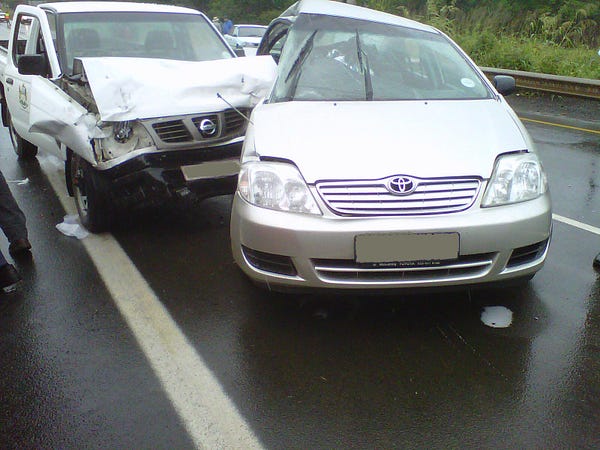
A common objection (or at least concern) regarding self-driving cars is the issue of liability. If my self-driving car hits another car, or person, who pays?
This seems to me like any easy problem to solve — it’s just a finance question — as opposed to the actual technology, which is a math and software and robotics question.
Presumably, for enough money, somebody will take on liability.
Nonetheless, it’s an interesting idea through which to work.
An obvious analogy is to commercial airplanes, and in that case the passenger bears no responsibility. Although I’m not knowledgeable of this field, I would imagine liability is shared between the airline, the airplane manufacturer, and the pilots, although all of these groups probably have some form of insurance or re-insurance.
This might even be a near-perfect analogy, if self-driving cars usher in an Uber-centric future in which individuals subscribe to car services, rather than own individual cars.
In a future more like the current world, though, in which individuals own cars, it’s a little less clear who will accept liability.
Volvo and other manufacturers have pre-emptively claimed liability, but since they aren’t actually selling autonomous vehicles yet, it remains to be seen how that will stand up in practice.
My guess is that, at least for a while, drivers will need to maintain personal auto insurance, if only because cars will continue to have manual override features. But I suspect auto manufacturers will be quick to take on as much liability as they can, if only to protect their brands and sell more cars.
This could lead to something of a boom in personal injury law, as lawyers develop more appetite to finance cases against defendants (car companies) with deep pockets, and juries feel less guilty delivering big damages awards against giant corporations. And, that, in turn will be a boon for the insurance industry.
Originally published at www.davidincalifornia.com on October 19, 2015.
 David Silver