
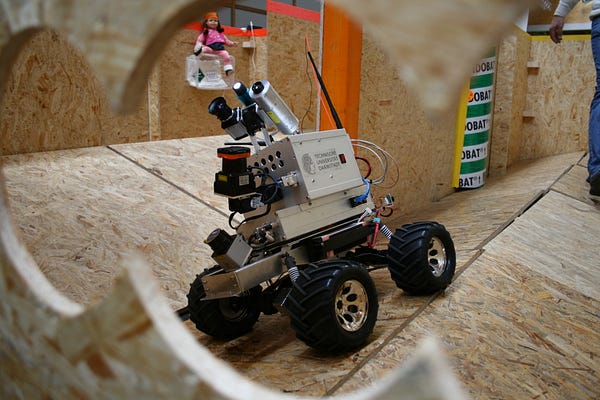
The final lesson in CS 373: Artificial Intelligence for Robotics, is about SLAM — Simultaneous Localization and Mapping. This is a category of techniques that a robot (or autonomous vehicle) can use to both map its area and determine its own location on that map.
This sounds like a standard problem, but it’s quite difficult, and often robots avoid the problem by relying on maps provided ahead of time. This is one reason, for example, that Google so heavily maps streets.
The class covers GraphSLAM, in particular, which is a way to reduce the computational complexity of mapping, essentially by reducing the amount of information necessary to store.
It’s a pretty neat algorithm, and one that involves more linear algebra than I’ve had to use in a while.
Linear algebra actually seems to be a theme that seems to be arising in a number of different machine learning and robotics courses that I’m taking.
I never really used linear algebra in any of the networking, probability, or web development work I have done, so I always questioned why I learned it in the first place. Now I can see.
Originally published at www.davidincalifornia.com on October 29, 2015.
 David Silver