Connected Teslas

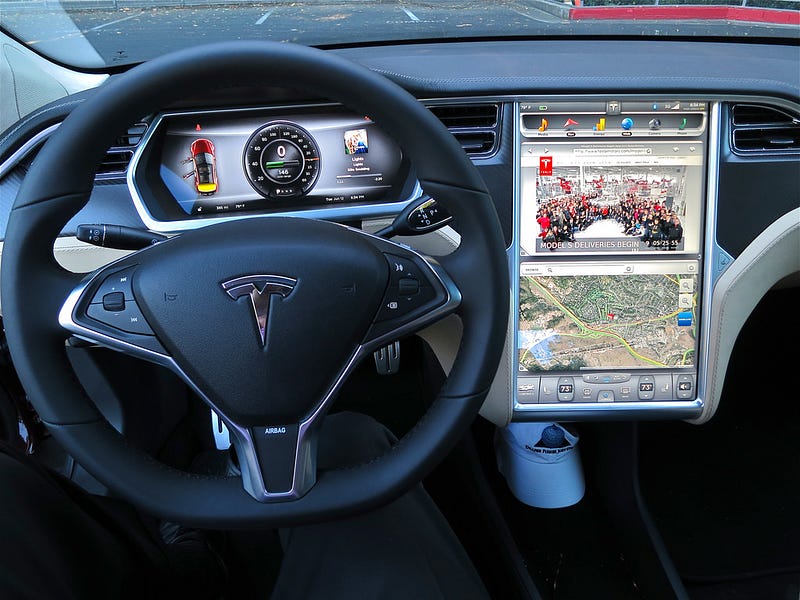
Tesla is updating the terms of its in-car Internet service. Existing Teslas will keep free “premium” cellular connectivity indefinitely. New Teslas will receive free “standard” connectivity, and one year of “premium” connectivity, with the option of paying for ongoing premium connectivity.

That is all fine, as far as it goes, and frankly it seems like a nice benefit of owning a Tesla. It’s not too hard to switch my mobile phone into hotspot mode nowadays, but it runs down the phone battery and it’s just nice to hop in the car and have WiFi connectivity, without having to think about it.

What I really wonder, though, when Teslas will start talking to each other. As fas as I know, Teslas are not equipped with DSRC transponders, which is the communications technology that high-end Cadillacs now use to communicate amongst themselves.

There is a lively debate in the connected car community over whether the future of vehicle-to-vehicle communication is peer-to-peer networking via DSRC, or cloud connectivity via the Internet.

The main advantage of cloud connectivity is that it’s easier to bootstrap — cars can begin talking with each other via the Internet, even if they’re not very physically close. The main disadvantage is the cost of cellular data connectivity.

Tesla is already covering the cost of “standard” data connectivity for all its customers, and I hope at some point soon they start to test out how helpful that can be for vehicle-to-vehicle communication.
Small World

Our friends and former Udacity colleagues at Voyage just announced the addition of Drew Gray as their CTO. Drew is one of the key contributors to building the Udacity Self-Driving Car Engineer Nanodegree Program, and has taught both our students and myself so much. Any company would be lucky to have Drew, so this is a huge hire for Voyage.

In just a few years, the self-driving car industry has seen so much movement, and in many ways it still feels like a small community that is poised for tremendous growth.

At Udacity, we are fortunate to be right in the middle of this. We met Drew right after he’d joined Otto from Cruise, and then worked with him at Uber and now Voyage. Our partners at NVIDIA and Mercedes-Benz have hired many of our graduates, and we see them regularly at conferences and industry events.

Udacity students work at every company I can think of the in the autonomous vehicle industry, from manufacturers like BMW and Ford to suppliers like Bosch to ride-sharing companies like Lyft to startups like Parkopedia and Phantom Auto.

It’s a lot of fun to be part of this community and grow with it.

Michigan Central Station

A couple of miles from downtown Detroit, in the Corktown neighborhood, stands Michigan Central Station. At 18 stories, it is a grand building that has been vacant and deteriorating for decades.

Ford Motor Company just announced that they have purchased the building and surrounding land, with plans to turn it into a campus for their autonomous vehicle and mobility teams.

The plans call for all of this work to complete by 2022, so it will be a while coming, but the vision is big and I’m looking forward to seeing it unfold.

Berkeley Deep Drive

A few weeks ago, the University of California-Berkeley released DeepDrive, which appears to be the largest open dataset ever compiled for self-driving cars.

This is super-exciting, because annotated data is one of the major roadblocks to developing self-driving cars.

Prior to DeepDrive, the state-of-the-art dataset was KITTI, from the Karlsruhe Institute of Technology in Germany.

KITTI has been tremendously important for self-driving cars, and DeepDrive will build on that. For comparison, whereas KITTI has 7,500 images annotated with 3D bounding boxes, DeepDrive has 100,000. And while KITTI has 400 images for semantic segmentation, DeepDrive has 10,000.

It’s really astounding what Berkeley has released, and I’m excited to see the models people are able to build with this.

Full Self-Driving Tesla Features

Elon Musk broke the Internet a few days ago with a tweet promising that in August Tesla “will begin to enable full self-driving features.”

I am pretty excited about this but it is also worth noting that this verbiage is vague enough to drive a Tesla semi through.

“Full self-driving features” presumably means something beyond current Tesla Autopilot, but short of “full self-driving”. What are the features that make up full self-driving?

Some ideas include end-to-end routing, even if drivers still have to pay attention to the road. Or even just automatic lane change decision and execution on a highway.

Potentially this could mean that Tesla is enabling drivers to stop paying attention to the road under certain scenarios, although that seems unlikely, given the recent spate of crashes.

It will be exciting to see what, if anything, comes of this. But Elon Musk himself warns us that these tweets are not well-thought out strategy, but rather off-the-cuff remarks:

Interviews in India

Last month I had the pleasure of making my first trip to India for Udacity. As part of the trip, I sat for several interviews with Indian journalists. All of them had great questions about self-driving cars and how that would impact India. Here are some of those articles:

“Infosys Building Self-Driving Golf Carts To Be Future-Ready”. Bloomberg Quint.

“How much does a self-driving car engineer earn?” Business Today.