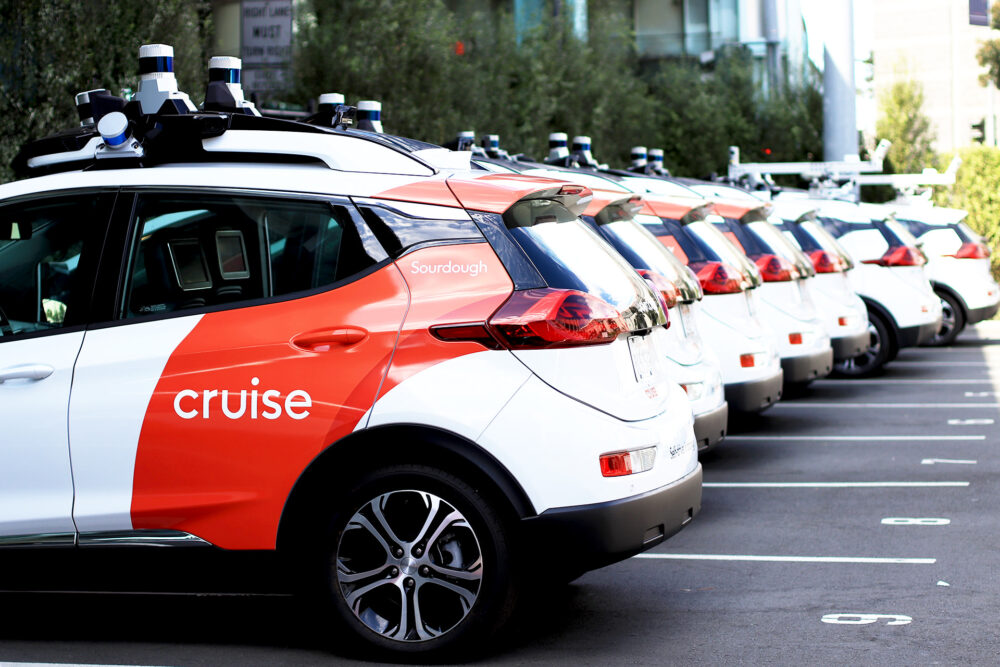
Nonetheless, this is an important step on the road to Cruise getting back to full autonomy. Last year’s collisions in San Francisco, followed by the departure of founder & CEO Kyle Vogt, could have easily killed the company.
Kodiak CEO Don Burnette recently appeared on the Autonocast. Of course you should listen!
One thing he mentioned that really resonates with me is the importance of shipping a product. Putting an autonomous vehicle on the road is an amazing achievement, and a big draw for talent.
He also mentions verifiable AI and talks a lot about our safety case.
My brother sent me today’s edition of Fortune‘s “Term Sheet” newsletter.
“Mobility tech deal value was up 13.9% quarter over quarter, led by autonomous driving startups,” the newsletter proclaims. It proceeds to rattle off some of the big investment rounds in Q2 2024 – Wayve and Waabi and Scale.
This angle interests me:
In fact, mobility tech deal count in Q2 was down 27.4% year over year and about 30% year-to-date. To me what that suggests is the same story as we’ve ultimately heard in other sectors—that the biggest names are drawing lots of funding, while smaller or less-well-known startups are more likely to be left in the lurch.Â
I did not attend, but Zoox held a public showing in San Francisco where the public could sit in its custom-build robotaxi. It appears the robotaxis remained stationary, so the session was primarily to check out the vehicle form factor.
Zoox is betting that its custom vehicles will (1) be permitted at scale and (2) will be an important differentiator between them and Waymo.
On the first point, I think they will succeed. The regulatory barriers to custom-built autonomous vehicles in the US are complicated, particularly related to the presence of a steering wheel in the vehicle. But I think the world is going to move in this direction and these types of vehicles will eventually become permissible.
I think the second bet is more tenuous. I’m not sure that matters, though, because even if Waymo winds up running away with the robotaxi market, Zoox is well-positioned to win the parcel delivery market, which might be much larger. Zoox is owned by Amazon, and these vehicles seem very well-suited for parcel delivery.
It’s interesting to me that Uber is expanding its Waymo partnership from Phoenix soon to Austin and Atlanta. It seems that Waymo gets a lot more out of this partnership than does Uber. For Waymo, the benefits are access to Uber’s customer base and also access to Uber’s human-driver fleet, for all sorts of situations in which Waymo cannot meet demand.
For Uber, the benefits seem more intangible.
“We’re thrilled to build on our successful partnership with Waymo, which has already powered fully autonomous trips for tens of thousands of riders in Phoenix,” said Dara Khosrowshahi, CEO of Uber. “Soon, riders in Austin and Atlanta will be able to experience that same mobility magic, through a new fleet of dedicated autonomous Waymo vehicles, available only on Uber.”
Delighting their customers, I guess, and maybe some amorphous “learnings” that Uber can apply to other partnerships with autonomous driving fleet’s like Cruise.
Mobileye recently announced the termination of its internal lidar development program. [H/T Think Autonomous]. It cited:
Improvements in its compute vision system
Improvements in its internal radar sensor
Decreases in the cost of simpler off-the-shelf lidar units
This is an interesting counterpoint to Aurora’s recent feature article in Fast Company, touting their reliance on their internally developed FMCW long-range radar.
Since relatively few lidar units are actually in production autonomous vehicle systems, it’s hard to know whether demand is moving upmarket, to higher-performance and higher-cost lidar units, or downmarket. It seems like Aurora is moving upmarket whereas Mobileye is moving downmarket.
This divergence may simply stem from the use case: Mobileye is selling L2 autonomous systems into automotive manufacturers, whose end-customers are quite price sensitive, whereas Aurora is creating its own L4 vehicles and then selling its driver service to shippers. Aurora’s combination of use case and customers may both require and support higher-price, higher-performance lidar units.
An article about a company called Fox Robotics crossed my wire. The publication is Modern Retail and covers a partnership between Fox and Walmart. Walmart does a very nice job trialing partnerships with lots of advanced technology companies – drones, autonomous vehicles, fork lifts.
More than 45% of Walmart’s e-commerce fulfillment center volume in the U.S. is now automated and about 1,800 Walmart stores receive freight from 15 regional distribution centers in various phases of automation implementation, Walmart CFO John David Rainey told investors Aug. 15. “As a result, our supply chain teams are processing more units through our [distribution centers] and [fulfillment centers], and while we’re spending more on CapEx than we have historically, we’re pleased with the returns from these investments,” he said.
As an aside, I’m surprised Walmart can service 1800 US stores with only 15 regional distribution centers. I don’t know much about logistics, so maybe that’s a normal ratio. But I might’ve expected a ratio under 100:1.
In any case, the forklift article piqued my interest because years ago I spoke with a company called Third Wave, which targets the same market.
As I remember, the eventual goal are so-called “dark warehouses”, similar to “dark kitchens.” The spaces would not be literally dark, but would be “dark” in the sense of “no humans, just robots,” so I guess you could turn out the lights, except often the robots have cameras, which still need light. Oh well.
The Modern Retail article mentions a couple of competitors – Vecna Robotics and Otto Motors. Throw in Amazon’s purchase of Kiva Robotics years ago, which solves a similar problem in a different way, and that’s a lot of warehouse automation. I wonder how big the market is – I suppose pretty large, considering third-party logistics providers.
About 110 FoxBots have been installed at around 55 warehouses and distribution centers across the U.S., including cold storage and freezer facilities. Customers range across four B-to-B verticals: retail, consumer packaged goods, logistics and food and beverage.
Andrej Karpathy appeared recently on the No Priors podcast and contrasted Tesla with Waymo.
“Tesla has a software problem and Waymo has a hardware problem…Software problems are way easier to solve.”
He says that even though Waymo appears to be ahead in self-driving right now, he actually thinks Tesla’s ahead and ten years from now we’ll recognize that in hindsight.
He’s not super-explicit about what these problems are, but it sounds as though he’s primarily thinking about Waymo’s hardware problem in terms of scaling (as opposed to hardware quality, or hardware cost, for example).
That’s an interesting way to compare the two companies. I’m not sure I buy it – the binding constraint on Waymo seems more like performance and safety and regulation, rather than hardware acquisition. But you can at least imagine how that constraint could start to bind in the future.
Last weekend I took my son and his friend to a baseball game at Oracle Park, in San Francisco. As I’ve often done in the past, I parked about 2 miles away from the stadium, so that I could get free parking. Sometimes I’ve used bikes or scooters to cover those two miles, sometimes the Muni, occasionally I have walked.
This time I decided to catch a Waymo.
The ride came pretty quickly! About 5 minutes.
It parked around the corner and across the street, which was not a huge problem, but it would’ve been nice to avoid getting the kids across the street. No big deal, though.
On the way to the stadium a very nice remote support human dialed into the vehicle to inquire as to the age of the children. Only eight year-olds and above can ride in Waymos without car seats – I think that’s a DMV rule in California. We confirmed we were legal.
The route was a bit circuitous. Instead of rolling straight up Third Street, we meandered around the UCSF Mission Bay Campus. The Waymo dropped us a few blocks from the stadium, which was as close as it seemed to be able to get.
The kicker was the price. $25 for 1.7 miles. When we got to our seats, a friend who met us there and had taken a regular Uber from home – a distance of about 15 miles – told me his ride had cost $35. So it cost almost as much to Waymo the last 1.7 miles as to Uber from home.
All in all, the ride was a lot of fun. But still maybe a bit of a splurge.
We rode the Muni back to our car after the game. $2.50.