Google’s self-driving cars are developed within X, the department colloquially known as “Google’s Moonshot Factory”.
Astro Teller is the head of X (his name was Eric until he changed it to something that suited him more).
Recently, in Backchannel, Teller describes the secret of X as trying to solve huge problems and then killing the solutions (and entire projects!) that don’t work.
It’s a great meditation on the Silicon Valley “fail faster” ethos.
So reports Crain’s Detroit Business, although I have seen this rumor in other places, previously. Among other public evidence, Google is hiring a project manager in Ann Arbor.
It’s hard to say whether this is because Google is considering ramping up manufacturing, or because existing and potential partners are all there, or because of the local automotive talent pool. But it makes sense, and it will be interesting to see how much of X’s self-driving car project shifts to Michigan.
This issue must have come up many times already — cars have had complex computer systems for years, if not decades — but I’m actually not sure what the answer is. Nor am I certain what the implications are.
The answer for computers and phones is (I think) that end-users purchase a software license (typically bundled into the purchase price of the device), but they don’t actually own the software.
Unless that model is for some reason unworkable in the automotive world, it seems reasonable enough to stick with that.
The 7NEWS story implies that the ownership issue has a bearing on how extensively end-users can modify their software, and indeed such an issue arose with Apple iPhones.
It will be interesting to learn more about the implications of this, especially since independent auto repair shops are a much larger economic force than independent computer repair shops.
In business school we did a case on eBay that was teed up perfectly for the professors to disabuse students of a cherished notion.
The central question was what makes eBay such a successful marketplace? And the intuitive answer is “network effects”. The more people are using eBay, the more the next user wants to join eBay, instead of a competitor.
And the professors loved this answer because it is so easy to pop a hole in it.
Buyers don’t want to be with other buyers — the competition just drives up prices. And sellers don’t want to be with other sellers — the competition just drives down prices.
Instead, the professors argued, it was eBay’s reputation metrics that really drove its success. Buyers and sellers want to transact with counterparties that have solid reputations, and only eBay can provide that.
This is a good and correct answer, but it’s always seemed incomplete to me. eBay has a couple of other strengths:
eBay has a thick market. There is no other market where you can find the Danish Christmas ornament from exactly 28 years ago that you just shattered and need to replace.
eBay has an incredible brand.
The point about branding is especially easy to ignore, in business school and elsewhere, because it is so close to magic. How do you build a good brand? How do you know if you have one? How do you know if one brand is stronger than another brand? How do you quantify when a brand is strong enough to support a monopoly?
Warren Buffett was a famously late in life convert to the power of branding, in all its mystery.
Which brings us to ride-sharing and Uber.
Uber, like eBay, has power in its reputation metrics, in the thickness of its market, and in its brand.
So how do these stack up to eBay?
Uber’s reputation metrics are less important than eBay’s. Uber’s ride-sharing flow is simpler than eBay’s asynchronous process of buying, and paying, and shipping, and receiving, so counterparty reputation matters less.
Uber’s market thickness is more important than eBay’s. If an Uber driver or rider can’t find a match at any given moment, they’re much more likely to give up on the service altogether, than if an eBay buyer or seller can’t find a match.
Uber’s brand is as important as eBay’s. But Uber hasn’t locked up the market yet. Lyft is on their heels. The question is, unlike with online auctions, is there room for two players?
One last note is that while eBay does not have a direct competitor, Craigslist serves as an alternative, albeit a distinct one.
Lyft is much more of a direct competitor to Uber than Craigslist is to eBay, but the existence of Craigslist raises the possibility that two firms could survive in the market.
The Obama administration, and US Secretary of Transportation Anthony Foxx, in particular, are huge fans of autonomous vehicles.
So it was nice to see the news that the National Highway Transportation Safety Administration views Google’s self-driving cars as legal and safe, even without a human driver.
On a practical level, this seems like a big deal, but I can’t actually pinpoint how this will affect legal and regulatory disputes. My understanding is that most motor vehicle regulation in the US is done at the state level. So when a federal regulator (the NHTSA) and a state regulator (the California DMV) disagree on whether a self-driving car needs a human driver, does the state win?
Although this is only a patent, it’s not hard to see from here to a place where Google is directly competing with Uber. And maybe FedEx and Amazon, for that matter.
On the other hand, it’s worth remembering that entering this type of business would be a direct departure from Google’s Android strategy. In that business, Google has been content to own the software and let other companies manage the hardware and services that come on top of it.
A third, more trivial, thought, is — do we really need a patent for this? Putting lockers inside of trucks is a neat idea, but it hardly seems like the type of thing that merits a patent. I would hate to see some small startup get squashed because it doesn’t own the patent for putting lockers in a truck.
The UK-based Institution of Mechanical Engineers makes the claim that self-driving cars could prevent 95% of all accidents.
That report seems to be based on the fact that 95% of all accidents are caused by driver error.
Claiming that self-driving cars could prevent all of these accidents seems like a stretch, and certainly the computer drivers will create accidents of their own making.
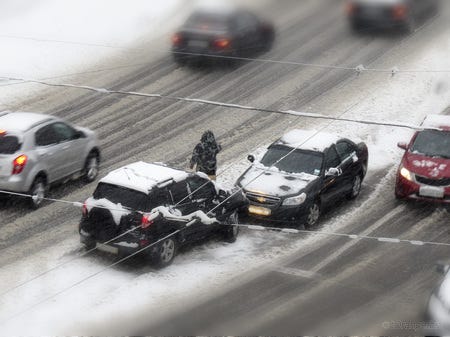
And it’s possible that self-driving car accidents could be more rare but also more brutal, particularly if autonomous vehicles are able to routinely travel at higher speeds than human drivers.
But even withstanding all of that, it’s clear why auto insurers are nervous.
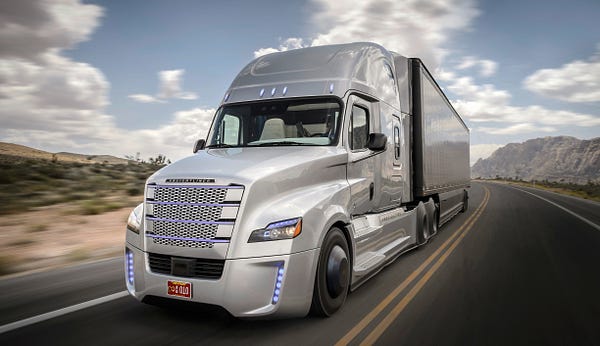
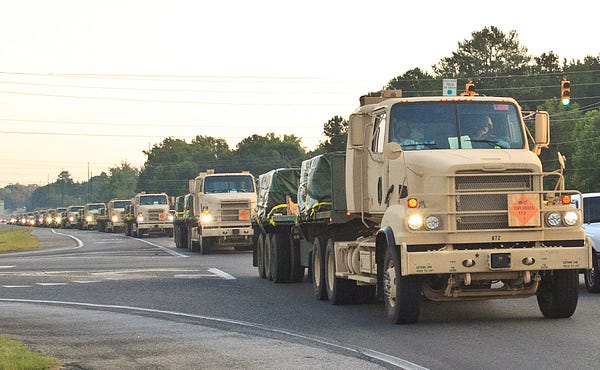
The United States Army is experimenting with self-driving trucks, and in a kind of cool way.
They are testing out whether trucks in a convoy can follow a human driver. The Army owns hundreds of thousands of vehicles, and sends big convoys to transport munitions and materials across the country and the world.
The interesting part of this is that maybe the Army can simplify the autonomous vehicle problem by simply having the trucks in the convoy follow a lead human driver.
Chewing on this in my mind, it’s not obvious to me whether this simplifies the autonomous vehicle problem or just morphs it. After all, there are going to be weird corner cases where trucks in the middle of the convoy shouldn’t really follow the truck ahead of them. Does designing for those corner cases simply amount to building a real self-driving car?





 David Silver