Cost-Benefit Analysis

Ed Zitron takes to TechCrunch declares self-driving cars “a bloody good idea” that will save many lives.

But:

People like to drive. People crave control. People love banal tasks done for them, but the transfer to a computer of a task that can threaten lives with one wrong turn will take a long time.

I’m even cynical that we’re five years from seeing millions of totally autonomous vehicles legally swamping our cities. It’s an exciting idea, a realistic idea — but the scariest idea in the world to rush.

This reminds me of the debate over whether people like to buy vs. rent music. We had that debate a lot when I was in business school. Some people (notably Steve Jobs) insisted that the failure of Rhapsody proved that consumers want to own their music.

I always thought that debate missed the point.

People like to listen to music. They’re agnostic about buying vs. renting. They choose to buy or rent purely as a mechanism to get the benefit of listening.

And now that renting offers more benefit than buying, sure enough people are renting.

I see the same thing with cars.

People don’t crave control. Nobody I know refuses to fly planes because they can’t sit in the cockpit.

People crave getting to where they want to go. Once self-driving cars can do that as well or better than people-driven cars, the switch will come faster than most of us expect.


Originally published at www.davidincalifornia.com on November 9, 2015.
Will Autonomous Vehicles Kill Digital Radio?

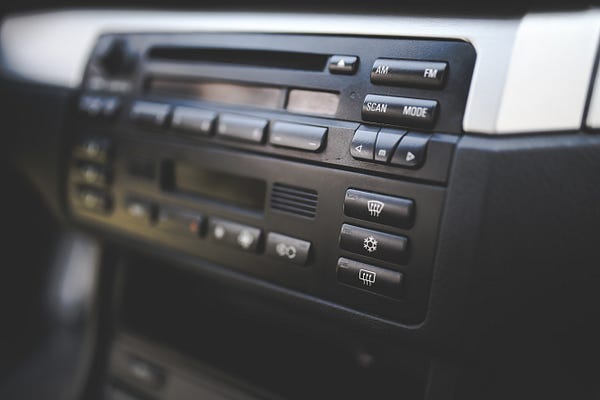
One of the prime locations for listening to radio is the car, which accounts for something like 1/3 to 1/2 of all radio listening hours.

Traditional AM/FM radio is on the decline, but digital radio and podcasts are growing.

The beauty of audio-only formats is that they do not demand full attention — in particular they do not demand any visual attention, which allows us to listen to audio while doing things like drive, clean the dishes, and vacuum the house.

As cars go fully-autonomous (i.e. the driver no longer even needs to pay attention to the road), will people stop listening to digital audio?

The dishes will always be there, but once vehicular transportation no longer demand our visual attention, I suspect people will opt for YouTube over Pandora.

For what it’s worth, I am a big fan of the Slate podcasts.


Originally published at www.davidincalifornia.com on November 6, 2015.

Friend and Enemies

When I was in business school, we did a case on XenSource in which we created a matrix listing the startup’s friends and enemies.

In emerging markets, this is an informative and non-obvious exercise.

In that vein, Forbes announces today that Elon Musk is maybe thinking about launching an Uber-competitor:

Tesla Motors CEO Elon Musk hinted Tuesday the carmaker may launch its own network of shared autonomous cars for users to borrow on demand, but he cautioned the company is not ready to make a formal announcement.

So let’s work out a preliminary matrix.

Apologies for the poor cut and paste job.

A few things jump out here.

Niche suppliers like MobilEye are friends with everyone.

Startups like Cruise have complicated relationships with everyone, because they are competitors to the same companies that might eventually acquire them.

The relationships status for Uber and Tesla just changed to, “it’s complicated”.

Apple and Tesla have a lot of enemies.


Originally published at www.davidincalifornia.com on November 4, 2015.

More Trolleyology

The Wikipedia entry for the Trolley Problem poses a further interesting question for autonomous vehicles:

there is a single person on the tracks who can be easily saved at the cost of inconveniencing your passengers, and the question is no longer “would you stop”, but “how many people need to be on the trolley for their inconvenience to trump someone else’s life”

Imagine that a vehicle has a choice between mowing down a pedestrian, or swerving and causing a tremendous traffic jam.

My sense is that while these are interesting ethical dilemmas, we can solve a lot of this by falling back on the laws governing human behavior.

Thanks to my brother Adam for an interesting discussion on this topic.


Originally published at www.davidincalifornia.com on November 3, 2015.

Buy vs. Rent vs. Subscribe

Cadie Thomson writes about a future in which fewer people own cars (note the headline overstates this a bit):

Industry experts predict car ownership will dramatically decline as cars become more automated. The notion being that people will instead take self-driving taxis hailed via app to get from point A to point B instead of owning their own car.

This is a scenario with which I am familiar, as Kristina and I spent about 18 months as a one-car household. Those 18 months can be broken up into 12 months of relative ease and 6 months of struggle.

The easy part was the first twelve months, when Kristina took public transportation to work in San Francisco. That meant our car was left to me five days a week. On weekends we needed to share, which sometimes got complicated but was mostly fine. Note that with a pair of kids that could have been a lot messier.

Even with just the two of us, though, things got frustrating when Kristina switched jobs and needed the car to commute four days per week. Then it was me who was left car-less. Most days I didn’t need a car (home office), but on days when I had meetings or errands that couldn’t be pushed, I was forced into a combination of Uber, Enterprise, ZipCar, biking, and public transportation.

Here’s the thing — even after paying for those alternatives, we probably saved money only having one car. But it was a huge pain.

Every time I needed to go somewhere, I did the mental calculations of how much each option would cost, how much time it would take, would I need a car again later, and so on.

Those calculations are the worst part about renting. Much better to subscribe to an all-you-can-ride service where the marginal cost of a ride is $0.

Even the subscription service could be a pain, though. Hailing an Uber is so much better than hailing a cab, but it’s still less convenient than walking out to the driveway and getting in the car.

Maybe that convenience cost flips for urbanites, though. For them maybe it’s easier to walk out onto the street and wait for an Uber, rather than to get into the parking garage and navigate out.

In sum, renting seems like too much of a pain to me, on an individual level, at least.

Subscription services seem promising, if the network is dense enough and the trade-offs come out right.

But there is a huge convenience factor to having a car in the driveway, ready to go whenever I need it.


Originally published at www.davidincalifornia.com on October 30, 2015.

Trolleyology: Driverless Car Edition

Reason reports on an interesting study that seems obvious but hadn’t occurred to me — would people buy a driverless car that was programmed to kill them, if it meant saving other people’s lives.

This is like the trolley problem, which is well-studied in philosophy, and has been often applied to driverless vehicles.

It seems pretty intuitive that if our car has to choose between staying in its lane and killing three people, or swerving and killing one pedestrian, we want the car to choose the option that minimizes loss of life.

But what if the life is our own?

What happens when there is no onlooker, but the one who gets sacrificed to save ten strangers is you as the passenger in the car? Should cars be programmed to sacrifice you? In fact, most respondents agreed that self-driving cars should be programmed that way, but a significant portion believe that manufacturers will more likely program them to save their passengers no matter the cost.

That’s an interesting take, and one where I’m not sure that stated preferences and revealed preferences will actually prove to be in alignment.


Originally published at www.davidincalifornia.com on October 29, 2015.

SLAM

The final lesson in CS 373: Artificial Intelligence for Robotics, is about SLAM — Simultaneous Localization and Mapping. This is a category of techniques that a robot (or autonomous vehicle) can use to both map its area and determine its own location on that map.

This sounds like a standard problem, but it’s quite difficult, and often robots avoid the problem by relying on maps provided ahead of time. This is one reason, for example, that Google so heavily maps streets.

The class covers GraphSLAM, in particular, which is a way to reduce the computational complexity of mapping, essentially by reducing the amount of information necessary to store.

It’s a pretty neat algorithm, and one that involves more linear algebra than I’ve had to use in a while.

Linear algebra actually seems to be a theme that seems to be arising in a number of different machine learning and robotics courses that I’m taking.

I never really used linear algebra in any of the networking, probability, or web development work I have done, so I always questioned why I learned it in the first place. Now I can see.


Originally published at www.davidincalifornia.com on October 29, 2015.

Japan vs. USA

Or is it technology companies vs. auto manufacturers?

Bloomberg reports that the Japanese Big Three (Toyota, Nissan, and Honda) are projecting the arrival of driverless cars to be in 2025 — five years after the 2020 deadline targeted by American firms.

The reasons seem to be liability concerns, and the fear of putting a beta product onto the road.

“On an experimental pilot stage, if the automated vehicle is driving a test course, that’s really possible and easy,” Toyota President Akio Toyoda told reporters on the sidelines of the show on Wednesday.

Putting self-driving cars on public roads too early risks a major accident that sets back the development of autonomous vehicles, he said. “The technological advancement would stop suddenly. We have to have a very long-term perspective.”


Originally published at www.davidincalifornia.com on October 28, 2015.