
Meet Cora, from Kitty Hawk.
Autonomous Trucking
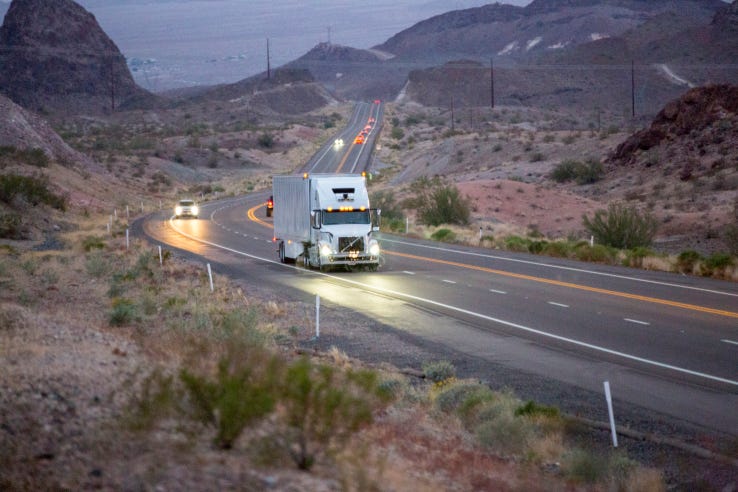
A few big news stories out of the autonomous trucking world, which is a place that has been mostly quiet for the last year.
Embark
In February, an Embark self-driving truck traveled 2,400 miles, coast-to-coast along Interstate 10.
TechCrunch reports a number of interesting factoids. There was a safety driver. The safety driver had to take control of the vehicle many times (“usually only a few seconds”). Embark is not using high-definition maps, although they appear to be using lidar. Their goal is not to replace, but to augment, the human driver.
Uber Freight
Recently, TechCrunch also reported that Uber Freight is hauling real cargo using autonomous trucks in Arizona, albeit there appears to be a safety driver involved.
Uber’s promotional video has a few interesting notes of its own. They appear to be very careful to stay within Arizona state lines. They’re also making a big deal out of the human interest angle — the self-driving truck works in tandem with human truck drivers and makes their work more enjoyable. They can be home in time for dinner.
Starsky Robotics
Riding the coattails of the Uber Freight press, Starsky Robotics upped the ante by sending a truly driverless vehicle — no safety driver — onto the highway.
Sort of. It was seven miles and the highway was totally closed to other traffic.
As somebody with a lot of extended family spread across Florida, I loved this observation:
“In true Florida Man fashion, founder and CEO Stefan Seltz-Axmacher decided to do something much bolder and a bit scarier: In mid-February, in the Sunshine State (where regulations are as lax as those in Arizona), he sent his truck down the road for a 7-mile journey — with nobody inside.”
Note that practically the first thing that appears in their promo video is an alligator. Florida!
Tesla
Not to be outdone, Elon Musk announced on Instagram that Tesla Semis are hauling batteries from the Nevada Gigafactory to the California car plant. It’s not clear whether Autopilot was involved.
https://www.instagram.com/p/BgCJlKbFckb
Waymo
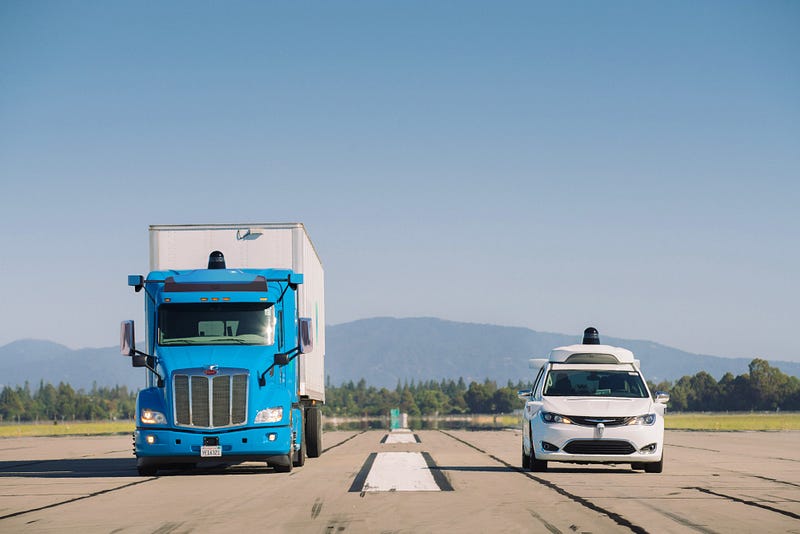
Finally, Waymo announced last week (on Medium, no less), that they are poised to begin delivering real self-driving freight in Atlanta. Atlanta, you will remember, is also the city where Waymo’s public ridesharing tests are coming next.
Waymo’s trucks will be hauling freight for…Google data centers. Hey, everybody’s gotta start somewhere.
Ironically, Waymo trucks do not have their own YouTube promotional video.
Pony.AI Launches China’s First Robotaxi Service
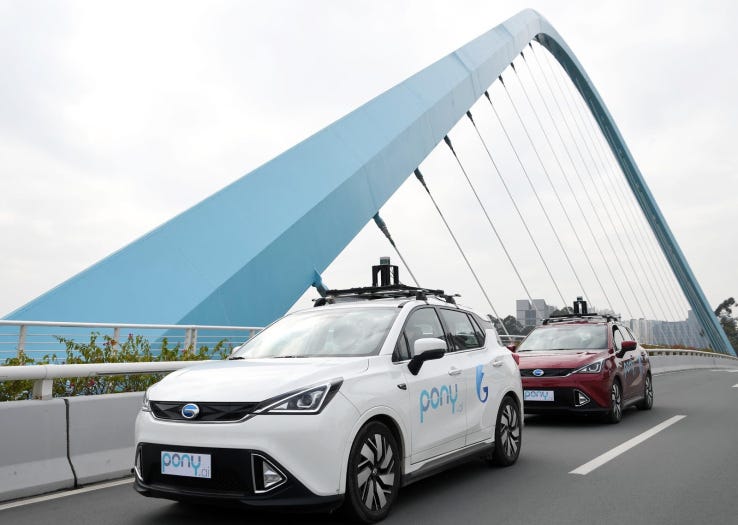
Add Guangzho, China, to the list of places where the general public can ride in self-driving cars, according to TechCrunch.
Autonomous driving technology startup Pony.ai has become the first company to operate an autonomous ride-hailing service on public roads for public users in China. The company, just over a year-old, recently raised $112 million in a Series A round to help it accelerate its efforts, and its fleet is running a nearly two-mile route in Nansha, Guangzhou, where its China HQ is located.
Between Baidu’s Apollo project, Didi self-driving robotaxi work, Momenta’s deep learning efforts, BYTON’s plans for electrics self-driving cars, and now Pony.AI, China is becoming a key player in the race toward autonomous vehicles.
Interestingly, Pony’s fleet includes: “four Lincoln MKZs, as well at two Guangzhou Automobile Group (GAC) Chuanqis.”
I wonder if the MKZs came from AutonomouStuff.
Update: Several commenters have pointed out, I think correctly, that with only six cars operating on a very short, fixed route, this isn’t really a “robotaxi” service. More like a proof of concept. Still a big step!
London on Thursday

The Udacity Self-Driving Car European tour continues.
On Thursday evening, March 8, the London Self-Driving Car Meetup will be hosting Udacity and me from 6–9pm at Parkopedia just south of London Bridge.
I’ll be talking about the future of self-driving cars and the future of Udacity. Please come say hello!
Toyota Research Institute — Advanced Development

The Silicon Valley office of Toyota Research Institute is within a long walk of Udacity’s headquarters in Mountain View, but they’ve been pretty quite about what they’re up to.
News today is that Toyota is creating a sister organization, based in Japan, called Toyota Research Institute — Advanced Development. TRI-AD will be headquartered in Tokyo as a partnership between Toyota and suppliers Aisin and Denso. Although Toyota is putting up 90% of the money.
Although the business will be located in Tokyo, it’s CEO will be current TRI CTO and former CMU professor James Kuffner, the chairman will be current TRI CEO Gil Pratt and former MIT professor Gil Pratt. And the language of TRI-AD is going to be English.
“This company’s mission is to accelerate software development in a more effective and disruptive way, by augmenting the Toyota Group’s capability through the hiring of world-class software engineers,” [says Kuffner].
It appears Toyota is setting up TRI as the pure research division and TRI-AD as the bridge to production, since TRI-AD will be in Japan and closer to Toyota’s main production facilities.
Oh, and did I mention they’re committing an additional $3 billion dollars to this?
You Can Build Self-Driving Cars
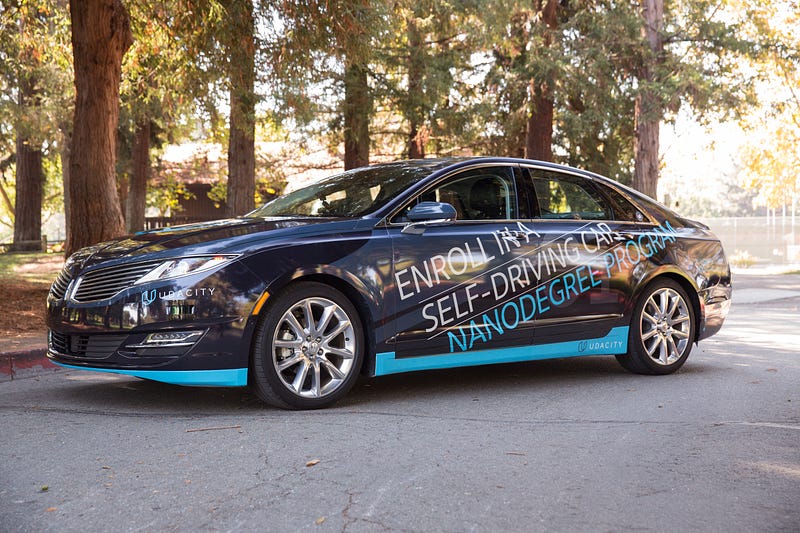
Here is the trailer for Udacity’s Intro to Self-Driving Cars Nanodegree Program. This is a program we built to prepare the whole world to work on autonomous vehicles.
If working with self-driving cars is something you’ve ever even thought about, you should check out the trailer.
Deep Learning Workshop in Berlin

Next Wednesday, March 7, I’ll be holding a workshop on Deep Learning for Autonomous Vehicles as part of the Automotive Tech.AD conference in Berlin. My colleague Aaron Brown and I will walk participants through how to build and train basic convolutional neural networks for traffic sign recognition.
The workshop will be similar to what we teach in the Traffic Sign Classifier Project of the Udacity Self-Driving Car Engineer Nanodegree Program, but in an in-person setting.
If you work in the automotive industry and have read a lot about deep neural networks, but have never built them yourself, this is the workshop for you. You’ll get hands-on experience setting up and training your own classification networks.
Udacity Intersect 2018: RSVP Now!

Update: There is a Udacity student discount! Email me directly (david.silver@udacity.com) for the discount code.
Sign up now! Intersect, Udacity’s annual conference on lifelong learning, will be on Tuesday, March 27, at the Computer History Museum, in Mountain View, California.
Early bird tickets expire tomorrow!
I am so excited about this conference. Do recognize these four technology power players?



If not, checkout the Intersect Speakers.
And how about these four?



Seriously, if you don’t recognize any of these speakers, stop reading this post and visit the Intersect Speakers page to learn about how they are changing the world.
Did I mention Udacity always keeps a few big announcements up its sleeve for Intersect?
Plus I will be there! I’ll be talking about self-driving cars, and giving rides in Carla, Udacity’s own self-driving car. Have you ridden in self-driving car recently? Come ride in ours.
Next Week in Berlin!
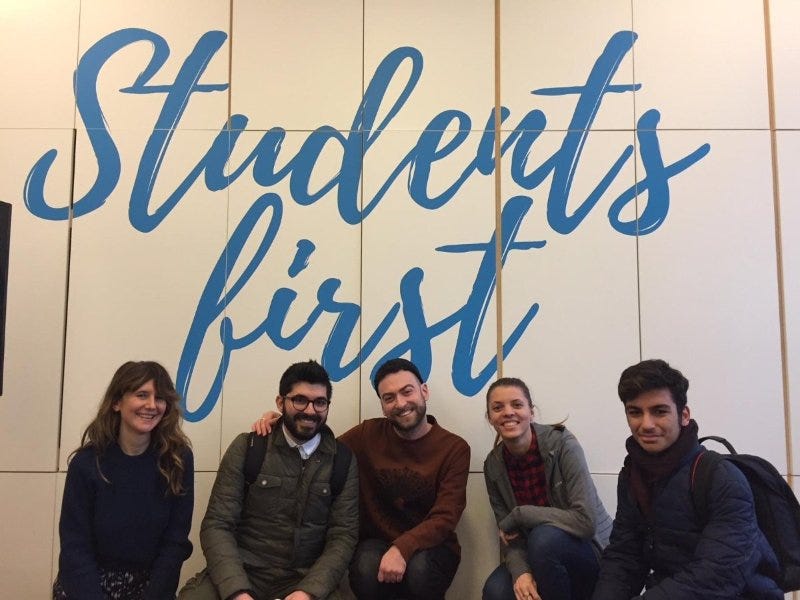
I am excited to be heading to Germany next week!
Stuttgart
On Monday I will be in Stuttgart. Join my Udacity colleagues and me at the Connected Autonomous Vehicle Meetup on March 5, organized by Udacity student Rainer Bareiß. RSVP here.
Berlin
On Wednesday I will be in Berlin. Join us on March 7 at Udacity’s Berlin office. Free pizza and drinks! I’ll show off some self-driving car videos and share the latest news about what Udacity is building for students. 7–9pm. RSVP here.
Bis bald in Deutschland 🙂
Next Week in Stuttgart
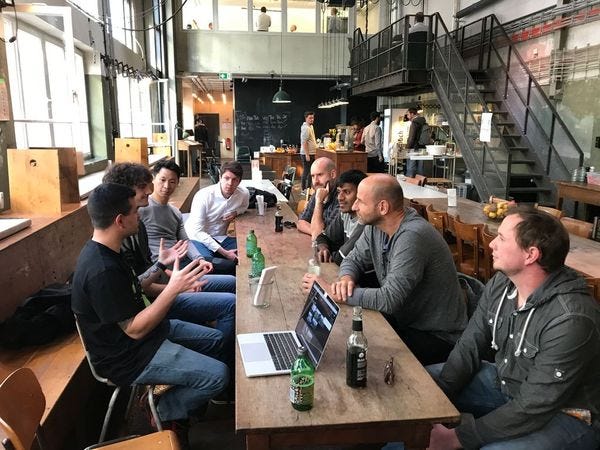
I am excited to head to Germany next week with my Udacity colleagues!
We’ll be in Stuttgart on Monday, March 5, where we’re lucky to be hosted by the Connected Autonomous Driving Meetup. We’ll be holding a joint event with our partners at Bosch, specifically Mirko Franke from their Automated Driving team. 6–9pm at Connectory Stuttgart. Please come!
Later in the week we’ll be in Berlin, where we’ll host an event for Udacity students. More to information to come on that.
 David Silver