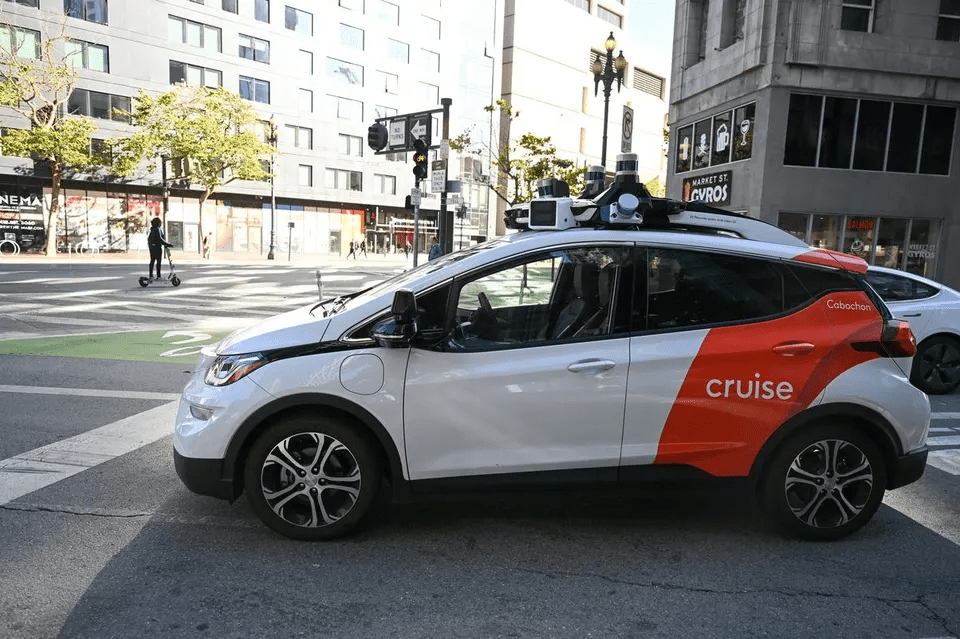
Cruise makes the important point that the hit-and-run driver is still at large. Safer streets require that we catch and correct human drivers who hit pedestrians, as in this case.
Cruise’s overview of their own vehicle’s actions is basically consistent with what the news has reported.
They include a simulation showing that, had a Cruise AV been driving in place of the human driver who performed the hit-and-run, the Cruise AV would have avoided contact with the pedestrian.
Gizmodo has a writeup (HT Reilly Brennan) about NVIDIA and Foxconn teaming up to build AI factories.
The article quotes NVIDIA CEO Jensen Huang, “This is a factory that takes data input, and produces intelligence as an output.”
As I understand it, the gist is that Foxconn will make cars, and the data from those cars will flow back to data centers running tons of NVIDIA processors, to gather intelligence from the data.
I guess the cars will also have NVIDIA chips in them, and I’m not totally clear who owns and runs the data centers. But both of those points seem secondary.
The main idea is that NVIDIA is going to have massive processing power in data centers, fed by data from Foxconn cars.
That kind of changes NVIDIA from a chip-seller, to a service provider, as Huang notes.
Huang says Nvidia is also in a transition, from a graphics chip maker into a data center scale computing company, claiming “most of the computers of the future that are interesting are going to be data center scaled.”
The DMV stated that Cruise AVs “are not safe for public operation.”
As far as I can tell, there does not appear to be any data supporting this decision.
That said, the DMV statement mentions that, “The DMV has provided Cruise with the steps needed to apply to reinstate its suspended permits.” Perhaps those undisclosed steps contain data-based metrics.
Perhaps the most worrisome sentence in the DMV statement is, “The manufacturer has misrepresented any information related to safety of the autonomous technology of its vehicles.”
On the whole, the statement seems quite opaque to me. More transparency from the DMV would be ideal.
Mercedes-Benz just announced a new electric truck, the eActros, with a 310-mile range. Mercedes, which sells trucks primarily in European, estimates that range covers 60% of long-haul trucks in Europe, according to Ward’s Auto.
The charging strengths of the eActros include smart charging, scaling the charging capacity with the truck’s usage and needs.
There’s also a nifty little web tool that estimates how long it takes to charge each of the different eActros models.
Mercedes-Benz Trucks is partnering with Siemens and other providers to help truck buyers install on-site charging infrastructure. This is probably a bigger deal for commercial trucks than personal passenger vehicles.
And this is good to know:
The eActros has a CCS2 connection and thus conforms with the general standard for charge connections in the passenger car sector. Cars and vans which are equipped for charging with direct current via a CCS2 connection can therefore be charged at charging stations for the eActros.
My former employer, Cruise, has been in the news a bunch recently. They’re expanding rapidly to new cities. And in their home city of San Francisco, they’re carrying lots of delighted passengers. But they’re also making headlines for blocking traffic and occasionally colliding with things.
NHTSA recently opened an investigation into some of these Cruise collisions.
The only documentation available about the investigation, so far, comes from the legally-mandates reports Cruise filed. In both reported cases, Cruise’s (subtly but clearly stated) perspective is that the incidents resulted from jaywalking.
There are a bunch of interesting angles to these reports: the incidents took place at night, Cruise’s reports seem accurate but maybe understated relative to the severity of at least one collision, and in both cases the pedestrians were allegedly jaywalking.
The jaywalking aspect of these incidents has some interesting broader implications.
Jaywalking is currently, I think, an intentionally overlooked issue. It’s rarely enforced, except maybe pretextually. When jaywalking leads to collisions with human drivers, I suspect those collisions often go unreported (as do most minor collisions). And when the jaywalking collisions do get reported, they don’t make the news – they’re a routine, uneventful, and regrettable aspect of urban life.
But the presence of self-driving cars raises the stakes for these types of collisions. A collision that would pass unremarked upon when John Q. Public is the pedestrian and Jane Q. Human is the driver becomes a news event when a robot is driving and Waymo or Cruise is involved.
At some point maybe the newsworthiness of these collisions will fade. But the presence of deep-pocketed corporations will, I suspect, continue to keep politicians’ and regulators’ and plaintiffs attorneys’ attention.
And that attention, I think, might ultimately be what changes the stakes for jaywalking. What is currently a tacitly-accepted nuisance traffic violation might start to receive a lot more scrutiny. And that might motivate both more enforcement and also more solutions, pushed by all sides.
I remember from my time at Udacity that easy-to-use open-source simulators are hard to come by. Waymo just released Waymax, a simulator for behavioral planning, which looks pretty cool.
The simulator is written with JAX, an ML-focused numerical analysis library, which sets up Waymax to work nicely with neural networks.
The GitHub repo has some pretty nice Google Colab tutorials, which I might try out over the coming days.
On Tuesday, November 7, I’ll be recording a live podcast with Jeremy Cohen of Think Autonomous.
Jeremy was one of the earliest students in the Udacity Self-Driving Car Nanodegree Program. He now has an online education startup of his own, offering advanced courses in many of the topics key to self-driving.
RED Mountain is a gem of a ski area, set just over the border from Washington, in British Columbia. Some notes:
The area is the size of a major western US resort – it’s larger than Northstar or Steamboat Springs, and only a bit smaller than Heavenly or Breckenridge, with 20% as many skiiers.
The name of the resort refers to the iron in the mountain, rather than anything to do with communism.
Canadian ski areas close at 3pm, compared to 4pm in the US. I unknowingly caught the last lift up at 2:58pm, cruised down the back-side of the mountain and popped into a lodge. My arrival bewildered the staff to the point of annoyance, until they realized I was a confused American. They pointed me on a route to the bottom of the resort without getting stuck at some closed lift.
I think there is a “BC Curve” for ski run ratings, the same way I think Mammoth has a “Southern California Curve.” There are black runs at Mammoth that seems pretty blue to me, and there are plenty of blue runs at RED that seem pretty black to me. It’s steep.
The bar at the base has a wall featuring all the locals who’ve skiied for the Canadian National Team. The heyday seems to have been the 70s.
Most of the lifts are a little old school. One whipped around so quickly after dismounting that it clocked me in the back of the head and knocked me to the deck. Fortunately, I was wearing a helmet, so nothing was injured but my pride.
The IKON Pass doesn’t work directly, maybe because RED Mountain is independently-owned. Instead, I had to take my IKON Pass to the ticket window and scan it for a RED Mountain lift pass.
Flying Phil’s Mexican food truck serves excellent gourmet Mexican fare. If you can get over the incongruity of “gourmet Mexican food out of a truck at the bottom of a ski run in Canada”, it’s worth a stop.
The resort has cabins for rent in the middle of one of the ski runs on the middle of the mountain. $500 per night seems steep to me, even in Canadian dollars, but they look awesome.
PizzaBass is served out of a local’s basement and is amazing.
The locals call it “Roz-land”.
I met more Australians (Brisbane, specifically) than Americans. This despite the mountains location less than 10 miles from the US border.
Mountain Shadow Hostel was nice, but I am too old to stay in a hostel, even when I rent a private room. There was a time…
Immigration officers at land crossings on either side of the border always seem sterner than their airport counterparts. I never get a “Welcome to Canada!” or a “Welcome home!” at a land crossing. He did ask about cannabis products, and when I last visited Canada.
I was worried about the lack of snow in Washington, but the road suddenly climbs to snow immediately after crossing the border.
The swim-through hot springs cave at Ainsworth Hot Springs is awesome and, to my knowledge, unique.
At Kodiak we have a weekly, optional meeting called Lunch & Learn, where somebody in the company talks about something they know well.
Usually the topic is related to, but not strictly a part of, Kodiak and autonomous trucking. And, usually, the format is for the session leader to play a video and add some comments. That’s a lot easier than coming up with an hour-long lecture from scratch.
This week, we learned about silicon chips, including why chips have been in short supply in automotive industry.
The video highlights five areas required for chips:
Instruction Set Architecture
Chip Design
Fabrication
Equipment & Software
Packaging
Of those, fabrication seems like the hardest, due to the massive capital investments required for fabrication equipment.
The whole video is great and worth a watch.
A bonus question somebody asked in our session, that is not addressed by the video: why are silicon wafers round?
Answer: silicon ingots are formed by the Czochralski method, which basically involves melting an ingot and letting it spread out from the center. This results in round wafers.