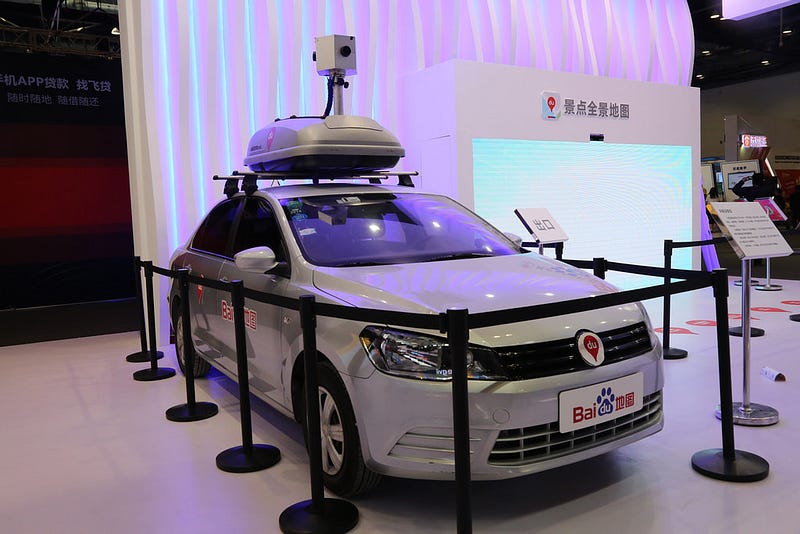
The latest news is that Baidu signed a partnership with NVIDIA, although it’s not clear to what extent this differs from the vendor-customer relationship that NVIDIA has with many automotive companies.
What is less obvious to me is why Baidu is putting so much effort into building a self-driving car center in Silicon Valley, instead of China or even Detroit.
It makes sense for them to have a presence here, as does almost every automotive company, but it seems like Baidu has gone beyond that and is centering their entire AV effort here.
I’m coming to the end of the terrific list of questions asked by Kyle Jepson.
That’s too bad because it’s been good content for slow news days, but it will be nice to finally clear that email out of my inbox 🙂
Finally, I’m a huge fan of Otto. I think long-haul trucking is a job that autonomous vehicles are especially well-suited for because computers don’t get bored. Are there other niche industries like this that you think autonomous vehicles will take over before they become commonplace for consumers like me? And, conversely, are there vehicles that you think might never be autonomous? (Construction vehicles come to mind, as do any sort of vehicles that operate in primarily off-road environments.)
Kyle wrote this in early August (sorry for the delayed response!) and we have since learn that Travis Kalanick is also a huge fan. Kyle, I hope you got in early on that one.
More seriously, I think there are a lot of niche industries where autonomous vehicles will make an outsize impact.
Delivery: Cutting edge autonomous vehicles are expensive, because of all the sensors and specialized hardware they require. Delivery companies like FedEx and UPS are well-positioned to amortize this cost over many hours of delivery driving.
Trucking: Although Otto has been acquired by Uber for presumably non-trucking purposes, the trucking industry is still a huge opportunity for autonomous vehicles. Many trucks are owner-operated, and autonomous driving means more hours on the road, more cargo carried, and more money for driver.
Interestingly, the construction opportunity that Kyle proposes is a terrific opportunity for self-driving vehicles (safety), but could be hard to implement in practice.
The nice thing about warehouses or agricultural fields or highways is that they’re basically constant. Construction zones are constantly in flux and might require more vehicle intelligence than we currently have.
But I’m not an expert on this and if readers know about self-driving construction vehicles, please put them in the comments!
Volvo and Autoliv are forming a software company. Sweden’s largest car manufacturer and one of its major auto suppliers are joining the movement of auto manufacturers diving headfirst into software:
Chinese-owned Volvo Car Group and auto safety group Autoliv said on Tuesday they would form a joint venture to develop autonomous driving software as automotive firms across the industry race to embrace the emerging technology.
The two Sweden-based companies said in separate statements the new company would have an initial work force of about 200 staff taken from both parent companies, a number that would increase to more than 600 over the medium term.
The joint venture, which is to be headquartered in Gothenburg, Sweden, and had yet to be named, will develop advanced driver assistance systems (ADAS) and autonomous drive (AD) systems for use in Volvo Cars.
At least if you live in the United States or Canada, where the first Monday of every September is a public holiday set aside to recognize the contributions of workers. It also marks the end of summer, but that’s neither here nor there.
I thought I’d take a few minutes on Labor Day to riff about how self-driving cars might affect the labor market and our future jobs.
According to the US Bureau of Labor Statistics, about 3.9 million Americans make their living as “motor vehicle operators”. That’s about 3% of the total labor force, which is surprisingly high.
About half of those workers are in trucking, with bus drivers and deliverymen making up most of the rest.
I’m not sure all of those jobs will go away, but eventually (40 years, say) a lot of them will.
So that’s the downside, or at least the largest part of the downside.
What’s the upside, particularly as it concerns the labor market?
I think most of the value will come from expanded opportunity. Getting to and from a job is a big cost, particularly for the poorest Americans. The New York Times goes so far as to assert (based on a Harvard study): “commuting time has emerged as the single strongest factor in the odds of escaping poverty.”
Lowering the cost of transportation, and the time it takes will help millions of Americans escape poverty.
It will also improve the lives of middle-class and affluent Americans, who will have access to a wider array of jobs, thanks to lower-cost transportation.
And companies should find hiring workers to be less difficult, as their talent pool expands.
This is a classic case of diffuse benefits and concentrated costs, and it’s important to remember that for the people bearing the cost, their whole way of life is disappearing. It’s catastrophic.
But, on net, the labor benefits to society should be tremendous.
Recently a friend asked me why I decided to work on self-driving cars. I’m sure I’ve written the answer to this at some point, but I’m not sure I’ve done it recently. So I’ll do it here.
There are two reasons I decided to work on self-driving cars: changing the world and getting a win.
I’m a huge believer in the opportunity for self-driving cars to change the world in everything from real estate to agriculture to human resources to travel to childcare. Removing the constraint on our lives due to travel time and cost is going to change the world in ways we can’t even imagine.
My desire to get a win is perhaps less noble, but more personal. I’ve worked for different companies in networking software, enterprise software, mobile software, and recruiting software, and the common theme is that they have all had average performance. I want great performance.
Maybe I’m an average influence!
I think more likely it’s been a combination of bad luck and perhaps some poor decisions on my part as far as which companies to work at.
Smartpeople say that the best thing you can do for your career is to work in a good industry, for a good company.
It seems to me like self-driving cars are a great industry, or at least they will be one.
I live in Boston. All the roads here are frighteningly narrow and windy. The street I live on, for example, is technically a tw0-way road, but it’s so narrow (and so lined with parked cars — yet another problem that autonomous vehicles will solve) that, whenever two cars pass each other going opposite directions, one of the two drivers has to pull over well in advance of the meeting if they want to avoid a collision (or having to back up). Is this the sort of thing current self-driving cars can handle, or is this a problem for future iterations? (I recognize this is a corner case, but in Boston, it’s our status quo.)
I think of this as a two-part problem: partly communication and partly internationalization. I realize Boston is in the United States, but the driving customs that Kyle is describing as basically foreign to most American drivers.
Both of these problems are really hard, and so the short-term answer will probably be geo-fencing. Essentially, the self-driving system will refuse to go on certain streets if it knows it’s going to wind up in situations like Kyle describes.
Depending on how the car is designed, there may be an option to shift the car into human-driver mode, and let the human driver navigate the narrow streets. Or the computerized driving system might just treat that road as unnavigable, the same way a human driver would normally treat a bike path as unnavigable in a car.
Long-term, vehicle-to-vehicle communication will eventually solve the communication problem, although it’s possible some sort of vehicle-to-human communication system might emerge to help human drivers and computer drivers share those roads.
The internationalization problem is more a function of economics than anything else. Right now, cars are learning the driving customs of California and Michigan and Germany and Japan, because that’s where the self-driving car development is taking place.
Over time, cars will learn the driving customs and rules of the entire United States (which are mostly uniform, with some exceptions), and then expand internationally.
Where internationalization might become pretty difficult is in countries where the formal traffic laws diverge widely from accepted customs. For example, when I lived in Brazil, I quickly learned that it was custom to fit two cars into a single turning lane. Even in the US, it’s widely accepted to exceed the speed limit on the highway and to fail to come to a complete stop at stop signs.
Most of the time it will probably be okay to program the car to follow the letter of the law, but occasionally engineers will discover that trying to diverge from accepted driving patterns has a big cost.
I think it’s fair to say that at a high-level of abstraction, there are two types of approaches to building self-driving cars.
I have been calling the approach that most companies use the “robotics” approach, or the “traditional” approach, or the “classical” approach. I just read a paper calling this approach “mediated perception”, a term I’d never seen before.
This approach combines computer vision, sensor fusion, localization, control theory, and path planning.
Unfortunately, the terms “traditional” or “classical” make this approach sound outdated— which it isn’t, in fact this is the state of the art. And, so far as I know, nobody uses the term “robotics” to describe this approach, except me.
The other, second approach is currently in vogue with Silicon Valley startups, and involves training a single deep neural network to take sensor inputs and produce steering, throttle, and brake outputs. This approach is sometimes called “behavioral cloning”, or “end-to-end driving”, or “deep learning”, or I just read a paper calling it “behavioral reflex”.
So we have a little bit of an issue with naming conventions. It would be nice if we could just use one term to refer to each approach, and maybe there are settled terms and I’m just missing them.
U.S. auto sales remained brisk in August but showed continuing signs of moving away from the blistering pace set a year ago, further fueling concerns the industry’s best days are behind it.
It’s hard to know whether this is signal or noise. There is certainly a story to be told that it’s a real trend:
Americans are migrating into urban cores, where costs to owning a car increase and benefits decrease
Ride-sharing services like Uber and Lyft are reducing demand for car ownership
Longer lives of existing vehicles reduce the need for new car purchases
Mass-transit is improving (I’m not sure that’s actually true, but maybe)
But it’s not obvious to me if that’s a real explanation or just one of many theories that happens to fit the facts.
What is true is that self-driving cars are really going to increase the power of that second bullet point.
A good model for this might be DVD sales. As the ease of streaming movies increased, DVDs sales dropped. Pretty classic substitution effect from business school.
As the ease of hailing a self-driving car increases, I expect car sales to drop, too.
And so do the automakers, which is why they are racing to become mobility companies.
The service is human-driven for now, but it’s pretty clear where this is going, and the destination doesn’t involve human drivers.
Google (Alphabet) will run the service through its Waze app, they’re calling it Waze Carpool. There are some wrinkles on the service for now — it’s limited to employees of certain companies, the rates are set too low to use it for income-generation — but it looks pretty clear that Google is going head-to-head with Uber in the future.
This is pretty exciting for consumers. Maybe less exciting for Uber.
I’ve heard it said that Uber’s survival depends on winning the self-driving car race, in a way that’s not true for Google, and that makes Uber a more dangerous competitor. On the other hand, I’ve seen Google winalotofmarkets that it didn’t have to win to survive, so don’t count them out. On yet another hand, Uber just acquired the hottest startup in the business.





 David Silver