Disability and Doing the Right Thing

Recode has a short article on the testimony of disability advocates at the recent NHTSA hearing in Silicon Valley.

The article raises two important points.

First, incorporating accessibility into the design of autonomous vehicles is the right thing to do, and will save people a lot of heartache in the long run.

Susan Henderson of the Disability Rights Education & Defense Fund argued, “For example, equal access to the internet for people who are blind and deaf and have other disabilities was not considered by web developers at first, and many people with disabilities experienced unnecessary obstacles to information — and still do.”

The second interesting point is that disability advocates are a natural constituency for relaxing autonomous vehicle regulation.

“NHTSA’s model state policies for [autonomous vehicle] operating or licensing users must preclude discrimination on the basis of disability by states or any government entity.”

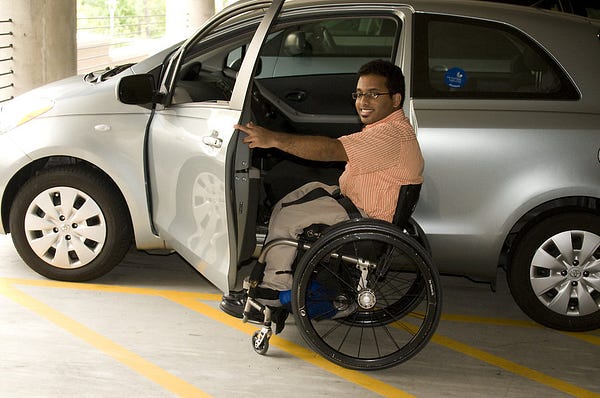
That quote may be a little hard to decipher out of context, but what Henderson is saying there is that regulations — like those proposed by the California DMV — that mandate a sighted driver operate an autonomous vehicle, are obvious non-starters of the visually impaired.

NHTSA Hearing in Silicon Valley

Yesterday the National Highway Transportation Safety Board held a hearing on autonomous vehicles on the campus of Stanford University.

This appears to be mostly an information-gathering hearing, and I haven’t seen a lot of headline-grabbing news originating from the event.

What encourages me, though, is that the hearing was held in Silicon Valley.

I grew up near Washington, DC, and my wife has worked various stints for the federal government, so I have some familiarity with its strengths and weaknesses.

One of the strengths of the federal government is the quality of the people who aspire to work there. That is particularly true at senior levels, where appointees and staffers have substantial power, but it’s really true up and down the federal bureaucracy.

One of the weaknesses, however, is how Washington-centric the government can be. All three branches of government are located in DC. The senior bureaucracy, and much of the lower-level bureaucracy, is located in the DC-area as well.

Particularly outside of the most senior positions, the federal government is staffed largely by people who come from the DC area or who have lived in the DC area for years. It’s inevitable — those are the people who happen to be around when a vacancy opens.

And those are good people, but sometimes the rest of the country can contribute a little bit of diversity in viewpoint and experience.

So it’s nice to see the NHTSA escaping the DC bubble and visiting the rest of the country.

Companies Team Up to Push for Self-Driving Cars

Google, Ford, Lyft, Uber, and Volvo are forming the Self-Driving Coalition for Safer Streets.

The goal is to “work with lawmakers, regulators and the public to realize the safety and societal benefits of self-driving vehicles.”

One of the biggest challenges for self-driving cars is regulation, and companies have had to decide between whether to fly under the radar and hope for the best, or whether to get out in front of regulators and invite scrutiny.

This looks like a vote for getting out in front of the issue.

Disruption Watch: Gasoline, Insurance, and Rental Cars

Gasoline: This article teases the headline of a gasoline-less future, but the article doesn’t really deliver on the headline.

I got to thinking, though — in a self-driving world, maybe gasoline doesn’t go away, but gas stations change a lot.

Modern gas station infrastructure is predicated on people stopping at stations that are convenient relative to their pre-existing routes. But if the car can drive itself to the station and fill up (or a station attendant fills it), then the stations no longer need such prime real estate.

It might also make sense to consolidate gas stations, much the way landfills are consolidated.

And that’s to say nothing of the convenience stores at the station, which presumably the self-driving car won’t need.

Could it be the end of iconic gas station price signs?

Insurance: A Cal Poly professor offers a contrarian take on insurance in the age of self-driving cars. Patrick Lin argues that a combination of corporate risk-aversion, personal privacy, and software bugs will necessitate the continued existence of auto insurance.

I think maybe so, but the industry might also be so different as to be almost unrecognizable. At some point that must count as the end of the auto insurance industry and the beginning of the self-driving car insurance industry.

Also, reinsurers may prove more adept at servicing this market than existing auto insurers.

Car Rental: A press release highlights a panel discussion about how self-driving cars will affect the rental car industry.

It sounds like early days for them, but it’s definitely on the radar.

Breaking the Law

Is it ethical to program a robot to break the law?

Is it good business practice?

It seems like these questions will come up a lot in the future of self-driving cars. In fact, I bet they already have arisen, although I don’t know if any specific cases and how they’ve been handled.

The simplest case might be, is it legal to program a car to exceed the speed limit by 1 mph?

Or what about executing a three-point turn in the middle of an alley blocked off by a delivery truck?

It seems like a vehicle that perfectly followed all traffic laws might work great most of the time, but would occasionally come to a dead stop for hours, or days, on end, until an obstruction cleared.

It’s not clear to me how legislators and police should handle these situations, either.

Logistics Trends

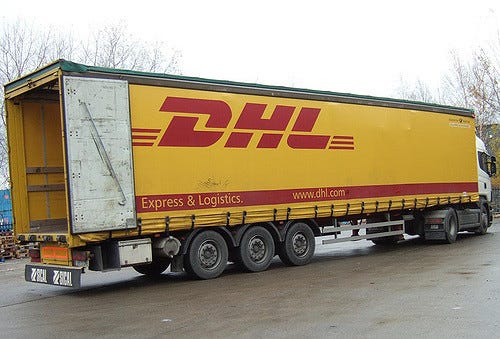
DHL has released the latest version of their Logistics Trend Report. The report breaks out two types of autonomous vehicles — aerial and ground.

Ground Logistics

The section on ground autonomous logistics is interesting and covers a lot of what we already know. DHL is using autonomous vehicles within warehouses. They will gradually move the vehicles into outdoor settings and then into uncontrolled environments (i.e. public streets) over time. Autonomous highway trucking will be important. The last mile problem will be the final issue to be resolved.

I was interested to see that DHL lists autonomous vehicles as having “high” potential impact on logistics, but they set the time frame as “> 5 years”.

Aerial Logistics

The more interesting section, for me, was their overview of “Unmanned Aerial Vehicles”. Note that this term subtly different from “autonomous” although the details don’t explore that distinction.

Many of the UAV points might seem obvious in retrospect, but I hadn’t thought of them before.

UAVs will basically become important for logistics in two scenarios:

  1. Where the value of a new service is high enough to justify the cost.
  2. Where the cost of an existing service is so high that it’s more economical to use UAVs than to continue the service.

An example of the first situation is aerial surveillance. The report states:

UAVs can monitor sites and assets to prevent theft and report suspected damage or maintenance requirements. They can also be used to coordinate major logistics operations on the ground.

An example of the second scenario is:

Rural delivery using UAVs is attractive for remote regions
that have limited logistics infrastructure or are hazardous
to access (e.g., islands during rough weather conditions,
villages located in mountain ranges). Logistics providers
can set up emergency delivery services (e.g., medicines)
for these communities.

It’s a brave new world ahead.

Greenfields vs. Infill

I recently read two interesting articles about real estate development — one on greenfields and one on urban development.

The first article, by Lyman Stone, hypothesizes that American history is largely the history of greenfields. Over time, people have moved from the populated urban centers of the East Coast, and into undeveloped land in the West.

Stone’s hypothesis is that greenfields are much attractive to people than building more densely-populated urban centers. So much so that Stone advocates encouraging dying urban centers to just die already so that we can later re-develop them as greenfields.

Stone doesn’t tie this hypothesis to self-driving cars, but he does talk a lot about commuting costs and it’s not hard to see how autonomous vehicles will greatly expand the scope of practical greenfield development. This is particularly true in a population-sparse country like the United States.

The second article I read took the opposite tack. A report out of the U.K. estimates that self-driving vehicles will free up road and parking space in cities, opening perhaps 20% of the city for redevelopment.

This infill story is the opposite of the greenfield story, although of course they’re not mutually exclusive.

But I do wonder whether self-driving cars will cause a bigger revolution in urban or rural living.

In the short-term, my money is on urban living, since it will take longer for self-driving cars to work in rural areas.

But in the long-term, my bet is that self-driving cars will change rural-life in ways we can’t even imagine.