We are excited to announce that, as of today, all Tesla vehicles produced in our factory — including Model 3 — will have the hardware needed for full self-driving capability at a safety level substantially greater than that of a human driver. Eight surround cameras provide 360 degree visibility around the car at up to 250 meters of range. Twelve updated ultrasonic sensors complement this vision, allowing for detection of both hard and soft objects at nearly twice the distance of the prior system. A forward-facing radar with enhanced processing provides additional data about the world on a redundant wavelength, capable of seeing through heavy rain, fog, dust and even the car ahead.
This is an interesting announcement because it lays so much responsibility on the software. No other company working on fully autonomous vehicles (that I’m aware of) thinks it can be done with just cameras, ultrasonics, one forward-facing radar.
Most competitors are relying on lidar plus 360-degree radar.
If Tesla pulls this off, it will be a game-changer.
Buying and renting anything — a home, a car, a movie — involves a tradeoff between stability and flexibility. Buying provides the stability of permanent ownership and availability, whereas renting provides the flexibility of adjustment to fit changing needs and wants.
The automotive market is moving from an ownership model to a rental model, as ride-sharing services push the stability-flexibility trade in favor of renting, rather than owning. And what we’ve seen with ride-sharing is just the tip of the iceberg. Self-driving cars will push this tradeoff an order of magnitude further.
Mass Customization
As consumers come to value flexibility in transportation, we can take lessons from the manufacturing industry on the practice of mass customization.
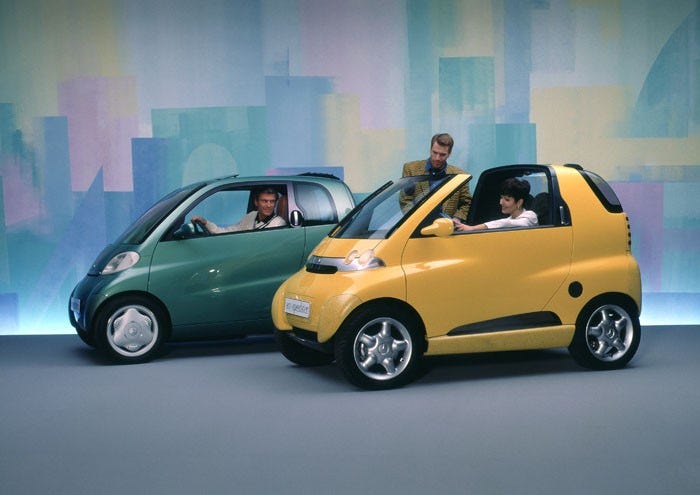
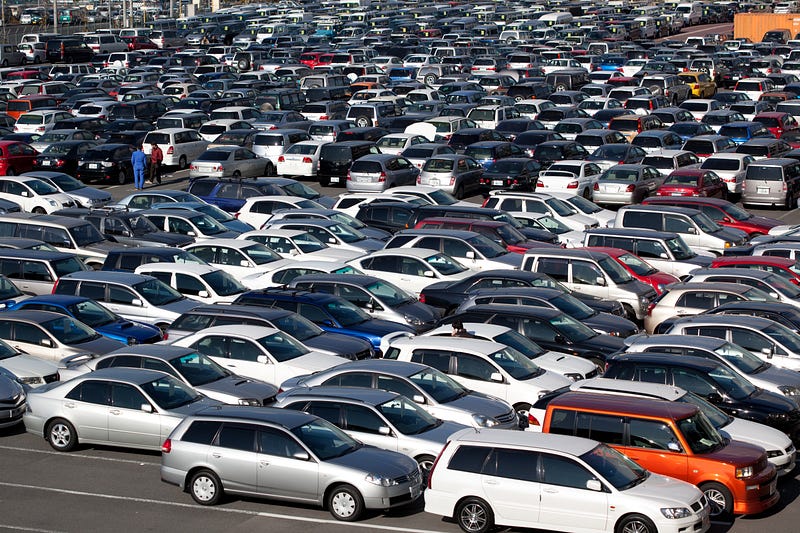
Today, car buyers have to purchase a one-size-fits-all vehicle. If I need to drive in snow twenty days a year, I might get a four-wheel drive vehicle, even though I would be better off with a compact car the other 345 days. Similar considerations govern the purchase of a car capable of occasional carpooling, or downtown parking, or a client visit.
In the self-driving car future, we’ll be able to rent the car we want, and the companies that win will get good at doing this really fast.
Need a minivan this morning? It’ll be there in 30 seconds.
Want a convertible this evening? It’ll be there in 45 seconds.
What Do People Want?
In this world, getting the right car to somebody’s door in 60 seconds or less might be the easy part. Mass customization has been studied and optimized and is mostly a solved problem.
The harder challenge is to figure out what people want.
We have some basic starting points: sedans, vans, SUVs, pickups, sports cars.
But these are all built for human drivers in a one-size-fits-all world.
In a mass customization world, we no longer have to make tradeoffs between scenario. We can tune each vehicle option to a specific use case.
It could even be that we’ll hail one car service if we want a maneuverable short-haul vehicle, and a different service if we want a fast, long-haul vehicle.
What kinds of vehicles would you like to see in a self-driving world?
How do you envision the future of vehicle mass customization? Share your thoughts in the comments. Thanks!
At 4:30pm PDT today (Tuesday, September 20) we’ll be hosting an online open house for the Udacity Self-Driving Car Engineer Nanodegree program.
We’re collecting questions from students and our Director of Learning, Dhruv Parthasarathy, will be asking me to answer them live. Hopefully I won’t trip up on live Internet.
If you have any questions you’d especially like us to answer, please leave them in the comments here.
A Wall Street analyst recently asked Elon Musk if he foresaw a future in which human drivers were banned.
Musk said no.
That seems right to me.
Modern vehicles are designed to last 10–20 years, and car manufacturers are having record years, so lots of consumers are buying cars today that will last until 2025 or 2030. Those consumers aren’t going to let governments ban their vehicles from the road, and retrofitting those vehicles will be prohibitively expensive for many people.
What seems more plausible is to build a network of “autonomous only roads”, kind of like an Interstate Highway system for self-driving cars.
Even that might be a heavy lift in the United States, though, where infrastructure projects are subject to an array of veto-wielding interest groups.
China, anyone? Brazil? Russia?
The list of states that might be able to build out autonomous vehicle infrastructure faster than the US is strange, and maybe a little depressing.
Queen Elizabeth II of The United Kingdom of Great Britain and Northern Ireland recently gave her annual address to Parliament, and allegedly it contained a plug for self-driving cars.
I write “allegedly” because I read several headlines about the speech, but none of the articles I read actually quoted the Queen. Maybe there is a prohibition against quoting British royalty?
A Modern Transport Bill, which encourages investment in driverless cars and aims to ensure insurance is available to their users, has been announced by the Queen at the state opening of Parliament.
The Government says the Bill will help cut red tape and put the right framework in place to allow innovation, which it claims will put the UK at the forefront of autonomous and driverless vehicle ownership and use.
Good for the UK!
Jaguar, Land Rover, and Volvo are all testing autonomous vehicles in the UK already, so hopefully this clears a path for them to accelerate.
In a short and disjointed piece, Mike Montgomery at Forbes labels Apple, Google, Tesla, and Uber as the new Big Four of automotive technology.
This is not itself outlandish, but its worth considering that these four companies are doing 3 different things.
Tesla, and reportedly Apple, are manufacturing autonomous vehicles.
Google is creating autonomous vehicle software.
Uber is creating a transportation network.
All four of these companies touch each other, sometimes in multiple ways.
And maybe over time their goals will converge, or maybe not.
Of course, they can still be the Big Four dominant companies in the autonomous vehicle market, even if they’re doing different things. But when we think of the Big Three automakers, or the Big Four accounting firms, or the Big Ten athletic conference, we tend to think of directly competitive organizations.
Ford is testing its autonomous vehicles in a simulated city in Michigan, named “Mcity”.
“Every mile driven there can represent 10, 100 or 1,000 miles of on-road driving in terms of our ability to pack in the occurrences of difficult events.”
Of course, note that this is similar to the difference between testing in a test harness, and testing in the real world, where users and the environment crazy things that the test designers never imagined.
Nonetheless, it’s an advantage that Michigan has over Silicon Valley when it comes to developing products for the non-digital world. Mcity is 32 acres dedicated to autonomous vehicle testing, and that kind of acreage is hard to come by in Silicon Valley.
One of the dreams of autonomous vehicles is the possibility of inter-vehicular communication, well beyond what is currently possible.
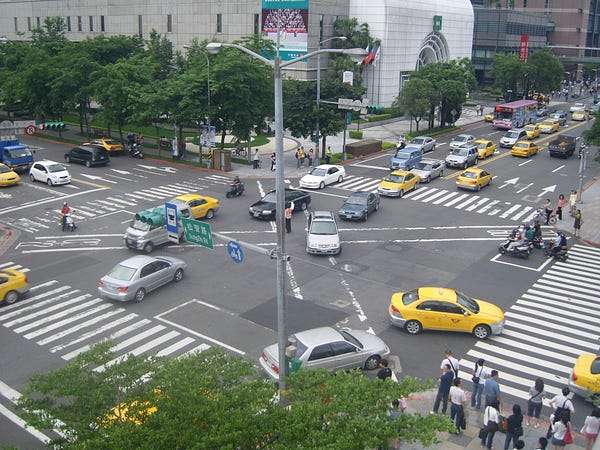
For example, when a stoplight turns green, all of the cars waiting in line could accelerate at the same time, having communicated that it is safe to do so. Contrast this with human drivers, each of whom must watch for the acceleration of the next driver, before accelerating their own vehicles.
However, there is some level of human-to-human driver interaction, and autonomous vehicles are potentially having trouble coping with this.
Think, for example, of arriving at a four-way stop, simultaneous to another car.
Theoretically, when cars arrive simultaneously, the left-most car has the right-of-way.
Practically, however, cars never arrive exactly simultaneously, and nobody pays attention to the left-hand rule anyway. Usually, one driver takes the initiative, or perhaps one driver waves another driver forward, ceding the right-of-way.
Intersections present a particular challenge, said Melissa Cefkin, who is based at Nissan’s Silicon Valley research centre.
“Sometimes drivers communicate between themselves and with pedestrians or cyclists directly, by swapping looks, with a hand gesture, or even verbally,” she said.
“Sometimes it’s interpretative: we look for signals while judging the vehicle’s speed and movements.”
The tiny pointers that motorists pick up from one another are not yet within the reach of the technology.
“Currently, the machine isn’t capable of grasping all the subtlety of these clues,” Cefkin said.
Increasingly, it looks like one of the sticking points for driverless cars will be the situations in which driverless cars have to interact with human drivers.
This isn’t that surprising. Studies show that drivers are safer violating the speed limit and keeping up with traffic, rather than adhering to the speed limit and going at a different speed than everyone else.
The interactions between human and computer drivers seems like a variation on that.






 David Silver