China recently released some basic guidelines for self-driving car development. As an American, I don’t always fully comprehend the line in China between private companies and the government. How much guidance to self-driving car developers in China get from published laws and regulations, and how much comes from internal communication with the relevant government agencies?
“The rules lay out requirements that vehicles must first be tested in non-public zones, that road tests can only be on designated streets and that a qualified person must always sit in the driver’s position, ready to take over control.”
As best I can tell from English translations, that is the extent of the rules. Presumably there must be more, but I don’t know if the rest is available in Chinese, or if you have to be in the industry there and know the right people to figure it out.
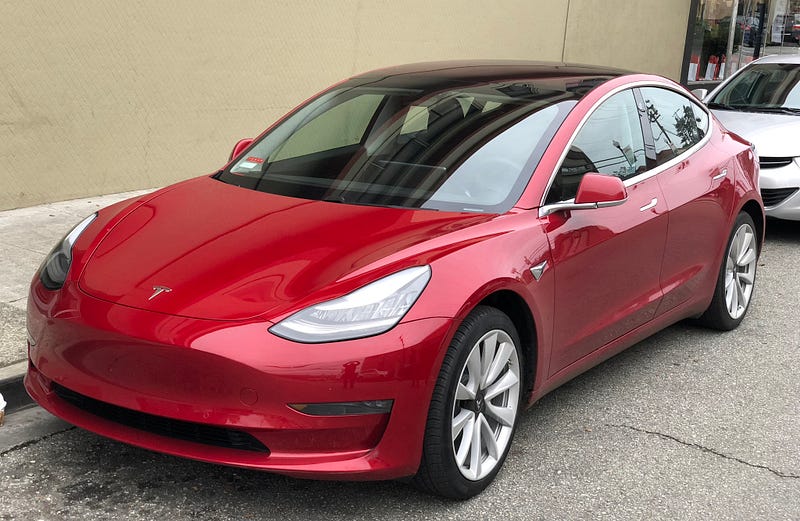
I’m a fan of Tesla, but it has been a rough month for the company.
Crash
In March, a Tesla Model X on Autopilot ran into a concrete barrier on Highway 85 in Mountain View, California. The driver was killed and the car exploded. Tesla wrote, “We have never seen this level of damage to a Model X in any other crash.”
“In the US, there is one automotive fatality every 86 million miles across all vehicles from all manufacturers. For Tesla, there is one fatality, including known pedestrian fatalities, every 320 million miles in vehicles equipped with Autopilot hardware. If you are driving a Tesla equipped with Autopilot hardware, you are 3.7 times less likely to be involved in a fatal accident.”
Statistics are rarely as compelling as stories, especially true stories, but I find these statistics reassuring. And, as with the Florida Autopilot crash in 2016, it makes a big difference that the only fatality here was the driver of the Tesla, not a member of the general public.
Regulation
In the aftermath of the crash, Tesla has gotten into a public disagreement with the National Transportation Safety Board, the US government agency running the main investigation. Apparently the argument is about how quickly to draw conclusions — Tesla wants to move faster than the NTSB does.
"This letter is to memorialize a conversation between you…and me on Wednesday, April 11, 2018. In that conversation I informed you that NTSB has revoked Tesla's party status from the investigation…" pic.twitter.com/R5VrCck6LJ
That last post involves Tesla pushing back against, “an extremist organization working directly with union supporters to create a calculated disinformation campaign against Tesla.” Tesla claims it is building the “safest factory on earth”, whereas Reveal claims, “Tesla has failed to report some of its serious injuries on legally mandated reports, making the company’s injury numbers look better than they actually are.”
I have no idea who to believe in this disagreement. But at the very least it has got to be a grind to be running PR for Tesla right now, and probably for a lot of other employees, as well.
Production
Tim Higgins of the Wall Street Journal, who has been on top of the Tesla beat for quite a while, reported last week that Tesla had temporarily shut down Model 3 production. Tesla has cracked 2,000 Model 3 units per week, but has gotten nowhere near the 5,000 per week it targeted for last year.
Higgins subsequently fielded an unprompted confession from Elon Musk on Twitter:
Yes, excessive automation at Tesla was a mistake. To be precise, my mistake. Humans are underrated.
“Humans are underrated,” is a pretty amazing quote, especially coming from Musk.
Stock
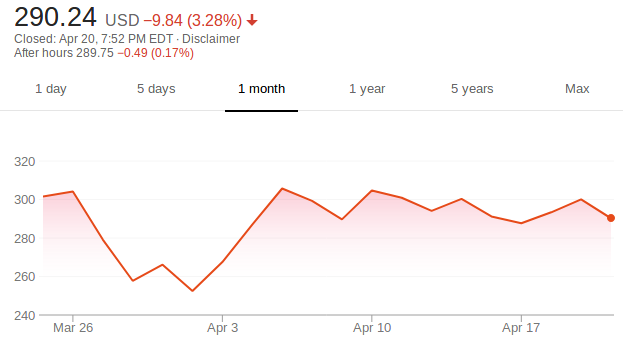
Through it all, Tesla’s stock has mostly held.
Valuation is down 25% from the highs of last summer, but this month has been pretty steady, except for a big dip and bounce-back right after the accident.
Tesla, for a time America’s most valuable car company, is now in 2nd place, behind General Motors.
But the fact that a month like this hasn’t sent investors running for the exits is a testament to the quality of the company and its cars.
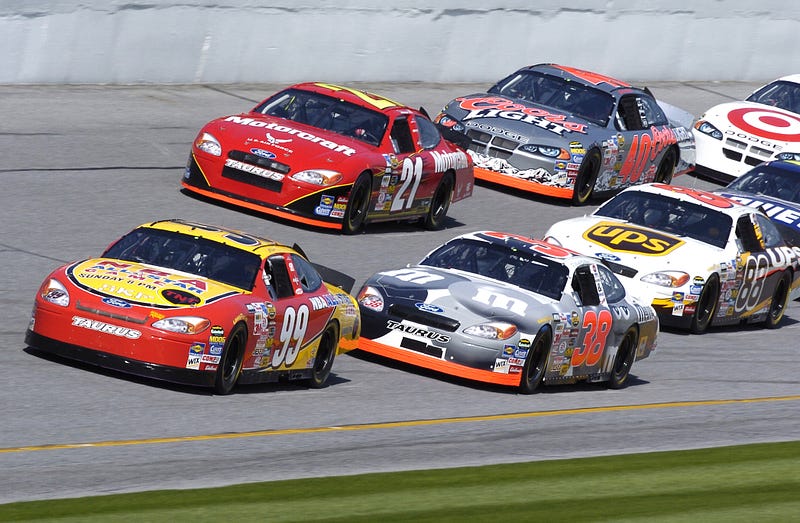
“Even when race car drivers leave the mayhem of the track, their skill doesn’t outweigh their appetite for risk: a study from the 1970s found that racing drivers from the Sports Car Club of America had a higher crash rate on public roads than other drivers from the same state of the same age and sex.”
Compare that to this:
“At the opposite end of the spectrum are those who use cautious driving styles to make up for their weak skills. Some elderly drivers who score poorly on a driving test nevertheless manage to drive crash-free by actively compensating for their deteriorating abilities, according to a Belgian study from 2000. They drive more slowly and avoid tailgating, leaving long safety gaps behind vehicles they’re following; they also plan their trips to avoid complex traffic or other challenging situations.”
Of course, this has implications for self-driving technology:
“Some of the more dramatic estimates have imagined quintupling the volume of traffic flowing down a road. But a short “headway” — the gap between one vehicle and the one just ahead — brings a higher crash risk than a long headway.”
Supposedly the reason the Google Self-Driving Car Project kept its vehicles tooling around Mountain View at 25mph for years is that a collision at 25mph results in something like a 20% chance of a human fatality. At 45mph, the likelihood of fatality flips, and becomes something like 80%. A 2015 report hints at this, although it is more vague about the statistics.
Chinese e-commerce giant Alibaba is building “self-driving technology”, according to the MIT Technology Review:
Alibaba says it has bigger ambitions than just robotic taxis. In June 2016, the company launched an AI-powered “city brain” system in Hangzhou, where it’s headquartered, to crunch data from mapping apps and increase traffic efficiency. Simon Hu, the president of Alibaba Cloud, says the firm’s ultimate goal is to produce the kind of autonomous driving that uses such data to help integrate transportation into urban infrastructure.
The common analogy is that Baidu is the Google of China, Tencent is the Facebook of China, Didi is the Uber of China, and Alibaba is the Amazon of China.
This announcement puts Baidu, Didi, and Alibaba all in the self-driving car race.
Talking Self-Driving Cars with Baidu’s Apollo team in China, and visiting Udacity’s offices in Shanghai and Beijing!
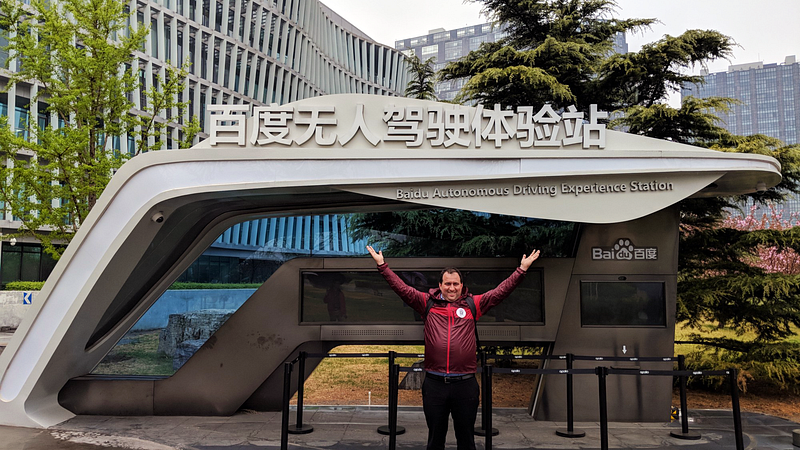
This past week I had the pleasure of visiting China for the first time in 20 years! I spent a few days working with colleagues at Udacity’s office in Shanghai, and followed that with several days at Udacity’s Beijing office. I was also able to take in some additional Beijing-based events. It was a whirlwind tour, and I loved it!
My traveling group was hosted by the terrific Apollo team at Baidu. Baidu is China’s largest search engine company, and one of the largest Internet companies in the world. And Udacity is building a free self-driving car course with them!
“Together with Baidu, we look forward to popularizing the Apollo system, and to giving everyone the opportunity to become a self-driving car engineer.” — Sebastian Thrun
This course will provide a conceptual overview of self-driving car technology, illustrated with the Apollo open-source self-driving car stack that Baidu is building.
Baidu has invested heavily in self-driving cars and has rapidly become an important player in the ecosystem. They are already testing vehicles on their Beijing campus.
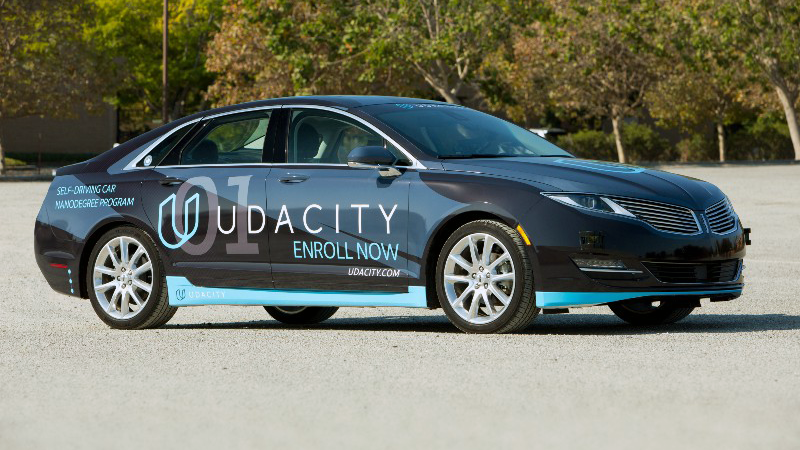
Their vehicles come in all shapes and sizes. Some of Baidu’s vehicles look like Carla, Udacity’s very own self-driving car.
Carla!
But Baidu has 13 different types of self-driving vehicles, ranging from small cars to big trucks!
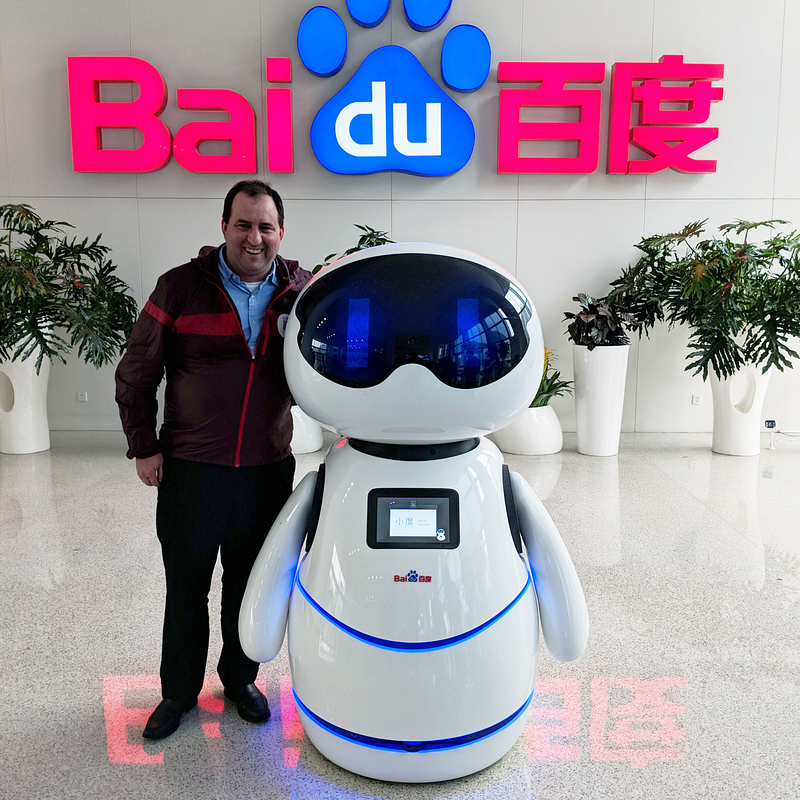
Beyond autonomous vehicles, Baidu has a world-leading artificial intelligence group. In their lobby I got to play with one of their robots, which talked, snapped my photo, and walked around with me.
The Baidu team was also kind enough to arrange and host an on-camera interview for me, with CSDN, a Chinese software developer network.
The most important part of the visit, however, were the ping-pong matches. I played two matches and went 1–1 in my first international ping-pong competition. No photos, you’ll have to take my word for it 🙂
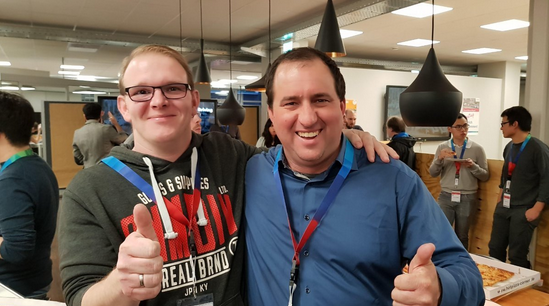
Michael Ikemann (Udacity’s first Intro to Self-Driving Car Nanodegree graduate) and me
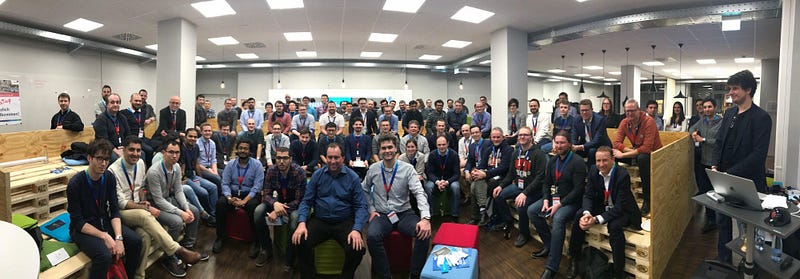
A few weeks ago, I had the delight of visiting Europe with Udacity’s Berlin-based European team, meeting both automotive partners and Udacity students. The trip was so much fun!
Stuttgart
We started in Stuttgart, where we met with our partners at Bosch and toured their Abstatt campus. Their campus reminds me of a plush Silicon Valley office, except instead of overlooking Highway 101, they overlook vineyards and a European castle.
Thanks to Udacity student Tolga Mert for organizing!
We discussed the self-driving ecosystem and, of course, how to get a job working on self-driving cars at Bosch.
Berlin
The next day we headed to Berlin to prepare for our deep learning workshop at Automotive Tech.AD. What a great collection of autonomous vehicle engineers from companies across Europe!
In the evening we hosted a Meetup for current and prospective Udacity students at our Berlin office. It is always a delight to meet students and hear firsthand what they love about Udacity, and how they feel we can improve the student experience.
It’s a lot of fun to fly across the globe and see different places, but the best experience of all is getting to meet students from all different parts of the world.
We learn what our students are working on, what excites them about self-driving cars, and about the difference Udacity has made in their lives. It’s wonderful!
If you’re interested in becoming a part of our global Self-Driving Car community, consider enrolling in one of our Nanodegree programs. No matter your skills and experience, we’ve got a program for you!
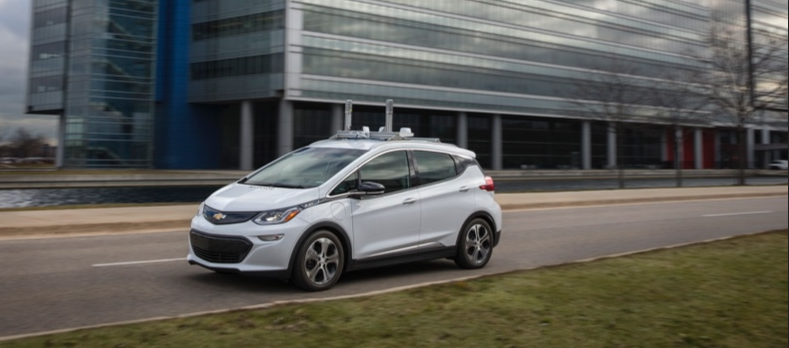
A police officer pulled over a Cruise self-driving car in San Francisco recently, and issued a citation for failing to yield to a pedestrian in a crosswalk. Cruise disputes the citation, but since nobody was hurt, the interesting thing to me is that the safety operator got the ticket.
Knowing nothing about the actual interaction, I imagine the police officer writing the citation, caring not a whit about who or what was actually operating the vehicle, and walking off.
Longer-term, how does this work? Specifically, what happens when safety drivers are no longer in the vehicle.
Maybe officers will ticket passengers. That will get the vehicle owners’ attention quickly.
What if nobody is in the vehicle?
Routine traffic stops are one of the most common interactions between citizens and police in the United States. For many people, this is their only interaction with the police. As self-driving cars progress, we’re going to need to rethink interactions between police and the public.
This diversity of partnerships presumably helps Waymo on both offense and defense. Deploying across multiple partners on different continents will move Waymo further into a position as the industry-standard for autonomous vehicle software. And maintaining alternative vehicle suppliers protects Waymo against any one supplier leaving the fold.
On the other hand, managing multiple supplier relationships is a huge time investment. There are parallels between Waymo’s new position in the automotive supply chain and the current positions of the automotive manufacturers, who spend a lot of time managing their own supply chains.
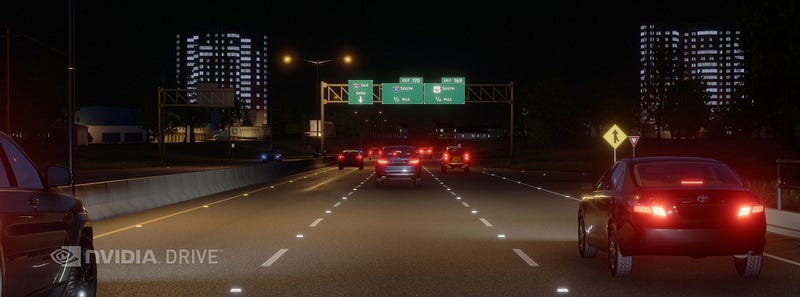
NVIDIA (ahem, one of Udacity’s partners in developing the Udacity Self-Driving Car Engineer Nanodegree Program) announced their new DRIVE Constellation Autonomous Vehicle Simulator a few weeks ago at their annual GPU Technology Conference.
NVIDIA is taking the next step toward the holy grail of autonomous vehicle simulation: training autonomous driving software in the simulator and deploying it straight to the real world.
“Deploying production self-driving cars requires a solution for testing and validating on billions of driving miles to achieve the safety and reliability needed for customers,” said Rob Csongor, vice president and general manager of Automotive at NVIDIA. “With DRIVE Constellation, we’ve accomplished that by combining our expertise in visual computing and datacenters. With virtual simulation, we can increase the robustness of our algorithms by testing on billions of miles of custom scenarios and rare corner cases, all in a fraction of the time and cost it would take to do so on physical roads.”
Testing and validation is hugely important to the autonomous vehicle industry. Every time a software developer tweaks a model or a the autonomous vehicle source code, the developer needs to verify that nothing else broke. The fastest way to do this is testing in simulation. NVIDIA is releasing what looks like the world’s best simulation platform for testing.
The biggest leap, though, is training in simulation. It’s one thing to write code, put it in a car, collect data about different scenarios, and then later test in simulation that the your self-driving software still handles those scenarios correctly.
It’s a whole different animal to be able to train self-driving software in simulation, without ever putting a car out on the road. Whoever cracks that nut will have a huge leg up in the autonomous vehicle race. Keep an eye on NVIDIA.
Back home on vacation this weekend, my brother was telling me about paying up to $30 one-way to drive Interstate 66 inside the DC Beltway. One the one hand, the pricing (which varies with traffic) is outrageous. On the other hand, people will pay it. My brother, coming off a 12- or 16- or 20-hour hospital shift as a medical resident, will pay whatever he has to pay to get home and sleep.
The latest round of self-driving car projections offer conflicting predictions about the effect self-driving cars will have on congestion. Self-driving cars should lower the psychological costs of vehicular transportation, which should in turn encourage demand and ultimately lead to more congestion.
On the other hand, self-driving cars may be more efficient drivers, and will encourage ride-sharing. Ride-sharing, in turn, has the potential to reduce parking needs and vehicle sizes. All of this should lead to less congestion.
Where all of this ultimately shakes out is to be seen, but congestion pricing has potential to reduce a lot of the zero-sum friction. With a few exceptions, most roads are free to use, paid for by tax dollars. Moving to a world in which we pay to use roads will lower our tax burdens, allocate space on the road more efficiently, and hopefully reduce congestion.










 David Silver