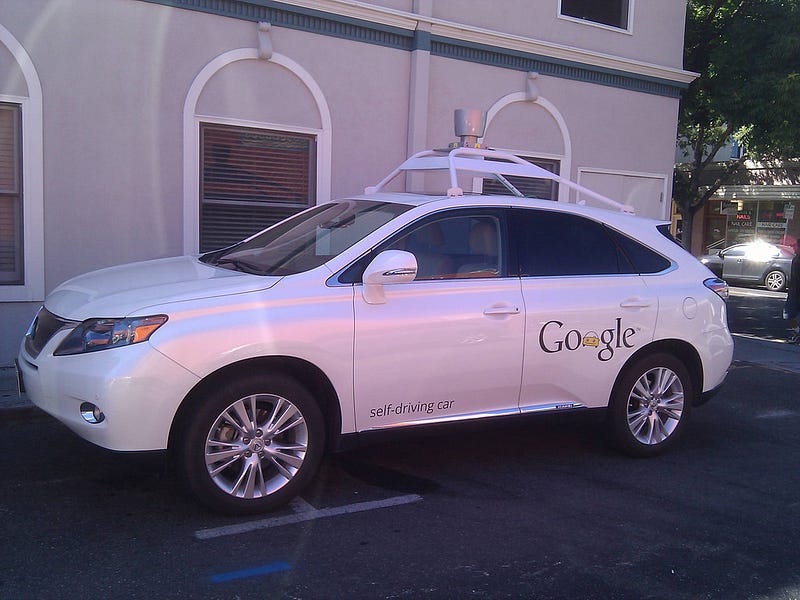
The Merc has a fun interview with Google Car Test Driver Stephanie Vargas. She’s been working at Google as a contractor since at least 2011, when she was on the Maps team and saw one of the early self-driving car prototypes.
Q: What are some dangers your cars have confronted?
A: A mattress has fallen from the back of a truck. Children running in the road after balls. People (on skateboards) skitching on vehicles, holding on, like Marty McFly in “Back to the Future.” Or coffining — people lie on their backs on skateboards and go between traffic. Imagine someone lying in a coffin, someone assuming the same position on a skateboard and then riding down the street. They ride between vehicles or under vehicles. It’s pretty death-defying. It’s actually pretty fun. I used to do it as a kid in my parents’ driveway. I’m not condoning that behavior. But very fun. Don’t do it in live traffic.
Forbes has a short post on a company called Mapbox, which offers maps to thousands of mobile apps, and is now releasing an autonomous vehicle product called Mapbox Drive.
What caught my eye here is the distinction between top-down and bottom-up map creation.
Traditionally, mapping has been a top-down exercise. Surveyors go out and measure the land, or, more recently, Google sends out special mapping vehicles to collect Street View data.
The Mapbox approach seems to be more bottom-up, utilizing user data to build maps.
This raises some privacy and usability issues, but it’s fundamentally more scalable than a top-down solution.
I should note that I ill-informed about the state of the art in mapping, and I wouldn’t be shocked if Google and HERE and other mapping companies are playing around with similar bottom-up technology, too.
The problem is that with user-generated data you have to take what you can get from users, without the control that comes in the top-down world. And whether the user data will contain everything Mapbox needs to create automotive-grade maps is an open question.
But this top-down vs. bottom-up question is going to come up a lot in autonomous vehicle engineering, and this seems like an interesting case study to watch.
A Wall Street analyst recently asked Elon Musk if he foresaw a future in which human drivers were banned.
Musk said no.
That seems right to me.
Modern vehicles are designed to last 10–20 years, and car manufacturers are having record years, so lots of consumers are buying cars today that will last until 2025 or 2030. Those consumers aren’t going to let governments ban their vehicles from the road, and retrofitting those vehicles will be prohibitively expensive for many people.
What seems more plausible is to build a network of “autonomous only roads”, kind of like an Interstate Highway system for self-driving cars.
Even that might be a heavy lift in the United States, though, where infrastructure projects are subject to an array of veto-wielding interest groups.
China, anyone? Brazil? Russia?
The list of states that might be able to build out autonomous vehicle infrastructure faster than the US is strange, and maybe a little depressing.
It sounds like early days, but I was interested to read about “GoMentum Station, a special testing facility near San Francisco.”
A challenge with developing self-driving cars in the Bay Area is the cost of land, and thus the scarcity of test facilities. Google tests their cars at decommissioned Castle Air Force base in the Central Valley, hours from their Mountain View headquarters.
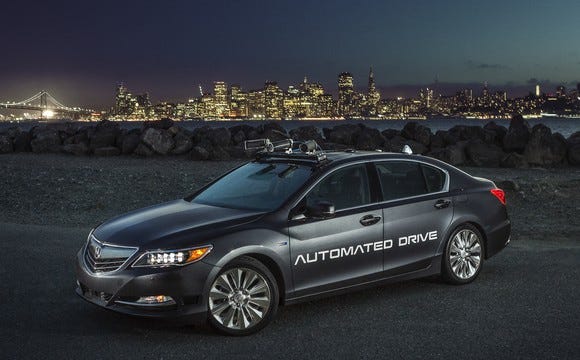
It’s also interesting to read about Honda’s foray into self-driving cars, as they have been one of the less visible autonomous vehicle OEMs, thus far.
Finally, the news-breaking ability of The Motley Fool is surprising to me. I think of them as a financial publication, not a tech or automotive shop. But they have been all over self-driving car news.
Chevy Bolt: GM is testing the Bolt in San Francisco. This is not surprising, given their acquisition of Cruise Automation. But it’s an indicator that the Cruise team is continuing to function post-acquisition, which is a good sign.
Tesla and Mando: Tesla has inked a deal with Mando, Korea’s largest Tier 1 automotive parts supplier.
Mando doesn’t have the name recognition in the US that Delphi, or Continental, or Bosch have, but they’re a major supplier, particularly to Korean car manufacturers.
It’s hard to tell how important this deal is — most OEMs have some sort of relationship with almost every supplier.
The theory floated by The Country Caller is that Mando is less expensive than other Tier 1 suppliers and this is a way for Tesla to cut costs as it moves down market to the $35,000 Model 3.
Otto is a hot new startup in the autonomous trucking space. They just landed a splashy article on the front page of The New York Times.
Otto, led by 15 former Google engineers, including major figures from the search company’s self-driving car and maps projects, is aiming at the long-haul freeway driving that is the bread and butter of the commercial trucking industry.
Beware any startup that is lead by 15 people, even if they are all former Google engineers.
That said, their approach seems terrific.
Their beachhead appears to be with owner-operators who drive their own trucks, because autonomy can help them stay on the road for more hours every day, which means more money in their pockets.
Also, presumably, those individuals are less risk-averse than big trucking companies that might have legal liability worries.
The article plays up the trucks vs. cars race to autonomy, but that seems like more of a sideshow to me.
Autonomous trucks are related to, but distinct from, self-driving cars and it makes sense that startups would exist to specifically target that market. Ultimately, I doubt Otto cares whether it beats Google cars to market, as long as they can gain a lock on the trucking industry.
The goal is straightforward enough — to create a Linux flavor that meets the needs of the automotive industry.
They’re starting with a focus on infotainment consoles, which are the big screens in the center of many modern cars that offer navigation, music, Bluetooth integration, and more.
But the eventual goal is to be the operating system for the entire car.
This is an interesting idea, and analogous to the hardware world. Automotive grade hardware is often a modified version of off-the-shelf hardware, with housing designed for the rough conditions and longer lifetimes required by a car.
One concern I have is whether there will be enough of an ecosystem around AGL. Ubuntu isn’t a perfect solution for cars, but one nice thing about it is that so many people use Ubuntu that the bugs are driven out quickly.
Crain’s Detroit Business published a story about all of the Michican law firms that are forming autonomous vehicle legal teams to handle this new category of business.
And I can imagine there is lots of new business to get. In particular, the attorney’s quoted in the story talk a lot about connectivity issues. Whereas I might have guessed that the legal issues surrounding autonomy are primarily safety-related, these legal teams think there is a lot of legal work related to transmitting data from the car to the cloud or to other cars.
The geographic angle is also interesting. One of the lawyers mentions that her autonomous vehicle group was formed in response to requests for legal help from startups.
Many of those startups are probably California-based, although the article doesn’t specify.
I’ve written before about the Michigan-California competition for OEMs, but it makes sense that this competition travels all the way up the supply chain.
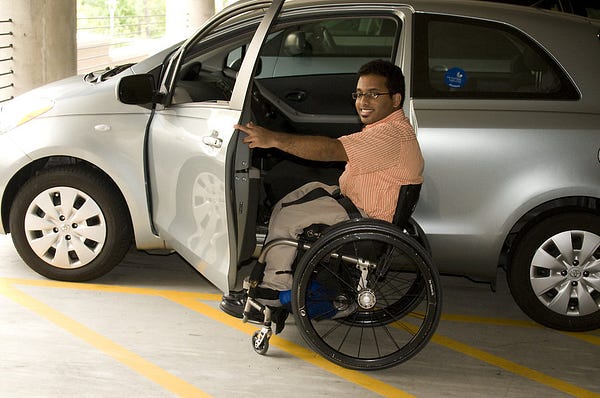
First, incorporating accessibility into the design of autonomous vehicles is the right thing to do, and will save people a lot of heartache in the long run.
Susan Henderson of the Disability Rights Education & Defense Fund argued, “For example, equal access to the internet for people who are blind and deaf and have other disabilities was not considered by web developers at first, and many people with disabilities experienced unnecessary obstacles to information — and still do.”
The second interesting point is that disability advocates are a natural constituency for relaxing autonomous vehicle regulation.
“NHTSA’s model state policies for [autonomous vehicle] operating or licensing users must preclude discrimination on the basis of disability by states or any government entity.”
That quote may be a little hard to decipher out of context, but what Henderson is saying there is that regulations — like those proposed by the California DMV — that mandate a sighted driver operate an autonomous vehicle, are obvious non-starters of the visually impaired.
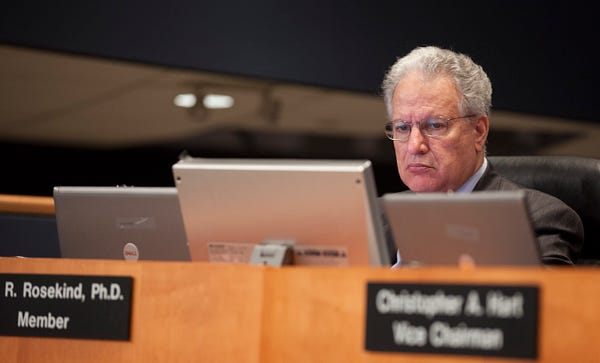
This appears to be mostly an information-gathering hearing, and I haven’t seen a lot of headline-grabbing news originating from the event.
What encourages me, though, is that the hearing was held in Silicon Valley.
I grew up near Washington, DC, and my wife has worked various stints for the federal government, so I have some familiarity with its strengths and weaknesses.
One of the strengths of the federal government is the quality of the people who aspire to work there. That is particularly true at senior levels, where appointees and staffers have substantial power, but it’s really true up and down the federal bureaucracy.
One of the weaknesses, however, is how Washington-centric the government can be. All three branches of government are located in DC. The senior bureaucracy, and much of the lower-level bureaucracy, is located in the DC-area as well.
Particularly outside of the most senior positions, the federal government is staffed largely by people who come from the DC area or who have lived in the DC area for years. It’s inevitable — those are the people who happen to be around when a vacancy opens.
And those are good people, but sometimes the rest of the country can contribute a little bit of diversity in viewpoint and experience.
So it’s nice to see the NHTSA escaping the DC bubble and visiting the rest of the country.






 David Silver