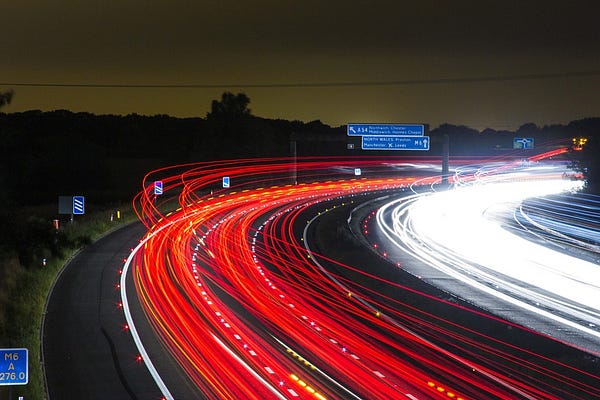
A team from MIT has proposed a system for removing stoplights from intersections. By using wireless connectivity between cars, intersections can advise drivers — human or computer — to adjust their speed an enter the intersection at exactly the right time.
This seems like an example of why path-dependence matters and how human drivers and computer drivers might need or at least want different infrastructure.
It would be awesome for computerized drivers, or at least human drivers in networked cars, to be able to travel through intersections without stoplights. But there are hundreds of millions of non-networked vehicles in the world, and they’ll be with us for a long time.
So the real challenge isn’t even building intersections that work without streetlights. It’s building intersections that work with both networked and non-networked cars.
A company called Sidewalk Labs, which is reported to have “spun off from Google”, has announced a platform to help city managers and traffic planners deal with the driverless car revolution.
It’s all pretty abstract right now, because their platform isn’t actually in use yet, but the federal DoT will be announcing grants to cities and the Sidewalk Labs platform will come along with the grant.
So far this sounds like a “not a big deal yet, but keep it in the back of my mind” kind of program. I wish them success.
But what really got me thinking is whether the driverless car revolution will require traffic planning, or whether planners will really even be able to control it.
Backlash is already growing against apps like Waze, which route human drivers through residential neighborhoods to avoid highway traffic. In spite of the backlash, I assume that only a small percentage of drivers are actually even capable of pulling this off.
But once the computer is driving the car, the road network will be utilized to maximum efficiency, even if that’s unpleasant for people living on now-quiet residential streets.
In the future, will planners be able to funnel self-driving cars onto the desired thoroughfares, or will the computers always be ten steps ahead?
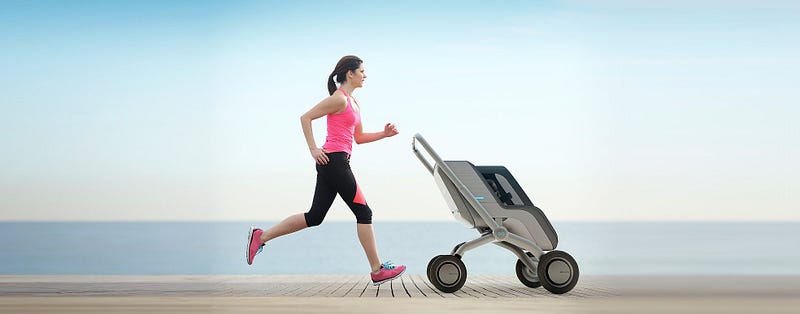
Smartbe, which is marketed as “the first intelligent stroller in the world,” uses a motion-tracking sensor to follow you wherever you go, allowing for hands-free strolling or an assisted push.
The company is here, and you can purchase one here.
NVIDIA: The graphical chip producer has developed a next-generation, water-cooled super-computer, capable of fitting in the trunk of a self-driving car. The PX2 computer will help cars process images and recognize objects.
Velodyne: LIDAR is the perhaps the most important component of an autonomous vehicle system, and also the most expensive. The world’s chief LIDAR manufacturer announced a smaller (and presumably cheaper) LIDAR system the size of a hockey puck.
Toyota: A new study finds that Toyota has more self-driving car patents than any other company (Google, somewhat surprisingly, ranks 24th). “Non-US companies tend to be more aggressive in filing patent applications than American companies.”
HERE: The navigational company jointly owned by several automakers is building a cloud-based mapping platform, seemingly to rival Google Maps.
Kia: The South Korean car manufacturer is getting into the autonomous vehicle race, but a little bit late. “Kia aims to have fully self-driving cars on the road by 2030 (yes, 14 years from now).”
Faraday Future: This isn’t technically an autonomous vehicle announcement, since Faraday is ostensibly focused on electric vehicles, but the upstart is taking shots at Tesla. “And then after 9 years, [Tesla] delivered their first mass market production vehicle…Faraday Future was founded just 18 months ago…we already have a staggering 750 employees globally, breaking ground on a 3 million square foot factory in just a few weeks, and we will deliver our first production vehicle in only a couple years time.”
Elon Musk makes the important point that getting self-driving technology to work 99% of the time is much different than getting self-driving cars to work 99.99999% of the time.
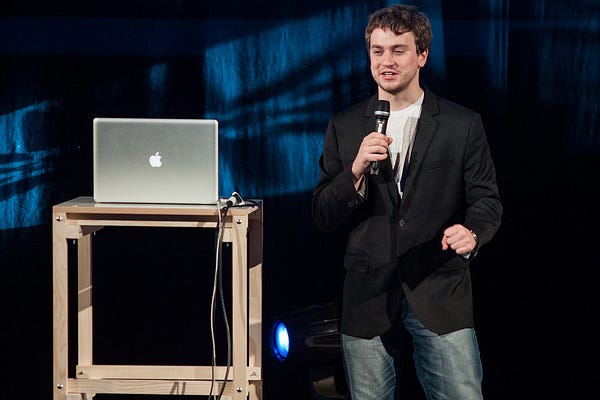
Nonetheless, this seems pretty impressive. I don’t think I’d be worried if I were MobilEye or Tesla, but I am impressed by George Hotz.
California’s Department of Motor Vehicles has just posted its new rules for self-driving cars, and they are decidedly a win for Tesla and a loss for Google.
The rules state that a licensed driver must be at the wheel of a self-driving car in California at all times.
This is a fail for Google in a few ways.
One, Google’s goal is to transform mobility for millions of people who cannot become licensed drivers — the disabled, the young, the old. Requiring at least one autonomous vehicle passenger to also be a licensed driver completely defeats that goal.
Two, Google’s strategy is to bypass the phase of autonomous vehicle development in which the car must be able to pass control to the driver. That phase is tricky, and by taking all driving control away from the humans in the car, Google simplified its needs. Now the California DMV is forcing Google to tackle this specific problem.
Three, Tesla has been working on this human-machine interaction model for a long time, so it has a big head start over Google.
That said, Google has a lot of money, and thus a lot of political muscle. I don’t consider this to be the final word on self-driving regulations.
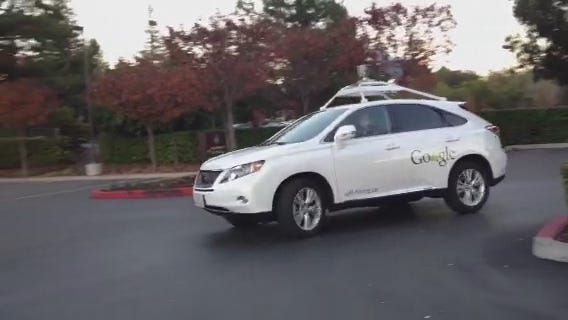
News has begun to leak that Google plans to make self-driving cars a stand-alone unit within Alphabet.
These seems logical and inevitable, and yet it’s not actually clear what this means from a practical perspective. Perhaps the division will eventually have to fund itself, instead of relying on funds from Google search.
Baidu is entering the self-driving car race, although it is setting a more basic goal for itself and is hopes to reach that goal more quickly.
While many top self-driving car companies are targeting a 2020 launch date, Baidu is targeting 2018 for “vehicles that will operate on fixed routes or fixed areas in select cities”.
That seems like a reasonable engineering goal, but of course the question is whether anybody will want that product.
The product sounds an awful lot like a bus, so perhaps Baidu is setting itself up for competition with ride-sharing services like Uber.
Although BI reports this breathlessly as, “Google and parent company Alphabet are not leaving such a key ingredient in someone else’s hands,” it seems a little less earth-shattering than that. To be fair, BI eventually concedes that possibility, as well.
Any large organization that depends on suppliers for key parts is going to have internal specialists in those parts. When I worked at in AOL’s data center, years ago, we had all sorts of routing and switching engineers, despite the fact that AOL never had any desire to build its own routing a switching hardware.
I think the more intriguing, if less newsworthy conclusion here is that Google is gradually looking more and more like it’s going to have a real autonomous vehicle business, and not just a moon-shot lab project.





 David Silver