Videos are already showing up on YouTube, demonstrating Tesla’s autopilot feature going awry:
Perhaps this is a #slatepitch, but I think this is a good indication of how much faster Tesla is going to advance beyond other driver-less car manufacturers.
Nobody else is getting their product debugged at this scale.
Actually, they don’t come out and say that in so many words. Instead, they write:
As the risk of accidents will fall drastically with the advent of autonomous vehicles, the insurance premium to cover that risk too will drop significantly. Nevertheless, original equipment manufacturers (OEMs) and suppliers will increase insurance spend to cover their share of product liability risk, thereby offsetting the shrinkage in consumer-driven insurance revenues.
With OEMs and tier 1 suppliers looking to ensure fool proof product safety, methods to access risk and certify the product will assume greater importance. The traditional method of underwriting that uses historic data will take a back-seat, paving the way for a new breed of underwriters capable of evaluating driving algorithms and assigning a relevant risk priority number.
I think the translation there is that disruption is coming to the auto insurance industry.
“If you could come up with anything involved in driving that cut accidents by 30 percent, 40 percent, 50 percent, that would be wonderful,” he said at a conference in March. “But we would not be holding a party at our insurance company.”
A common objection (or at least concern) regarding self-driving cars is the issue of liability. If my self-driving car hits another car, or person, who pays?
This seems to me like any easy problem to solve — it’s just a finance question — as opposed to the actual technology, which is a math and software and robotics question.
Presumably, for enough money, somebody will take on liability.
Nonetheless, it’s an interesting idea through which to work.
An obvious analogy is to commercial airplanes, and in that case the passenger bears no responsibility. Although I’m not knowledgeable of this field, I would imagine liability is shared between the airline, the airplane manufacturer, and the pilots, although all of these groups probably have some form of insurance or re-insurance.
This might even be a near-perfect analogy, if self-driving cars usher in an Uber-centric future in which individuals subscribe to car services, rather than own individual cars.
In a future more like the current world, though, in which individuals own cars, it’s a little less clear who will accept liability.
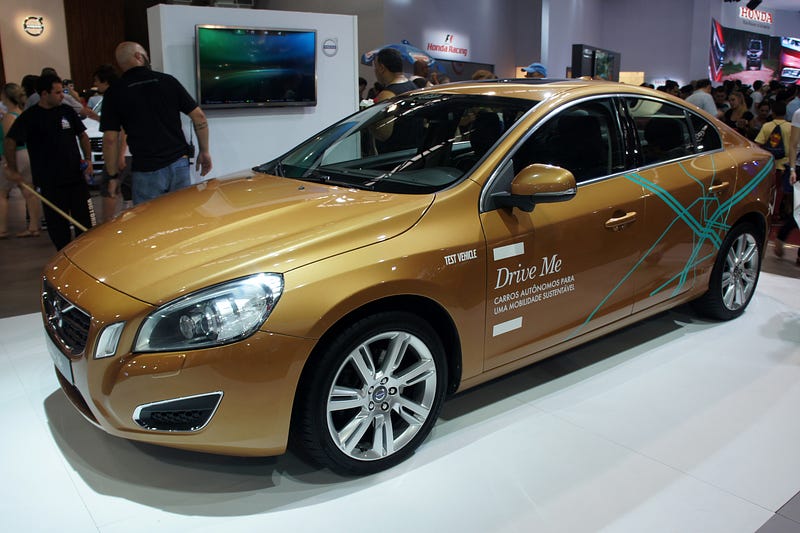
Volvo and other manufacturers have pre-emptively claimed liability, but since they aren’t actually selling autonomous vehicles yet, it remains to be seen how that will stand up in practice.
My guess is that, at least for a while, drivers will need to maintain personal auto insurance, if only because cars will continue to have manual override features. But I suspect auto manufacturers will be quick to take on as much liability as they can, if only to protect their brands and sell more cars.
This could lead to something of a boom in personal injury law, as lawyers develop more appetite to finance cases against defendants (car companies) with deep pockets, and juries feel less guilty delivering big damages awards against giant corporations. And, that, in turn will be a boon for the insurance industry.
Last night, Tesla rolled out a software update to its Model S sedans. The update enables autopilot functionality on highways, as well as auto-parking in some situations.
This is a great step forward for Tesla, and a long-term step forward for consumers, as the new data will give Tesla a huge leg up in race for self-driving cars. Nothing like tens of thousands of users to work out the bugs in your software.
In the short-term, I think it’s probably only a small win for consumers. Tesla has been vocal that any accidents caused by the software will be the responsibility of the driver. This means drivers will have to stay engaged throughout the trip, scaling back a lot of the benefits to a self-driving car.
But, as Tesla gets more and more data and becomes more and more confident in its software, I imagine the day that Tesla takes responsibility for its autopilot is coming fast.
TechRadar has a pretty good slideshow, outlining the major players in the self-driving car space:
Google
Uber
Tesla
Honda
Mercedes-Benz
BMW
Audi
Delphi
Apple
They make the interesting point that Uber is the most secretive of these companies, at least as far as its self-driving car technology. Although there was a very public uproar when they partnered with, then hired away, Carnegie Mellon’s team, very little actual technology news has come out of the company. That doesn’t mean they’re not advancing fast, of course.
One of the revelations from CS373: Artificial Intelligence for Robotics, is the extent to which autonomous driving technology uses a hybrid of global mapping and local sensing.
So, for example, when if a car wants to drive from Los Angeles to San Francisco, it basically outsources the mapping functions to Google Maps, and only uses local computation for visual horizon driving.
This simplifies the software and allows the robotics wizards to focus just on local issues.
It’s one of those things that’s obvious once it’s explained but kind of revelatory.
Chris Gerdes is a Stanford engineering professor working on driverless race cars. I imagine he’s doing some pretty neat technological work, but he’s made the press recently for a more philosophical reason — the ethics of driverless cars.
Bloombergdoesn’t do a terrific job raising the different ethical issues that might arise for a robot driver, but it gets the ball rolling and it’s not hard to imagine from there:
Take that double-yellow line problem. It is clear that the car should cross it to avoid the road crew. Less clear is how to go about programming a machine to break the law or to make still more complex ethical calls.
One potential dilemma, for example, is how to program for the famous trolley problem. If a computer has to make a decision between staying on course and killing 5 people, or veering off the road and killing one pedestrian, what do we program the computer to do?
What if it’s a 25% chance of killing 5 people against the certainty of killing one person?
These are pretty extreme examples, but even the more mundane decisions aren’t entirely clear. Should driver-less cars adhere rigidly to the speed limit? 5 m.p.h. in parking garages?
What if another driver motions at the car to proceed out of order through a stop sign?
What about a late merge that requires crossing a solid white line?
I don’t expect these would be insurmountable issues, but they will make explicit the extent to which we implicitly assume the violation of our traffic laws.
Of these, the taxis in Japan seem by far the most interesting, from a rider’s point of voice. The engineering involved in all five of them is spectacular of course.
But the benefits of self-driving cars will only really arrive when they move beyond being “monorails on wheels” and they become personal vehicles to go wherever we want.
Swedish automotive group Volvo Cars Wednesday urged U.S. federal authorities to impose nationwide guidelines for self-driving cars, vowing to accept full liability should one if its cars be involved in an accident while in autonomous mode.
Musk, who spoke Tuesday at the Automotive News World Congress conference, said he expects the lack of clear federal regulations covering self-driving cars could delay their introduction until 2022 or 2023.
These are smart guys, and I’m sure they’re aware of Uber’s success vis a vis regulators.
To at least some extent, presumably they are angling for regulations that will reduce their own liability or box competitors out of the market.
But, if companies can get driver-less cars into the hands of consumers before the regulations clamp down, then those consumers will wind up powering the driver-less car lobby.
To take just one example, a key market segment for driver-less cars will be the elderly. And the elderly vote. A lot.


 David Silver