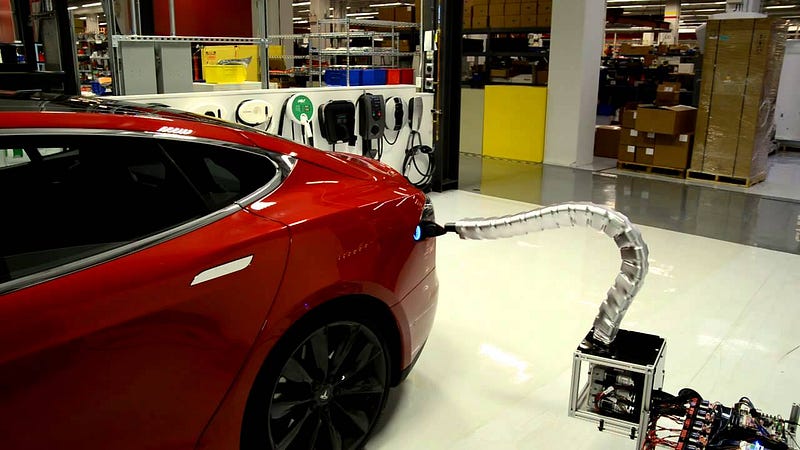
In 2015, Tesla released a video demonstrating a prototype “snake charger” that (presumably autonomously) connects and charges a car. It’s amazing and honestly not as creepy as I might have imagined.
I missed this prototype at the time and apparently not much has happened with it in the interim, but recently Elon Musk confirmed on Twitter that the charger is still in the works.
This charger would make a lot of sense were Teslas able to drive autonomously, as Musk hints they will be able to do soon (note that a lot of people are skeptical on that point). Autonomous charging would really untether the vehicle from the need for human intervention.
At this point neither the snake charger nor Full Self-Driving mode are ready. But it’s a pretty awesome video.
On a more immediately feasible note, he also says, “November or December of this year, we [Tesla] should be able to go from a parking lot in California to a parking lot in New York, no controls touched at any point during the entire journey,”
That’s pretty awesome, although the catch with these things is how generalizable the solution is.
If the demonstration works only from one very specific parking lot in New York, to another very specific parking lot in California, and only over one precise cross-country route, that’s impressive but not groundbreaking. Delphi actually did something like that a few years ago.
If, on the other hand, Tesla builds a system that can drive over a wide variety of routes, that will be a huge step toward Level 5.
Yesterday Chris Dixon announced Andreesen Horowitz’s investment in Comma.ai, the self-driving car company founded by hacker protegy George Hotz.
In the brief announcement, Dixon highlighted “The WhatsApp Effect”:
WhatsApp was able to build a global messaging system that served 900M users with just 50 engineers, compared to the thousands of engineers that were needed for prior generations of messaging systems. This “WhatsApp effect” is now happening in AI. Software tools like Theano and TensorFlow, combined with cloud data centers for training, and inexpensive GPUs for deployment, allow small teams of engineers to build state-of-the-art AI systems.
“I expressed some skepticism here, like, look Mobileye has got hundreds of engineers and they’ve been working on this problem for quite awhile and I think they’re pretty smart guys,” Musk says. “He wanted to make a bet, and he said ‘well how much is that worth to you?’ And I said, ‘well I mean if it were true, it would be worth millions of dollars, but I don’t think it’s true.’”
Further on, Musk advises:
The path of success for Hotz — if he wants to create a competing product to Mobileye — is to build a small company, get funding, increase its size so it can conduct verification and validation testing, Musk advises.
“There’s a ton of hard work and bug fixes, and it’s kind of like painful work, and it’s not fun and after doing that for a few years, if George, is prepared to do that, I think he would have a product that would be competitive with Mobileye,” Musk says in a tone you might hear from a parent or older sibling.
Now, to be fair, Comma.ai is on said path to success — creating a small company getting funding, increasing its size.
But I get the sense that Tesla (13,000 employees) and even Mobileye (450 employees) are different from the vision Chris Dixon has for Comma.
When GM recently acquired Cruise for a cool billion, the startup had under 50 employees. So it’s certainly decidedly to build a billion dollar self-driving car company with under 100 employees.
I guess the next question is can 50 employees create a $10 billion self-driving car company.


 David Silver