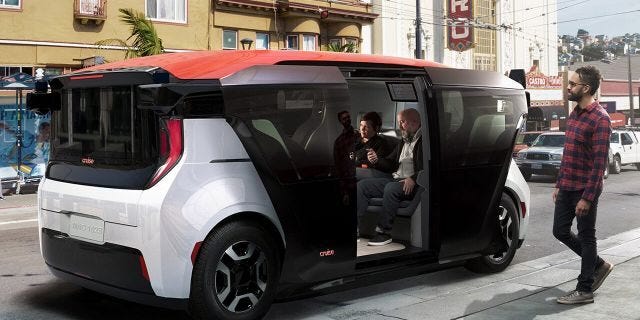
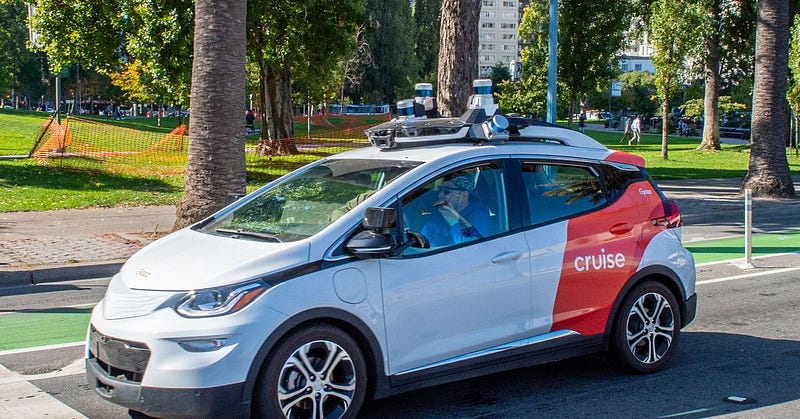
Cruise CEO Dan Amman announced yesterday that his company will test fully driverless vehicles on the streets of San Francisco “before the end of this year.”
The post heavily emphasizes the environmentally friendly nature of Cruise’s all-electric fleet, including its Origin prototype vehicle.
“Single occupant, human-driven, gasoline-powered cars are the second largest contributors of greenhouse gases on Earth…burning fossil fuels is no way to build the future of transportation.”
A video by Cruise founder and CTO Kyle Vogt accompanies that announcement. Vogt mentions that Cruise has accumulated “over a million miles of fully autonomous driving, in complex urban environments.”
That seems much lower than I would’ve guessed, so much so that I wonder if it was a mis-statement. Given Waymo’s record of over 20 million autonomous miles, I would assume Cruise would want something closer to that before putting fully autonomous vehicles on the road.
Combined with Waymo’s recent move to open driverless vehicles in Phoenix to the public, it’s been a great week for self-driving cars.
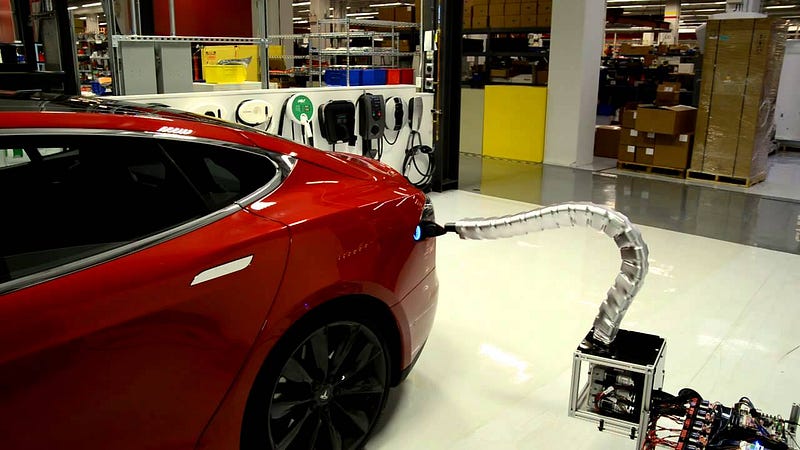
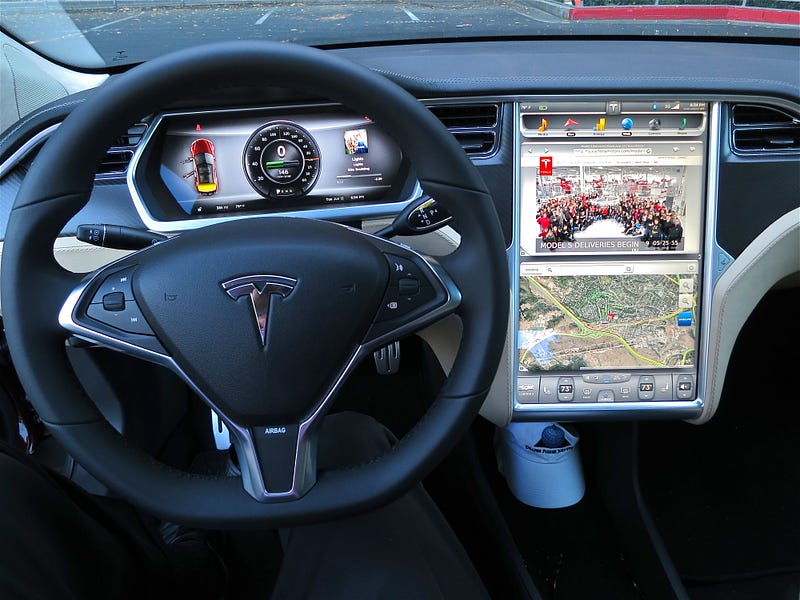
In 2015, Tesla released a video demonstrating a prototype “snake charger” that (presumably autonomously) connects and charges a car. It’s amazing and honestly not as creepy as I might have imagined.
I missed this prototype at the time and apparently not much has happened with it in the interim, but recently Elon Musk confirmed on Twitter that the charger is still in the works.
This charger would make a lot of sense were Teslas able to drive autonomously, as Musk hints they will be able to do soon (note that a lot of people are skeptical on that point). Autonomous charging would really untether the vehicle from the need for human intervention.
At this point neither the snake charger nor Full Self-Driving mode are ready. But it’s a pretty awesome video.
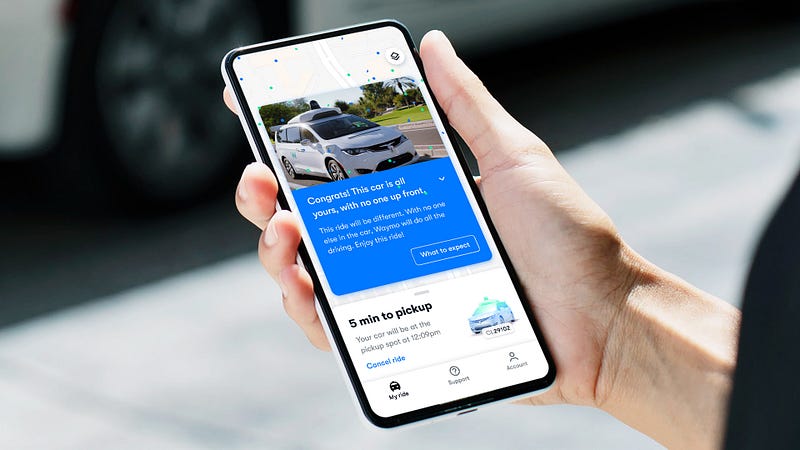
Waymo has begun offering (“selling”) driverless rides to members of the general public in the Phoenix area. This is super-exciting, both because of the technological achievement and also because of what this advancement will make possible. And that relates to economics.
With paying customers in the vehicle, each ride covers (or at least subsidizes) its own cost. This means that, over time, Waymo can afford to drive many more miles than it could if it had to cover the cost of each ride for testing purposes.
Let’s do some math to see how that works out.
Waymo is currently logging about 1 million self-driving miles per month. Let’s assume all of these miles are part of the Waymo One service in Arizona — just for the purpose of this exercise.
Waymo’s blog post this week shared that “5–10% of our rides in 2020 were fully driverless.” To keep the numbers easy, let’s multiply 1 million by 10%, which yields 100,000 driverless miles per month.
How much money does Waymo save by going fully driverless?
Presumably the driverless vehicles are operating in low-speed environments, at least to start. That means lots of intersections and stopping. Let’s assume the driverless vehicles average 10 miles per hour. That means that, in order to log 100,000 driverless miles in a month, Waymo would have to drive for 10,000 hours.
I’m honestly uncertain of the policies and economics at Waymo One, but let’s imagine that a vehicle normally has a single operator that costs Waymo $30 per hour (wage plus taxes and benefits). That implies an operator cost of $300,000 per month (10,000 hours times $30 per hour), or $4 million per year, to log driverless miles.
That is a lot of money to me, but it doesn’t actually feel like that much money for Waymo. But now imagine scaling up.
On average, for human-driven vehicles (not Waymo), an automotive fatality occurs once every 100 million miles. Imagine that we want Waymo to drive an order of magnitude more than that, every month, in order to validate the safety of its vehicles. That’s 1 billion miles per month. Now the driver cost becomes 1 billion miles, divided by 10 miles per hour, times $30 per hour, equals $3 billion per month. That’s prohibitive, even for Waymo.
But if the vehicle becomes driverless, those costs go away.
For me, that’s one of the really exciting aspects of Waymo opening to the general public. If riders will pay enough to cover the marginal cost of the ride without a driver, then it becomes possible to massively scale testing and validation.
I suppose it would be a little much to claim that Waymo was paying attention to my tweets, but lo and behold, today they announced that I can take a fully driverless ride, if I can get to Phoenix 😉
“Beginning today, October 8, we’re excited to open up our fully driverless offering to Waymo One riders. Members of the public service can now take friends and family along on their rides and share their experience with the world.”
You’ve been asking, and now it’s here: Waymo is opening its fully driverless service to the general public in Metro Phoenix. To our valued riders, take a ride and share your experience by tagging #WaymoOne! More here: https://t.co/0066gAbLegpic.twitter.com/xDTrn6FPjW
“Waymo and Cruise allow their staffing vendors, Transdev North America and Aerotek, respectively, to make decisions regarding when it is safe to test and how to respond to driver concerns. But drivers say those companies can be slow to act, communications are often contradictory, and they feel pressured to keep working despite unsafe conditions.”
Self-driving car operators, particularly at larger organizations like Waymo and Cruise, tend not to be employees, but rather are often contract workers, often employed by an outside staffing agency. This state of affairs is hardly limited to self-driving cars — contract workers employed by staffing agencies are so common in the Bay Area, for engineering, program management, sanitation, and more.
Even companies whose hourly workers are employees, for example firms with large retail or operations centers, face this COVID challenge. Salaried headquarters staff who can work productively from home, while the hourly employees have to be physically present. The division is really about whether you work with ideas or with the physical world. Doctors and dentists have to go to the office for the same reason.
The Verge reports that Waymo is paying its contractors to stay home, although the story only mentions this in passing, and then proceeds to relay other reports that Waymo contractors are pressured to come to work. So it’s hard to know what to make of that.
I confess the best response to this situation eludes me. It feels right to say that companies should pay their workers to stay home and not risk their health, but it is only a short-term solution for a private company to pay people to not work. In the long-term, those companies will struggle to fund those costs.
There is a public health case to be made for some sort of tax or penalty on firms whose employees catch COVID. That doesn’t solve the wildfire problem that also comes up in the piece, though.
Perhaps the best solution is meticulous record-keeping, so that employers can verify that their teams are in fact staying safe while working.
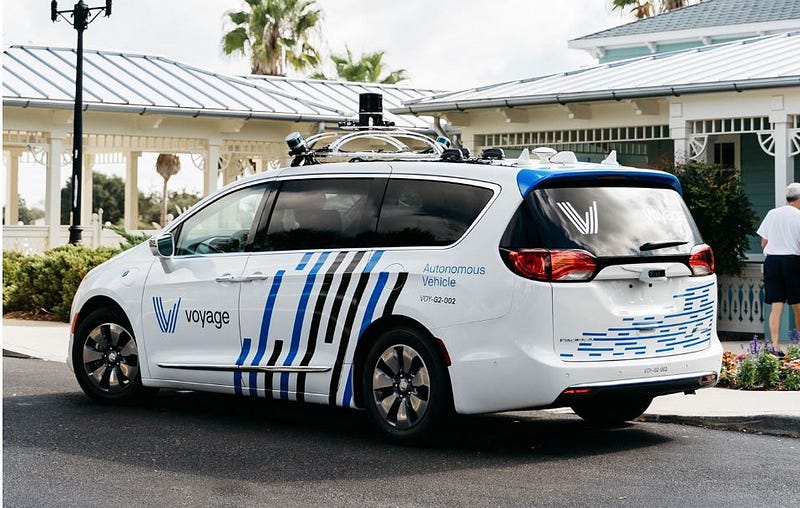
Voyage CEO Oliver Cameron broke the self-driving car Internet recently (I just, but only a little), by predicting, “ I feel very confident that in the next 12-to-24 months, you’re going to see self-driving vehicles, with no person in the vehicle, moving people on a daily basis.”
And I think he’s right about this! It might already be true, in fact.
Waymo is supposedly moving people in fully driverless vehicles in the Phoenix area and has been for quite some time. The riders are pre-selected and under NDA, so the reporting has been quite limited. But it might already be happening daily.
In very constrained, geofenced operational domains, I suspect we’ll see more companies launch driverless vehicle services — particularly Chinese companies, which don’t get a lot of coverage in the US, but are progressing rapidly.
In the meantime, if you want to see driverless vehicles in action, follow Oliver’s Twitter feed.
It’s a surreal feeling to see a car with no one driving it.
Regardless of the doubters, this technology will transform how we all move, reducing needless death and giving independence back to those who don’t have it.
I just saw that a few weeks ago Elon Musk tweeted that Tesla’s Full Self-Driving Functionality will be a “full architectural rewrite”, presumably of the code base.
The FSD improvement will come as a quantum leap, because it’s a fundamental architectural rewrite, not an incremental tweak. I drive the bleeding edge alpha build in my car personally. Almost at zero interventions between home & work. Limited public release in 6 to 10 weeks.
Rewrites are hard. They often seem exciting at the beginning, because of the opportunity to do everything the “right” way, from the ground up. But it usually turns out that recreating existing functionality, built up over years, requires a lot of effort. If the original software took years to write, the rewrite won’t be trivial.
On the other hand, there is a reason Tesla is the most valuable car company in the world, and now one of the most valuable companies in the world, period. Elon Musk is amazing at leading his people to accomplish what would be impossible for most teams.
A rewrite hardly qualifies as impossible. But it’s usually a pretty big effort.
My latest Forbes.com article explores the many facets and possibilities of the recently-announced partnership between Waymo and Volvo.
“Volvo and Waymo each announced that, “Waymo is the exclusive L4 partner for Volvo Car Group.” Waymo did not offer up any comparable exclusivity to Volvo. Indeed, Waymo has varying levels of partnership with Fiat-Chrysler, Jaguar, and Renault Nissan, which it mentions in the same blog post announcing the Volvo partnership.”
There’s a sensor angle, a ridehailing angle, an Uber angle, and even a China angle. Lots going on there. Check it out!
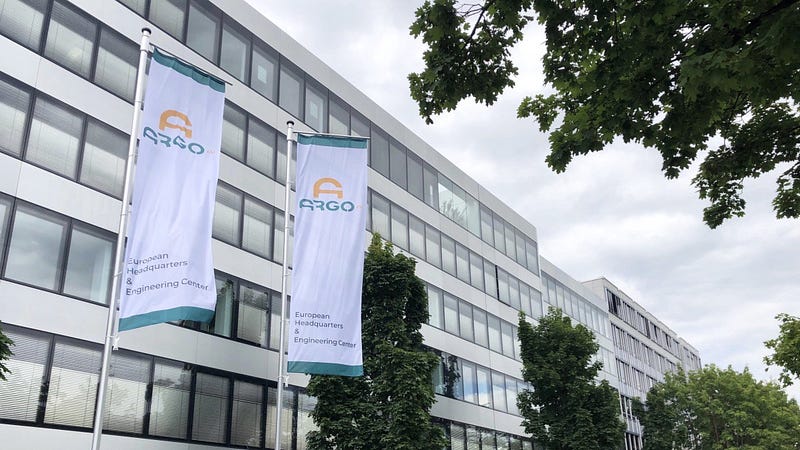
A few weeks ago, Volkswagen closed a multi-billion dollar investment in Argo AI. The investment was originally announced last summer, so this was hardly a shock. Nonetheless, the deal results in a really interesting ownership structure for Argo, that is shared by Cruise, and is pretty uncommon among startups.
When GM purchased a 40-person startup called Cruise Automation in 2016 for a reported $1 billion, a self-driving acquisition race began.
About a year later, Ford announced that it “would” invest $1 billion over four years in a little-known Pittsburgh-based startup called Argo AI. Confusingly (at least to me) for $1 billion Ford was not “acquiring” Argo — it was becoming a shareholder. It wasn’t even clear whether Ford would be a majority shareholder.
There is a certain logic to this structure, but it’s really unusual. The logic is that Argo, as an independent company, would be able to grow rapidly, like a startup, unencumbered by Ford’s constraints and brand. It would just have a lot of Ford’s cash.
On the other hand, Ford made a tremendous bet on what was then a very small team. If Argo hit a home run, Ford wouldn’t necessarily reap most of the reward. And if Argo took all that money and drained it, Ford had limited power to prevent that.
In the time since the Argo investment, Cruise has essentially spun out of GM into a similar structure. It’s taken major investments from both Softbank and Honda, to the point that Cruise is once again an independent company with corporate investors who have poured in billions of dollars but have a lot less control than you might imagine.
Volkswagen’s investment in Argo seems to be a vindication of this unorthodox approach. Unlike Ford, Volkswagen is investing in a real company — still a startup, but one with hundreds of employees and solid technical progress. Volkswagen’s investment shows they think this may be the path forward.
So often when you see a corporate investor try to become a venture capitalist, things go poorly for both the big company and the startup. In this case, things seem to be going quite well.
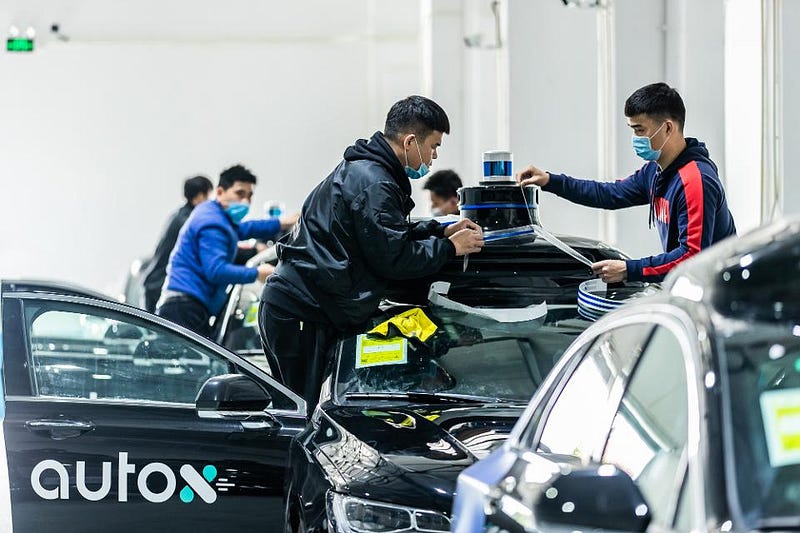
This week I had the pleasure of interviewingAutoX COO Jewel Li for Forbes.com. We discussed what it’s like to run a company spread across the US and China. Diversity brings challenges:
“Culture is hard to explain,” says Li, who immigrated from China to the United States in 2011 to pursue her PhD at the University of Delaware. “It’s in every single detail. Are you writing all of your documents and messages in English, so that everyone can understand? If the company caters for employees, is it a diverse selection of food?”
But there are unexpected advantages:
“A lot of AV companies haven’t been testing and are data hungry. We were very lucky that there were always fleets to test in China. It never slowed us down,” says Li.


 David Silver