
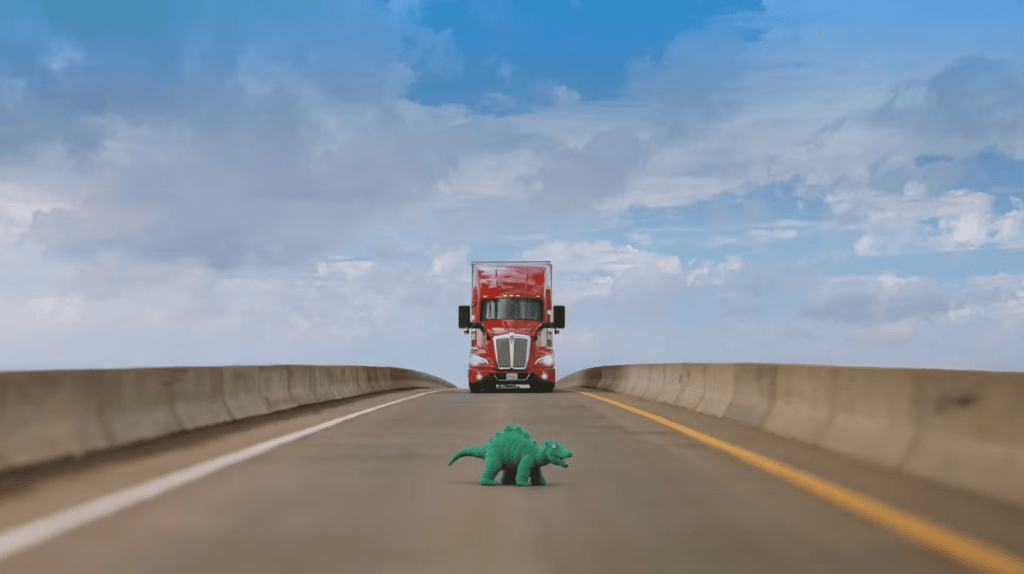
Probabilistic Risk Assessment

The hardest challenge is autonomous vehicle development isn’t technical – it’s raising enough money to keep going 💸

The hardest technical challenge, however, is determining when you are ready to remove the safety driver and let the system operate on its own. Once you’re able to make that assessment, the task list to get to “ready” becomes clear, and progress is steady.

Kodiak just published a blog post on two of the major tools we use to determine when we are ready to “go driverless.” We use these tools every day, and we’ve used them to go driverless in an increasing range of domains. We’re using them to prepare to go driverless on the highway.

The tools are heavily dependent on probability and statistics. The first tool, in fact, we call “probabilistic risk assessment.”

In simple terms, the Kodiak PRA decomposes scenarios into three primary factors:

  • Scenario Exposure: How often does our vehicle encounter this type of operating scenario? 
  • Collision Likelihood: Given that our vehicle encounters this operating scenario, how likely is it that a collision occurs?
  • Severity of Collisions: How severe would the collision in this scenario be?

The second tool is called “Breakpoint.” This tool feeds values into the three factors of the PRA:

BreakPoint deliberately injects realistic, time-varying errors onto the signals that flow through the autonomy system in order to ensure that the autonomy system still drives safely in both normal and extreme conditions. Better yet, BreakPoint actively guides its search adversarially, actively trying to drive our system into a “collision” situation, thus helping us discover autonomy failure modes. Then, BreakPoint tooling helps us estimate the risk associated with this failure mode, and this information flows directly into our PRA.

If you’re interested in solving the hardest technical challenge in autonomous vehicle development, you should read the blog post.
2024 Autonomy Predictions

I used to be much more diligent about my annual autonomy predictions, writing them on January 1 and evaluating them the following December 31.

I fell off that wagon a number of years ago. Sorry!

Nonetheless, here are some predictions for 2024.

100% Confidence

  • No Level 5 self-driving vehicle will emerge.

90%

  • Waymo will continue to offer driverless service to members of the public.
  • I will ride in a driverless Waymo.
  • Tesla Full-Self Driving will remain a Level 2 advanced driver assistance system.

80%

  • A driverless truck will run on a US highway.
  • I will not receive an aerial (drone) delivery at my house.
  • No driverless service will open to the public in Europe.

70%

  • At least one company besides Waymo will offer self-driving service to members of the US public, possibly requiring approval.
  • No Level 3 vehicle will assume legal liability from the driver in any domain within the US.

60%

  • No Level 4 self-driving vehicle will be at fault in a fatal collision.
  • Tesla does not announce the inclusion of lidar in its vehicles.
  • I will purchase a Comma device.
  • Mobileye will not launch a public driverless robotaxi service.

50%

  • At least one company besides Waymo will offer self-driving service to members of the US, without any pre-approval required.
  • Cruise will relaunch driverless service to the public, somewhere.
  • A Level 4 autonomous company will hold an IPO.

Kodiak’s Driverless Truck Debuts At CES

Kodiak’s driverless-ready sixth-generation truck debuted last week at the Consumer Electronics Show in Las Vegas. There was lots of great coverage!

Kristen Korosec from TechCrunch wrote:

This isn’t just any big rig. Packed inside this sixth-generation semi truck are two — and sometimes three — of every mechanical component that is critical for safe operations, including braking, steering, sensors and computers. Those redundant systems are there as a backup in case anything were to fail while its self-driving truck barrels down a highway without a driver behind the wheel.

And Ed Garsten from Forbes summarized:

Specifically, the sixth-generation Kodiak self-driving technology includes:

  • Redundancy across all safety-critical functions, including redundant braking, steering and power systems.
  • Kodiak’s custom-designed high-integrity Actuation Control Engine system. The ACE is responsible for ensuring that the Kodiak Driver can guide the truck to a safe “fallback” out of the flow of traffic in the unlikely event of a critical system failure.
  • The Kodiak Driver, the vehicle-agnostic self-driving system which includes Kodiak’s redundant, driverless-ready hardware platform, is “designed to be safer than a human driver,” the company says.
  • Twice the GPU processor cores, 1.6 times greater processing speed, 3 times more memory, and 2.75 times greater bandwidth to run software processes compared to Kodiak’s first-generation truck.
  • Kodiak’s proprietary SensorPods, which replace a truck’s side-view mirrors and house two upgraded higher-resolution, automotive-grade LiDAR sensors and two additional side radar sensors to improve long-range object detection.
  • 12 cameras, four LiDAR sensors and six radar sensors.

One thing I add is the quality of the process Kodiak uses to determine that our systems are ready for different domains (test tracks, highways, surface streets, driverless operations). Kodiak’s Systems Engineering team is incredibly thorough and thoughtful in terms of preparing test data and analysis for each new domain. And our internal Safety Review Board is rigorous, thorough, and demanding.

Putting a driverless vehicle on the roads in 2024 will demand world-class hardware, software, data, but most of all a top-notch safety culture and safety process.