
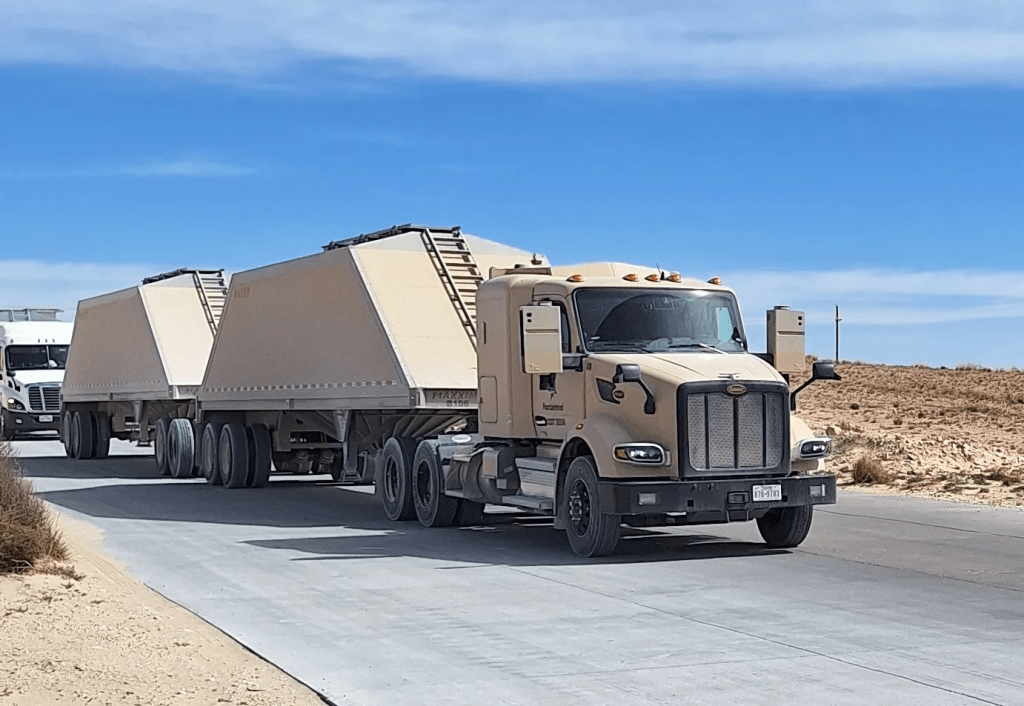
Bloomberg columnist Thomas Black recently traveled to the Permian Basin to observe Kodiak’s autonomous trucks hauling sand for Atlas Energy Solutions. He came away with a really deep understanding and a great write-up of the early stages of autonomous trucking.
Kodiak is operating 28 driverless trucks to haul sand, and the startup, which began trading publicly in September, is under contract to deliver an additional 72 to Atlas…The trucks pick up the sand at the end of a $400 million, 42-mile conveyor belt — aptly named the Dune Express — that Atlas built to ship sand from the mine to a staging area deep in the oil patch, allowing the company to bypass several crowded public roads.
He also nods toward the Dune Express, Atlas’s massive conveyor belt.
Although many people think of chatbots when it comes to artificial intelligence, the conveyor belt, like its cousin the driverless truck, has the components of physical AI. Sand whirls along on a belt with almost 69,000 rollers that have sensors that monitor speed, vibration and other variables and flag the need for preventative maintenance. Another sensor detects any tear of steel cables in the belt. A slew of cameras and fiber optic cable allow the conveyor to be monitored remotely.
The Permian Basin is tough to reach – you have to fly to Dallas or another southwestern hub city, and then catch a connecting flight, and then drive an hour or two. Not a lot of people have gotten out there to see what’s going on. Kudos to Thomas Black for putting in the legwork.

