When Jack Dorsey first conceived of the payments company Square, he realize that the smartphone was, in fact, a supercomputer. That computing power obviated the need for cash registers.
I wonder if something similar will happen with self-driving cars.
For the moment, the focus of self-driving cars is on powerful computational devices, sometimes liquid-cooled, in the trunk of a car. This is especially important for GPU-based systems, which are the backbone of deep learning.
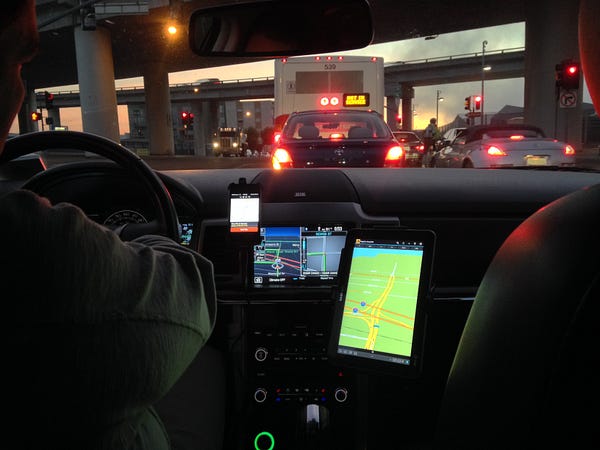
But what if we can get the computational needs of a car to run on a smartphone? Or an array of smartphones?
The video capability is there. The accelerometer is there. Can we streamline the computations to the point that the compute power is there?
That would truly enable self-driving cars for the masses.
Internet pioneer and robocar afficionado Brad Templeton has a post up questioning whether self-driving cars will increase or decrease auto manufacturing.
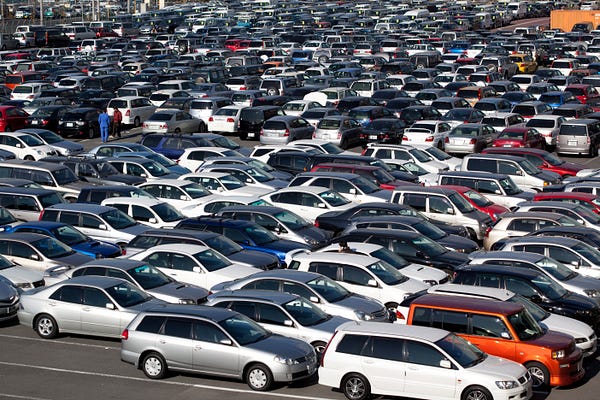
The conventional wisdom is that self-driving cars will decrease the number of cars produced, because we can share cars, instead of purchasing lots of cars and then leaving them parked most of the time.
Templeton makes the excellent point that there the total volume of cars produced will be equal to:
Total Vehicle Miles per Year / Average Vehicle Lifetime in Miles
Both the numerator and the denominator are likely to change as we shift toward self-driving cars.
Total Miles will increase as people opt to ride in self-driving cars instead of fly, walk, bike, or stay put.
Average Lifetime is harder to predict, since some factors will drive lower lifetimes and others will drive higher lifetimes.
Of the factors above, sharing rides and making longer-lived cars could reduce the number of cars needed, and the reduction in car cost reduces the total the world spends on cars (as well as the energy required to build them.) Perhaps those factors might counter the additional travel and the empty miles.
One factor will overwhelm all of this, however. Cheap robotaxi service under 50 cents/mile will suddenly make personal car transportation economically accessible. Drop to 30 cents/mile or even 10 cents/mile in poorer economies, and we’re talking vastly more accessible to billions of new people. The market may already be mostly saturated in the United States which has vast car ownership, but the global average is about 15%. It’s going to grow, and by a lot. The car industry is facing a boom, not a bust from this technology.
This may sound like a nightmare to those who blame private cars for many of our environmental and urban woes. Fortunately the picture is not quite the same with these cars which are far more likely to be efficient, low-emitting and sustainable, indeed more sustainable than the transit systems we use today. (Indeed, they could be combined with a new vision of even more sustainable transit during peak times.)
The entire post is difficult to excerpt and covers a number of interesting points. Read the whole thing.
This is an interesting approach that has some distinct advantages and disadvantages.
The advantages include a target user base of young, tech-savy passengers, a clear geo-fenced area, and slow speeds.
The disadvantages include pricing, volume, and mapping (I’m assuming college campuses are not as well mapped as roads, and suffer from more obscure desire paths).
The company is currently touring college campuses in California, and it’s worth keeping an eye on.
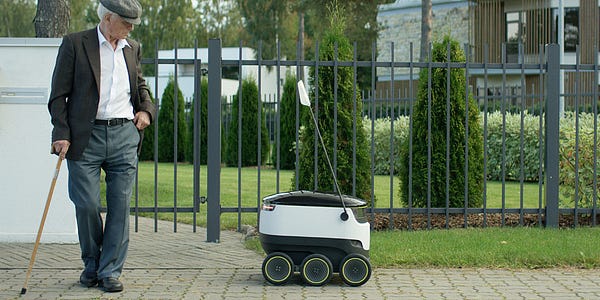
The interesting thing about Starship Technologies is that they are designing a relatively small autonomous vehicle designed for delivering small packages, instead of a full-fledge self-driving car.
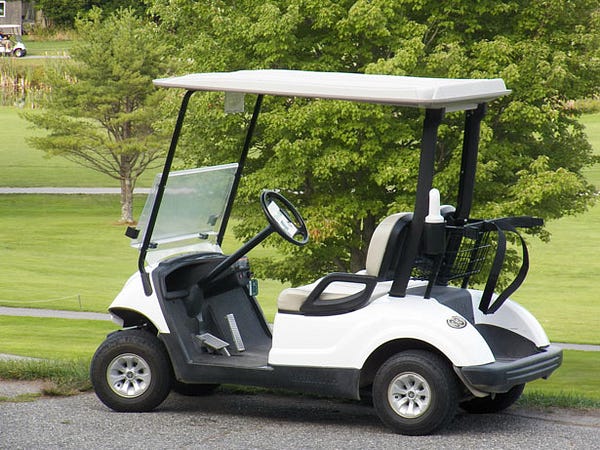
Although self-driving cars get most of the press, a lot of autonomous robotics work is being done with other types of robots. Some are designed to work on factory floors, others are designed to run on specified bus routes, others are designed to deliver packages.
Our current conception of a vehicle is largely one of an all-purpose transportation system, because: a) all vehicles need human drivers, and b) it is difficult to switch vehicles on an as-needed basis.
What I am seeing is that technology is rendering both of those constraints obsolete. So it makes sense that we will start to see much more customized vehicles, and also vehicles that we never would have imagined in our more constrained environment.
A team from MIT has proposed a system for removing stoplights from intersections. By using wireless connectivity between cars, intersections can advise drivers — human or computer — to adjust their speed an enter the intersection at exactly the right time.
This seems like an example of why path-dependence matters and how human drivers and computer drivers might need or at least want different infrastructure.
It would be awesome for computerized drivers, or at least human drivers in networked cars, to be able to travel through intersections without stoplights. But there are hundreds of millions of non-networked vehicles in the world, and they’ll be with us for a long time.
So the real challenge isn’t even building intersections that work without streetlights. It’s building intersections that work with both networked and non-networked cars.
That seems unbelievably large, especially with the technology of self-driving cars so uncertain.
The news reports do make the point, however, that one of Uber’s biggest current problems is its drivers. Computer drivers don’t kill passengers, kidnap passengers, or stage protests.
A company called Sidewalk Labs, which is reported to have “spun off from Google”, has announced a platform to help city managers and traffic planners deal with the driverless car revolution.
It’s all pretty abstract right now, because their platform isn’t actually in use yet, but the federal DoT will be announcing grants to cities and the Sidewalk Labs platform will come along with the grant.
So far this sounds like a “not a big deal yet, but keep it in the back of my mind” kind of program. I wish them success.
But what really got me thinking is whether the driverless car revolution will require traffic planning, or whether planners will really even be able to control it.
Backlash is already growing against apps like Waze, which route human drivers through residential neighborhoods to avoid highway traffic. In spite of the backlash, I assume that only a small percentage of drivers are actually even capable of pulling this off.
But once the computer is driving the car, the road network will be utilized to maximum efficiency, even if that’s unpleasant for people living on now-quiet residential streets.
In the future, will planners be able to funnel self-driving cars onto the desired thoroughfares, or will the computers always be ten steps ahead?
And Google is at least taking the idea seriously enough to send a representative up to talk with state officials.
Inclement weather is one of the biggest challenges facing autonomous vehicles, and Alaska is a good place to find and test against inclement weather.
This story is of particular interest to me because I was born in Alaska and have strong family ties to the state. It would be super-cool if this came to fruition.
Baidu has announced a plan to test autonomous cars in the United States, and to build commercially viable cars by 2016, according to The Verge.
The Verge notes that Baidu previously announced a partnership with BMW to launch a car by 2016, and that plan did not bear fruit. So, caveat emptor.
The current plan is interesting however, because Baidu’s chief scientist, Andrew Ng, is on-record as stating that self-driving cars are not yet technically feasible. Ng, by contrast, has favored self-driving buses on well-defined and limited routes.
One of the elements of the self-driving car industry that fascinates me is the interplay of cooperation and competition between companies.
Google is the most interesting company in this regard, because Google is so large that it touches many different elements of other businesses.
For example, Google Ventures has invested money in Uber, Google Maps supplies Uber, [Google] Android is Uber’s largest platform, and yet [Google] X is building self-driving cars that might compete with Uber.
In some countries, searching for a route from one destination to another now prompts Google Maps to provide information about Uber and about competitive ride-sharing services.
Interestingly, the US is not in that list of “some countries”. Google Maps does not promote Lyft in the US, only Uber. So far.






 David Silver