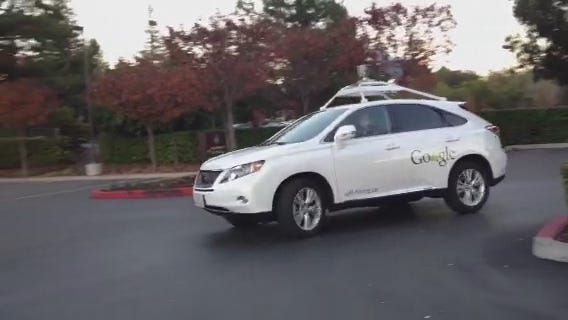
Academia and Autonomous Vehicles

The development of self-driving cars is one of the great stories for academic engineering departments of the last twenty years. While the cutting-edge of software development and research has moved to open-source and commercial projects, robotics is an area where university researchers have made huge contributions, arguably the dominant contributions.

It feels like that dynamic has changed, though, as more and more companies pour resources into autonomous driving technology. Universities can’t keep up.

A headline crossed my inbox this morning, “CAMBRIDGE WIZ TECHS HAVE DEVELOPED NEW GIZMOS FOR AUTONOMOUS VEHICLES“.

It’s telling that my first though was, “this probably isn’t relevant”. As great as the Cambridge technology is, and it may be more cutting-edge than anything any commercial vendors are doing, it must be so far from commercialization.

Elon Musk recently made the point that getting an autonomous vehicle to work for one team is a whole different animal than getting it to work in the wild, with millions of customers. He wasn’t talking about academic labs at the time, but he probably could have been.


Originally published at www.davidincalifornia.com on December 23, 2015.

Google and Ford

Google and Ford are going to build self-driving cars together!

Or so say several unnamed sources.

The news is apparently leaking in advance of the Consumer Electronics Show in January, where the announcement will be made official.

Ford has been building out its own city — MCity — to test self-driving cars, so they are an obvious choice for Google.

It will be interesting to see whether Ford manages to lock up Google’s software — similar to the way AT&T locked up the iPhone for several years after launch — or whether Ford is merely one of many partners with whom Google works.


Originally published at www.davidincalifornia.com on December 22, 2015.

The Magic of Uber

Last weekend, my wife and I returned home to the Bay Area after a weekend getaway to New Mexico.

Because of flight schedules, we landed at Oakland International Airport, even though our home is on the Peninsula, and much closer to SFO.

In the past, our arrival at Oakland would have necessitated a long trek back home on public transportation — airport monorail to the BART system, BART system all the way around the Bay to Millbrae, and a cab home from Millbrae.

That trip costs ~$30 for two people and takes probably 75 minutes. The transfers all involve lugging backs around train terminals.

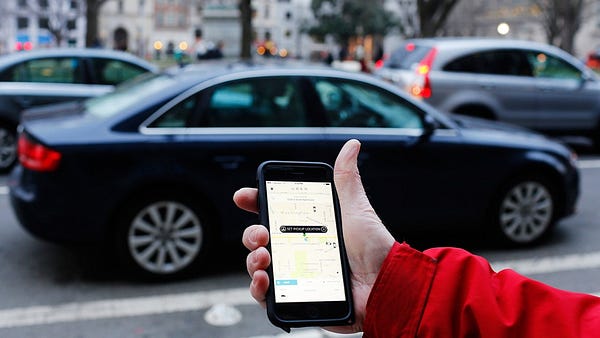
This weekend, however, we hailed an Uber at the airport drop-off lane, and it took us home for $42 (including tolls~).

The Uber trip took us half the time, felt five times as comfortable, and was only $10 more expensive.

Small victories, but the world is changing for the better.


Originally published at www.davidincalifornia.com on December 21, 2015.

Ride-Sharing

Yesterday, I had a frustrating experience with a ride-sharing service, which highlights one of the problems not yet overcome.

I live in the suburbs, albeit in a fairly dense part of the suburbs and near the airport, so it’s a little hit or miss how long it will take to catch a ride with a ridesharing service.

Yesterday afternoon I had an important meeting in the city, so I hailed my ride about twenty minutes before I needed to.

Unhappily, my ride to 25 minutes to show up. And guess what? I arrived to my important meeting 5 minutes late.

In retrospect, I should have just cancelled the ride and hopped in my car. Even more unhappily for me, however, the ride sharing service and I were both wrong about that 25 minute pick-up delay. On the map it looked like the driver was 5 minutes away, and the ride-sharing service was 5 minutes away. The map was not yet accounting for a recent accident, however.

So the big problem here is that waiting for a ride in the suburbs is still a little dicier than just hopping in your own car. In the cities, you would think this problem has been solved, but I’m not sure that’s true either.

On the way home from my important meeting, I had a long wait for my ride, while one driver cancelled the trip and another one had to do some navigational contortions to get to the correct side of the street.

These problems seem solvable, perhaps just by offering more money to be retrieved sooner, but the system isn’t quite there yet. And that’s a reason to keep owning a car, at least for now.


Originally published at www.davidincalifornia.com on December 19, 2015.

Garage Start-Up

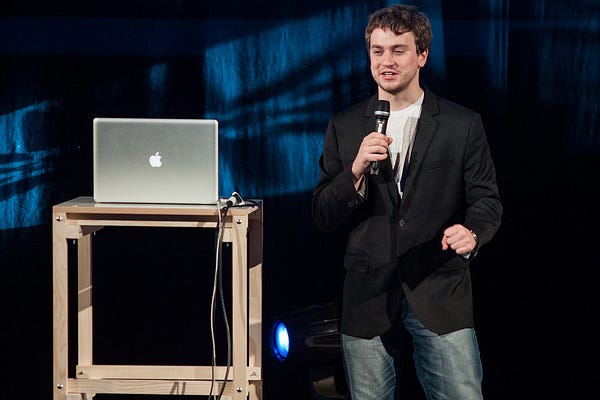
The Internet is a-twitter with the news that George Hotz has built his own self-driving car and claims he will unseat MobilEye as the supplier of autonomous driving technology.

Elon Musk makes the important point that getting self-driving technology to work 99% of the time is much different than getting self-driving cars to work 99.99999% of the time.

Nonetheless, this seems pretty impressive. I don’t think I’d be worried if I were MobilEye or Tesla, but I am impressed by George Hotz.


Originally published at www.davidincalifornia.com on December 18, 2015.

California DMV Updates Rules

California’s Department of Motor Vehicles has just posted its new rules for self-driving cars, and they are decidedly a win for Tesla and a loss for Google.

Google is not happy.

The rules state that a licensed driver must be at the wheel of a self-driving car in California at all times.

This is a fail for Google in a few ways.

One, Google’s goal is to transform mobility for millions of people who cannot become licensed drivers — the disabled, the young, the old. Requiring at least one autonomous vehicle passenger to also be a licensed driver completely defeats that goal.

Two, Google’s strategy is to bypass the phase of autonomous vehicle development in which the car must be able to pass control to the driver. That phase is tricky, and by taking all driving control away from the humans in the car, Google simplified its needs. Now the California DMV is forcing Google to tackle this specific problem.

Three, Tesla has been working on this human-machine interaction model for a long time, so it has a big head start over Google.

That said, Google has a lot of money, and thus a lot of political muscle. I don’t consider this to be the final word on self-driving regulations.


Originally published at www.davidincalifornia.com on December 17, 2015.

Baidu Self-Driving Cars

Baidu is entering the self-driving car race, although it is setting a more basic goal for itself and is hopes to reach that goal more quickly.

While many top self-driving car companies are targeting a 2020 launch date, Baidu is targeting 2018 for “vehicles that will operate on fixed routes or fixed areas in select cities”.

That seems like a reasonable engineering goal, but of course the question is whether anybody will want that product.

The product sounds an awful lot like a bus, so perhaps Baidu is setting itself up for competition with ride-sharing services like Uber.


Originally published at www.davidincalifornia.com on December 15, 2015.

Wanted: LIDAR Engineer

Business Insider reports that Google is hiring a LIDAR engineer.

Although BI reports this breathlessly as, “Google and parent company Alphabet are not leaving such a key ingredient in someone else’s hands,” it seems a little less earth-shattering than that. To be fair, BI eventually concedes that possibility, as well.

Any large organization that depends on suppliers for key parts is going to have internal specialists in those parts. When I worked at in AOL’s data center, years ago, we had all sorts of routing and switching engineers, despite the fact that AOL never had any desire to build its own routing a switching hardware.

I think the more intriguing, if less newsworthy conclusion here is that Google is gradually looking more and more like it’s going to have a real autonomous vehicle business, and not just a moon-shot lab project.


Originally published at www.davidincalifornia.com on December 14, 2015.

Ice Driving

A big challenge for self-driving cars (and for human drivers) is driving in sub-optimal conditions, especially snow. Everything looks different, the vehicles behave differently, and the mechanical components aren’t as reliable.

That’s part of why most autonomous vehicle testing has taken place in sunny coastal California. Mountain View has 260 sunny days per year, and 0 snowfall.

Of course, not everywhere has weather like Mountain View, and getting cars to work in the snow is important. And to build autonomous vehicles that work in the snow, developers want access to as much snow as possible. It’s unproductive to sit around for weeks on end waiting for snow to fall.

So perhaps it is unsurprising that Audi is planning to build a test track in Deadhorse, Alaska — the very northern end of the US road system.


Originally published at www.davidincalifornia.com on December 11, 2015.