Elon Musk makes the important point that getting self-driving technology to work 99% of the time is much different than getting self-driving cars to work 99.99999% of the time.
Nonetheless, this seems pretty impressive. I don’t think I’d be worried if I were MobilEye or Tesla, but I am impressed by George Hotz.
California’s Department of Motor Vehicles has just posted its new rules for self-driving cars, and they are decidedly a win for Tesla and a loss for Google.
The rules state that a licensed driver must be at the wheel of a self-driving car in California at all times.
This is a fail for Google in a few ways.
One, Google’s goal is to transform mobility for millions of people who cannot become licensed drivers — the disabled, the young, the old. Requiring at least one autonomous vehicle passenger to also be a licensed driver completely defeats that goal.
Two, Google’s strategy is to bypass the phase of autonomous vehicle development in which the car must be able to pass control to the driver. That phase is tricky, and by taking all driving control away from the humans in the car, Google simplified its needs. Now the California DMV is forcing Google to tackle this specific problem.
Three, Tesla has been working on this human-machine interaction model for a long time, so it has a big head start over Google.
That said, Google has a lot of money, and thus a lot of political muscle. I don’t consider this to be the final word on self-driving regulations.
News has begun to leak that Google plans to make self-driving cars a stand-alone unit within Alphabet.
These seems logical and inevitable, and yet it’s not actually clear what this means from a practical perspective. Perhaps the division will eventually have to fund itself, instead of relying on funds from Google search.
Baidu is entering the self-driving car race, although it is setting a more basic goal for itself and is hopes to reach that goal more quickly.
While many top self-driving car companies are targeting a 2020 launch date, Baidu is targeting 2018 for “vehicles that will operate on fixed routes or fixed areas in select cities”.
That seems like a reasonable engineering goal, but of course the question is whether anybody will want that product.
The product sounds an awful lot like a bus, so perhaps Baidu is setting itself up for competition with ride-sharing services like Uber.
Although BI reports this breathlessly as, “Google and parent company Alphabet are not leaving such a key ingredient in someone else’s hands,” it seems a little less earth-shattering than that. To be fair, BI eventually concedes that possibility, as well.
Any large organization that depends on suppliers for key parts is going to have internal specialists in those parts. When I worked at in AOL’s data center, years ago, we had all sorts of routing and switching engineers, despite the fact that AOL never had any desire to build its own routing a switching hardware.
I think the more intriguing, if less newsworthy conclusion here is that Google is gradually looking more and more like it’s going to have a real autonomous vehicle business, and not just a moon-shot lab project.
A big challenge for self-driving cars (and for human drivers) is driving in sub-optimal conditions, especially snow. Everything looks different, the vehicles behave differently, and the mechanical components aren’t as reliable.
That’s part of why most autonomous vehicle testing has taken place in sunny coastal California. Mountain View has 260 sunny days per year, and 0 snowfall.
Of course, not everywhere has weather like Mountain View, and getting cars to work in the snow is important. And to build autonomous vehicles that work in the snow, developers want access to as much snow as possible. It’s unproductive to sit around for weeks on end waiting for snow to fall.
A Florida woman was recently reported to the authorities for a hit-and-run. The twist is that it was her own car that reported her.
The Ford car was outfitted with a program to automatically dial police in the event of an accident (the driver’s airbag deployed).
While this story has some bizarre twists to it — the driver committed the hit-and-run while fleeing a different, earlier accident — it’s representative of the world to come.
We’re used to thinking of computers as dumb machines that do what we want them to do. They’re turning into smarter machines that do what somebody else programmed them to do.
Generally speaking, that’s a good thing, but we’ll increasingly notice these kinds of principal-agent problems.
Cars will increasingly resemble mobile apartments, he said, and service stations along highways will evolve to support them, offering drivers facilities for washing, dining and shopping.
Hotels would change in response, Schuwirth added, with drivers using their facilities but returning to their cars to sleep. “Why should a hotel look like a hotel today?” he [Audi executive Sven Schuwirth] said.
An element of this is certainly true — some travelers will occasionally sleep in their cars. But I suspect this will be more like the way some travelers now sleep on red-eye plane flights. It happens, but it’s not that common (as a percentage of total nights spent on trips), and nobody likes it.
This does raise an interesting question about the ride-sharing industry, though. How much more specialized will vehicles become in the future?
In a world where people simply order up a ride, it’s possible to imagine specialty “overnight” vehicles that have beds instead of seats. And single-passenger pods. And a much wider range of delivery vehicle shapes.
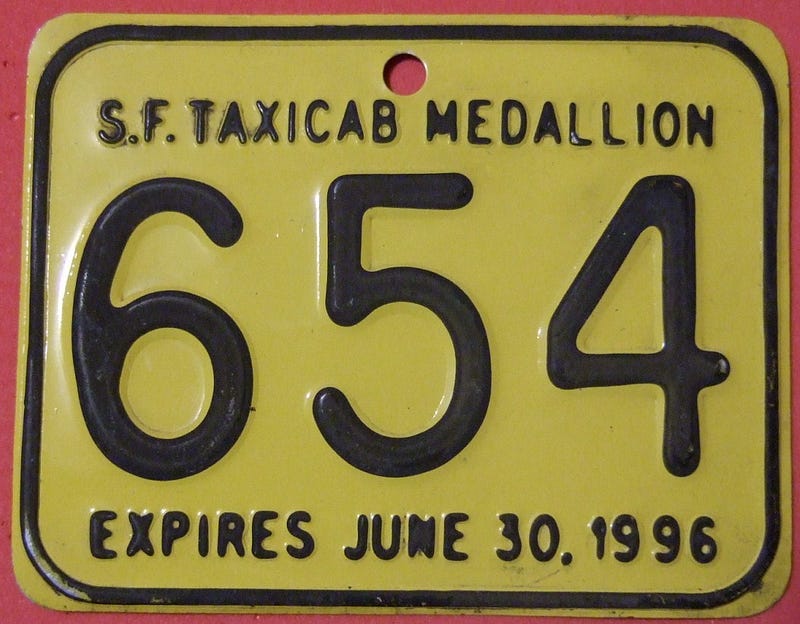
Other medallion lenders that have acknowledged being blindsided by the rapid rise of San Francisco-based Uber in New York City include Valley National Bank of Wayne, which said it is “closely monitoring” a $159 million portfolio of medallion loans; New York City-based Signature Bank, which added $2.4 million to its loan-loss reserve in the third quarter, partly due to concerns about its $600 million medallion loan portfolio; and Citibank, which is suing a New York City taxi mogul over alleged defaults on medallion loans.
This of course is due to Uber’s defeat of occupational licensing, not autonomous vehicles. But I think these lenders are an interesting example of the first- and second-derivative business that collapse when an industry gets disrupted.
What will the autonomous vehicle corollaries be? Auto insurance? Auto lending? Auto repair? Fast food might be an interesting example, if autonomous driving changes the cost/benefit economics of drive-through windows.