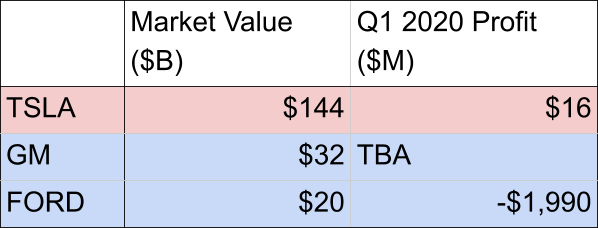
Tesla’s Q1 2020 earnings call was Wednesday. By all accounts, the company crushed it. They turned a $16 million profit, which Car and Driver marks as the first time the company has ever turned a profit in Q1.
The Tesla roller coaster ride has been and up and down for years. The nadir was perhaps when short-sellers baited Elon Musk into tweeting that he would take the company private. That tweet violated all sorts of SEC guidelines and was a bit of a PR disaster. Around the same time, the company periodically came within months or even weeks of bankruptcy.
Flash forward a few years and today Tesla is back on top as the America’s most valuable (and most profitable) care company.
Keep in mind, of course, that by just about any other metric — revenue, units, employees — GM and Ford are an orders of magnitude bigger than Tesla.
But Wall Street seems to think Tesla’s small profit in the present is a prelude to much bigger profits in the future.
I have a three year-old boy who, like most three year-old boys everywhere, is in love with construction equipment. He’ll watch construction sites for hours. He can’t even put on his own socks, but he can distinguish between a dozer, a digger, a front-loader, a crane, and a backhoe.
I stumbled across this writeup of Built Robotics, a San Francisco-based construction equipment maker. Their homepage features a rotating model (I think it’s a model?) of an autonomous dozer. I have to get one of those for my kid.
It’s interesting that their autonomous dozers feature cabs, although the video on their website shows an operator on foot controlling driver-less equipment via iPad.
Back when I worked at Ford, one of the points that my manager liked to emphasize was that Ford makes cars for the masses.
Although he never made a specific comparison to Tesla, it wasn’t too hard to imagine the connection. Ford, the company of the Model T and the $5 Day, isn’t on earth to make high-end cars for Silicon Valley millionaires. Ford’s purpose in this world is to make terrific, affordable cars for everyone.
It makes perfect sense that the company’s recent announcement of the Mustang Mach-E — an electric SUV — is priced at less than half of Tesla’s Model X. Ford makes cars for the masses.
And frankly, it looks like a pretty awesome car for the masses.
Recently, Waymo rolled out fully driverless vehicles to pre-approved riders living in suburban Arizona. Ed Niedermeyer has a great article (and video) in TechCrunch.
My former boss, and Voyage CEO, Oliver Cameron is a bit astounded that this event has passed with barely a ripple in the news cycle, as am I.
The lack of attention is, in some ways, a good thing.
Suburban Arizona residents haven’t gotten upset, there’s been relatively little news to make of the whole event, and so far none of the riders (who are under NDA) have found a reason to make a big deal over this.
One of questions Niedermeyer ponders is what threshold Waymo crossed that finally allowed for driverless vehicles, albeit in a tightly geofenced area.
“Waymo’s decision to put me in a fully driverless car on public roads anywhere speaks to the confidence it puts in its ‘driver,’ but the company wasn’t able to point to one specific source of that confidence….
‘Autonomous driving is complex enough not to rely on a singular metric,’ Panigrahi said.
It’s a sensible, albeit frustrating, argument, given that the most significant open question hanging over the autonomous drive space is ‘how safe is safe enough?’”
I’m not so sure I agree with Niedermeyer that the argument is “sensible”. Waymo’s response to the key question of what makes its vehicles safe enough to be driverless is, essentially, “trust us”.
And so far that works, at least for Waymo, which has done virtually everything right and caused no significant injuries, much less fatalities, in its ten years of existence.
Were Waymo to continue that trend indefinitely into the future, “trust us”, would continue to suffice.
Presumably, though, as Waymo ramps up miles and riders, collisions and injuries will happen. At that point, “trust us” probably won’t seem so sensible.
But all of that is in a hypothetical future. For now, I think it’s okay to celebrate and revel in what humanity is accomplishing.
We hear from a lot of Udacity students about their experiences in our programs — the good and the bad. Both positive and negative feedback are valuable, and it’s always nice to hear when we’ve done a good job.
I will present Teaching Autonomous Driving at Massive Scale at 9am on Sunday, October 27. WEinADT (as it is called) is part of the larger IEEE Intelligent Systems Transportation Conference.
Professor Alexander Carballo has done terrific work organizing the workshop and I am lucky to be a part of the agenda!
This will be my first time visiting New Zealand, and I am super-excited to participate in WEinADT and ITSC. If you’re going to be at ITSC, please swing by my presentation at 9am on Sunday to say hello!
If you happen to be in New Zealand, even if you won’t be attending ITSC, send me (david.silver@udacity.com) an email! I’d be delighted to meet some friendly faces in Auckland.
Reilly Brennan, a venture capitalist at Trucks.VC and one of the movers and shakers in the world of autonomous vehicles (seriously, look at that investment portfolio!), has a short post critiquing the naming regulations for advanced driver assistance systems.
“We’re probably using [driver assistance systems] the wrong way and I believe a significant contributor to that problem is the branding and marketing of these systems.”
In particular, Reilly points out that USDA food labeling standards are much more stringent than labeling standards for driver assistance systems, which don’t even really exist.
“But if you want to brand your car’s systems as Auto-magic-pilot-drive-yourself, there is little today that the US Department of Transportation or Federal Trade Commission will do to prevent you.”
He doesn’t quite prescribe a solution, but calls for “equal attention” between food labeling and vehicle systems, particularly because vehicle systems can kill other people on the road besides just the customer of the system.
I’m genuinely uncertain how to handle this myself, and the post is worth a read and a ponder.
On a recent episode of MergeNow, Ed Niedermeyer interviewed Jon Mullen of RightHook, an autonomous vehicle simulation startup. I worked with Jon at Ford, so I was particularly interested.
Jon was on the show describing ScenarioScript, “an open format scenario-describing language.” Think of ScenarioScript as a format for describing traffic scenarios for autonomous vehicles, including variables like weather, road dimensions, and other relevant parameters.
Early in the show, Ed asked Jon if the release of ScenarioScript is an attempt to move everyone onto RightHook’s ecosystem. Jon said that was not the case, and it’s worth listening yourself to hear why and decide whether you believe that.
What struck me, though, was the question of whether and why it ever would be remunerative for a company to move the world onto its chosen open-source ecosystem.
The best example I can think of this is Bell Labs, where Unix, C, and C++ were invented, along with lots of other things. Bell Labs seems to me to be understudied — the Wikipedia section on Nobel Prizes and Turing Awards is tremendous and must outstrip any other non-university in the world, certainly any for-profit entity.
But it’s less clear how much Bell (later AT&T, and now Nokia) benefited from these inventions. At the very least, the through-line from open-source creation to corporate profit requires some thinking.
Another, smaller, example is Willow Garage, the technology incubator that at one time maintained ROS, OpenCV, and PCL. All of those projects have been critical for self-driving car development, and robotics more generally. But Willow Garage dissolved as an entity in 2014.
The list could keep going. The success of Java was, at least, insufficient to prop up SUN. JavaScript didn’t save Netscape, or its eventual acquirer, AOL.
Perhaps the most prominent counterexample is Android, which has made Google lots of money (I think) via Google Play commissions on apps.
Other companies are centered around developing hosting and services for a particular open-source project. MongoDB Inc. does this for MongoDB, Elastic does this for Elasticsearch, and Databricks does this for Apache Spark. All of these companies have been quite successful, but in the long run, Amazon Web Services and other cloud providers look like real threats.
Looking over this list, I actually think the invention of JavaScript at Netscape is the most instructive. JavaScript was transformational for the browser industry, and the Internet generally. But the open-source nature of the tool may have limited the value that Netscape specifically was able to capture.
A similar case might pertain to Unix, C, and C++ at Bell Labs.
These tools were a tremendous benefit to the entire industry, and perhaps helped Netscape and Bell at the expense of alternative (TV and postal mail, respectively?). However, the benefit accrued to the entire industry, not only to the company that invented to the technology.
To bring this full circle, if you go back and listen to Jon Mullen’s rationale for open-sourcing ScenarioScript, that’s what he says 😉
Dan Primack has been writing about the stumbles of VC-backed companies that have grown tremendously but struggle with unit economics. WeWork is the poster child of the moment, but per Primack:
“There are dozens, if not hundreds, of other mature startups caught with their income statements down.”
While he’s not quite willing to come out and make a bold prediction, he hints that maybe, possibly, things might be tough for certain types of startups:
“For companies with reasonable controls and paths to profitability, all systems remain go….But for unicorns that never looked beyond the trough, it could be slaughter season.”
Where I think this intersects with autonomous vehicles is that so many AV startups have raised huge amounts of money without a clear path to revenue, much less profitability.
This aligns with another trend, which is the increasingly common belief that the deployment of driverless (i.e. no safety operator) Level 4 vehicles is going to take a while.
“We expect to see small-scale deployments of self-driving vehicles in the next five years, and then see the technology phase in over the next 30 to 50 years.”
Autonomous vehicles have tremendous capital requirements, which have thus far been financed either by automotive companies or VC firms. This has, in some cases, been spectacularly successful for early investors.
But if the funding well dries up, and we’re looking at 30 to 50 years until meaningful deployment, there’s going to be a push for revenue in the near term.
I’m interested to watch those revenue sources emerge.
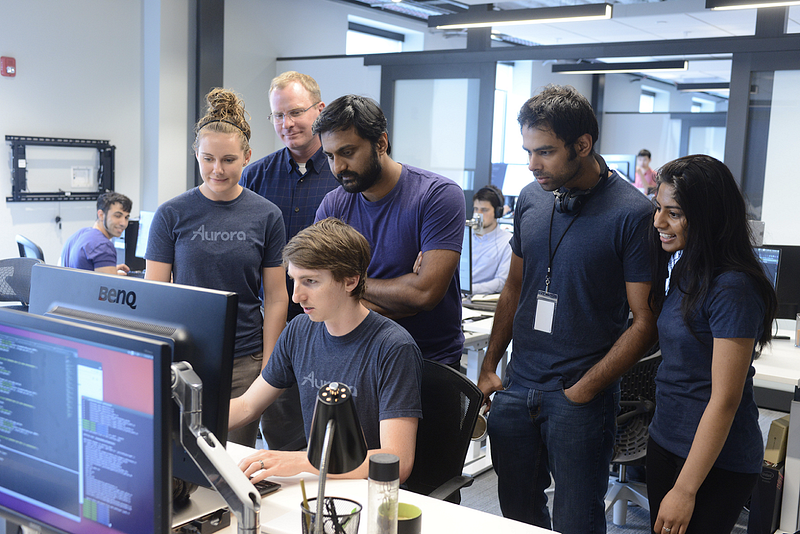
Aurora founder and CEO Chris Urmson is one of the most experienced and most respected self-driving car engineers in the world. His team authored a safety report earlier this year: “The New Era of Mobility.”
Safety culture, in particular, is a critical input to safe autonomous vehicles, and one that is easy to overlook. Aurora’s focus on this is reassuring.
I would love to see more detail around metrics. Urmson states,
“At Aurora, we’ve made a commitment: We won’t deploy our self-driving vehicles on public roads without human safety drivers until our technology is safer than a human driver. Which begs the question, what does safer than a human driver actually mean?”
A few sentences later, he seems to concede that Aurora hasn’t yet zeroed in on a meaning: “we continue to focus on identifying these metrics.”
Earlier in the post, Urmson reveals:
“We resist the urge to put more and more cars on the road in an effort to ramp up on-road miles. Instead, we use on-road testing to validate our virtual tests.”
This seems in tension with the commitment to ensure super-human safety prior to deployment. In order to truly validate that Aurora’s technology is “safer than a human”, it seems like that technology is eventually going to have to go on the road in a big way.
The search for coherent AV safety standards continues.
And it might take a while:
“We expect to see small-scale deployments of self-driving vehicles in the next five years, and then see the technology phase in over the next 30 to 50 years.”