GM and Lyft seem to be heading toward a reckoning, similar to what Google and Uber are experiencing. Minus the allegations of intellectual property theft, at least so far.
Reuters has an article (written by Paul Lienert, a reader of this blog) highlighting the tension between GM’s growing presence in the ridesharing space, on the one hand, and on the other hand GM’s partial ownership, of and partnerships with, Lyft.
On the one hand, GM has invested heavily in Lyft, and holds a 9% ownership stake. GM also benefits from Lyft Express Drive, a Lyft program that leases GM vehicles to Lyft drivers.
On the other hand, GM is launching and expanding a number of programs that are competitive to Lyft.
“Maven can provide GM vehicles directly to ride-sharing drivers who previously leased them through Lyft Express Drive and Uber Vehicle Solutions.”
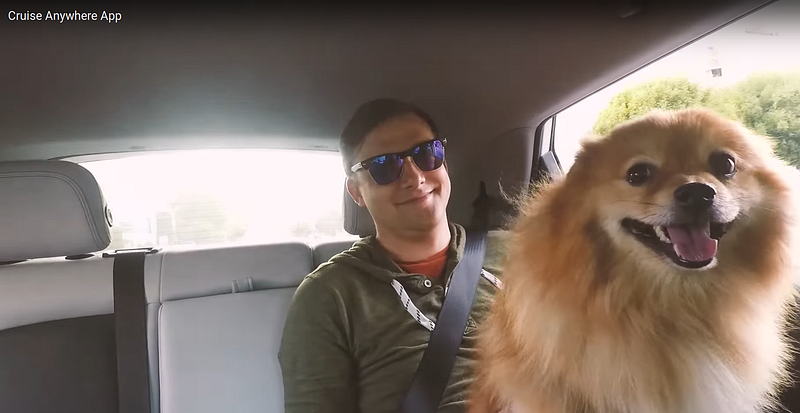
Similarly, GM’s Cruise subsidiary is beta testing a service called Cruise Anywhere that seems poised to use self-driving cars compete directly with Lyft’s core on-demand transportation service.
Partnerships are tricky, especially because companies’ interests and plans can diverge over time. Scott McNealy famously tweeted:
Most over used phrase in business is "strategic partner". Favorite partnership for me is a purchase order. Defined charter, beginning, end.
Ronald Coase won a Nobel Prize in part for theorizing about how ownership affects outcomes. Right now we’re seeing lots of self-driving car companies form partnerships, but I suspect in the future we’ll see many more outright acquisitions. Owning a company, instead of partnering with it, and can help align everyone’s interests.
I am, of course, very proud of the Self-Driving Car Engineer Nanodegree Program we have built at Udacity, which teaches software engineers to become autonomous vehicle engineers. You should enroll!
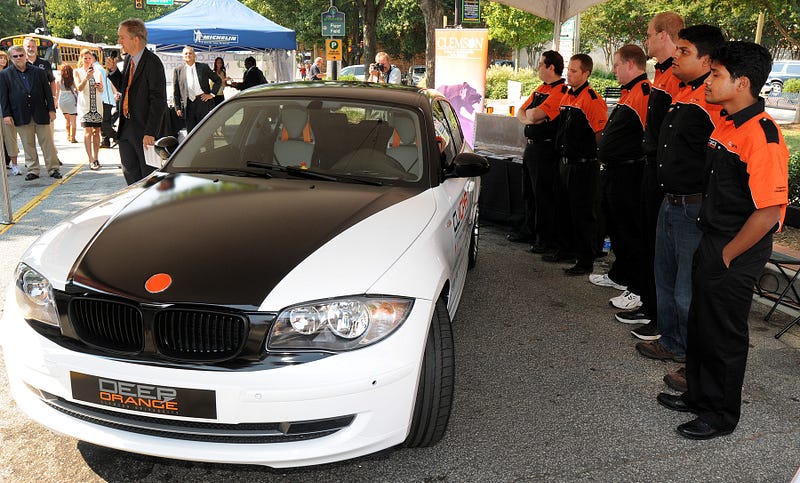
CU-ICAR, as they style themselves, is a graduate school about 40 minutes up the road from the main Clemson campus, and it offers master’s and doctoral degrees in automotive engineering across a number of different specialties.
The 250 acre campus in Greenville, South Carolina, is located nearby BMW’s US manufacturing center in Spartanburg, SC, and is a great example of the type of industry-educational partnerships we engage in at Udacity.
I know very little about the Clemson program directly, and I’ve never been to Greenville, but I keep running into their graduates on autonomous vehicle teams at some of our largest hiring partners, so I thought I’d mention them.
I’ve also run into a few Clemson students who are taking the Self-Driving Car Nanodegree Program, so of course that makes me happy 🙂
Are you trying to decide which Udacity Nanodegree Program you should enroll in? Here’s an all-in-one guide to help you determine which program is best for you.
Partner:Google Lead Instructors:Katherine Kuan, Chris Lei Difficulty:Beginner Time:6 months Syllabus:User Interface + User Input + Multiscreen Apps + Networking + Data Storage Prerequisites: None! Cost: $199 / month Best For:Aspiring Android Developers with no programming experience.
Partner:Google Lead Instructor:James Williams, Reto Meier Difficulty: Intermediate Time: 8 months Syllabus: Developing Android Apps + Advanced Android App Development + Gradle for Android and Java + Material Design for Android Developers + Capstone Project Prerequisites: Java, git, GitHub Cost: $999 upfront OR $199/month Best For:Intermediate programmers who want to become Android specialists.
Partners:IBM Watson, Amazon Alexa, DiDi Chuxing, Affectiva Lead Instructor:Sebastian Thrun, Peter Norvig Difficulty: Advanced Time: 6 months Syllabus: Foundations of AI + Deep Learning and Applications + Computer Vision + Natural Language Processing + Voice User Interfaces Prerequisites: Python, basic linear algebra, calculus, and probability Cost: $1600 Best For:Engineers who want to apply AI tools across an array of domains, from computer vision to natural language processing to voice interfaces.
Partners:AT&T, Lyft, Google Difficulty: Intermediate Time: 6 months Syllabus: UIKit Fundamentals + iOS Networking with Swift + iOS Persistence and Core Data + How to Make an iOS App Prerequisites: macOS 10.12 or OS X 10.11.5 Cost: $199 / month Best For:Beginners who want to launch their iOS developer careers.
Partners:Alteryx, Tableau Lead Instructor:Patrick Nussbaumer Difficulty: Intermediate Time: 160 hours Syllabus: Problem Solving with Advanced Analytics + Creating an Analytical Dataset + Segmentation and Clustering + Data Visualization in Tableau + Classification Models + A/B Testing for Business Analysts + Time Series Forecasting Prerequisites: Basic statistics and spreadsheet skills, a Windows computer Cost: $199 / month Best For:Aspiring data analysts who want to launch a career in data-driven decision-making and visualization, as opposed to programming.
Partners: Facebook, Tableau Lead Instructor:Caroline Buckey Difficulty: Intermediate Time: 260 hours Syllabus: Descriptive Statistics + Intro to Data Analysis + Git and GitHub + Data Wrangling + MongoDB + Exploratory Data Analysis + Inferential Statistics + Intro to Machine Learning + Data Visualization in Tableau + Introduction to Python Programming Prerequisites: None! Cost: $199 / month Best For:Aspiring data scientists who want to launch a career in developing software to extract meaning from data.
Lead Instructors: Ian Goodfellow, Andrew Trask, Mat Leonard Difficulty: Intermediate Time: 6 months Syllabus: Introduction + Neural Networks + Convolutional Neural Networks + Recurrent Neural Networks + Generative Adversarial Networks Prerequisites: Python, basic linear algebra and calculus Best For:Students excited by the potential for deep learning to change the world, and who additionally wish to earn guaranteed entry into Udacity’s Artificial Intelligence, Robotics, or Self-Driving Car Engineer Nanodegree Programs (a special “perk” of the program for graduates!).
Digital Marketing
Partners: Facebook, Google, Hootsuite, HubSpot, MailChimp, Moz Lead Instructor:Anke Audenaert Time: 3 months Syllabus: Marketing Fundamentals + Content Strategy + Social Media Marketing + Social Media Advertising through Facebook + Search Engine Optimization (SEO) + Search Engine Marketing with AdWords + Display Advertising + Email Marketing + Measure and Optimize with Google Analytics Prerequisites: None! Best For:Hard workers seeking to launch or advance their digital marketing careers through real-world experience and multi-platform fluency.
Partners: Amazon Web Services, GitHub,AT&T, Google Lead Instructors: Mike Wales, Karl Krueger Difficulty: Intermediate Time: 6 months Syllabus: Programming Foundations with Python + Responsive Web Design Fundamentals + Intro to HTML and CSS + Responsive Images + Intro to Relational Databases + Authentication & Authorization: OAuth + Full Stack Foundations + Intro to AJAX + JavaScript Design Patterns + Configuring Linux Web Servers + Linux Command Line Basics Prerequisites: Python and git Cost: $199 / month Best For:Developers who want to learn to build web applications from end-to-end.
Lead Instructor: Andy Brown Difficulty: Beginner Time: 5 months Syllabus: Learn to Code + Make a Stylish Webpage + Python Programming Foundations + Object-Oriented Programming with Python + Explore Programming Career Options + Experience a Career Path Prerequisites: None! Cost: $399 Best For:Beginners looking for an accessible approach to coding.
Lead Instructors: Michael Jackson, Ryan Florence, Tyler McGinnis Difficulty: Intermediate Time: 4 months Syllabus: React Fundamentals + React & Redux + React Native Prerequisites: HTML, JavaScript, Git Cost: $499 Best For:Front-end engineers who want to master the web’s hottest framework. React is the highest-paid sub-field of web development!
Partners: Bosch, Electric Movement, iRobot, Kuka, Lockheed Martin, MegaBots, Uber ATG, X Lead Instructor: Ryan Keenan Difficulty: Advanced Time: 6 months Syllabus: ROS Essentials, Kinematics, Perception, Controls, Deep Learning for Robotics Prerequisites: Intermediate Python, calculus, linear algebra, and statistics Cost: $2400 Best For:Makers who dream of building machines that impact everything from agriculture to manufacturing to security to healthcare.
Partners: Mercedes-Benz, NVIDIA, Uber ATG Lead Instructor: David Silver (that’s me!) Difficulty: Advanced Time: 9 months Syllabus: Deep Learning + Computer Vision + Sensor Fusion + Localization + Path Planning + Control + System Integration Prerequisites: Intermediate Python, calculus, linear algebra, and statistics Cost: $2400 Best For:Engineers who want to join technology’s hottest field and revolutionize how we live.
Partners: Google VR, Vive, Upload, Unity, Samsung Lead Instructor: Christian Plagemann Difficulty: Advanced Time: 6 months Syllabus: Unity + C# + Google Cardboard + Ergonomics + User Testing + Interface Design + Mobile Performance + High-Immersion Unity + High-Immersion Unreal Prerequisites: None! Cost: $1200 Best For:People who want to build new worlds. VR is the most in-demand skill for freelance developers!
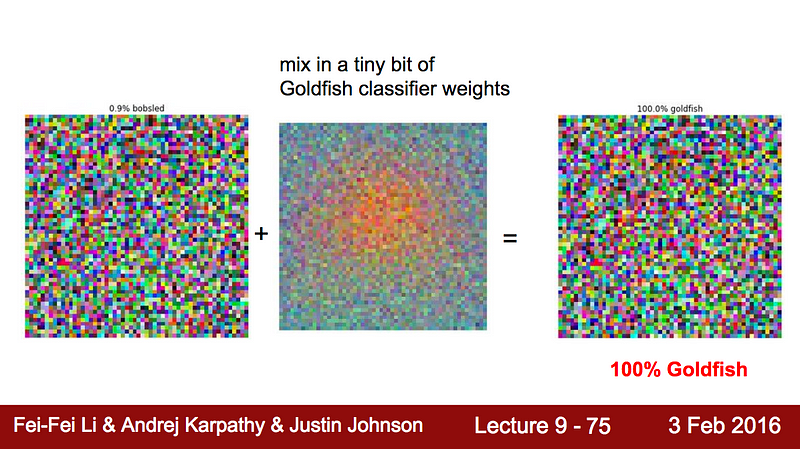
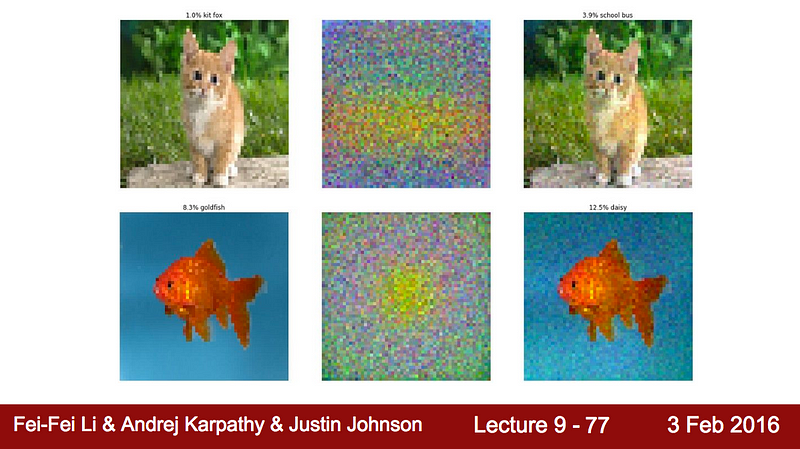
This appears to be an extension of a property of neural networks that was already known, which is that they can be fooled in surprising ways. This is called an “adversarial” attack.
So it’s no shocker that the computer vision systems for cars, which rely largely on CNNs, can be fooled.
But notice that it’s not obvious how to apply Justin Johnson’s examples above to an actual printed photo of a goldfish in the real world. The examples above only really work if you have a digital photo of a goldfish.
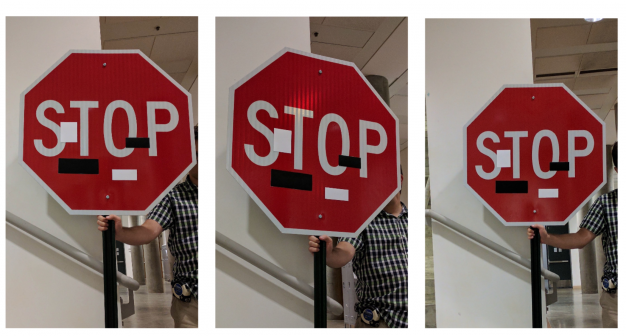
The breakthrough of the Evtimov et al. paper is that they developed an attack algorithm, which they call Robust Physical Perturbations, that allows them to apply this attack to signs in the real world.
So now we are heading down the road of fooling cars into blowing through stop signs. Is the end nigh?
I’m skeptical.
Hackers hardly need to wait until self-driving cars are on the road before they mess with stop signs. It’s easy enough to cause real carnage today just by removing a stop sign. Indeed, this happens already and the people who do it get convicted of manslaughter. (Although note that particular case was overturned on appeal because it wasn’t clear whether the convicts removed the precise stop sign in question, or a different stop sign.)
I don’t see too many hackers messing with street signs, though, presumably because the result is both fleeting and unpredictable, and the cost (jail time) is high.
In fact, self-driving cars seem even less likely than human drivers to be fooled by tampered stop signs. Self-driving cars are likely to have maps and sensors that could override whatever the car’s camera sees.
It’s possible this paper leads to further breakthroughs in adversarial attacks that could cause more problems, but I don’t think this advance by itself is too worrisome.
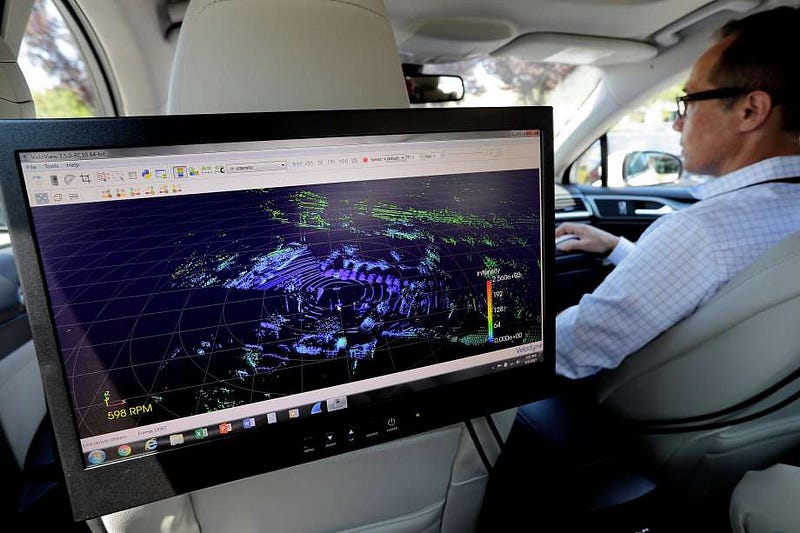
Of all the funny stories in the self-driving car world, surely one of the most improbable is the transformation of Velodyne from a subwoofer manufacturer into the world’s premier lidar supplier.
Lidar, an array of lasers, is the key to tracking and understanding the environment around a vehicle, at least until computers get good enough to do this with a camera.
The San Francisco Chronicle has a short writeup of how Dave Hall transformed his audio company into an autonomous sensor company, and I’d love to read the book-length version. It involves the DARPA Grand Challenge and a tinkerer on “the lunatic fringe”. The story is an old-school inventor’s dream.
For now, though, I’m just grateful for Udacity’s two VLP-16 units and our precious HDL-32E.
3M is developing road signs that have specially printed bar codes for self-driving cars, according to Business Insider. This is a clever entry in the vehicle-to-infrastructure communication field.
Often that’s thought of as infrastructure and vehicles communicating back and forth electronically. But this approach, in which the road signs simply have specially encoded information, is much simpler and presumably cheaper.
The article is light on details of how exactly the barcode is written onto the sign, although supposedly the barcode is invisible to humans. Even without that requirement, though, you could imagine tagging each road sign with a small visible barcode, the same way canned goods have barcodes.
Information on the barcode can include the type of sign, of course, but also the GPS coordinates, which would be super-helpful for localization. Other information, about upcoming waypoints or intersections, could also be valuable.
Pretty simple, but effective, and cheap and easy to roll out.
The latest entrant into the ridesharing world is Cruise, which has alpha-launched Cruise Anywhere, a self-driving ride-sharing service for their San Francisco employees.
The service is available to 10% of Cruise’s employees, and only within San Francisco, making the “Anywhere” portion of the title fairly aspirational.
Nonetheless, I remain impressed by the progress of Cruise, which GM bought for a reported $600MM-$1BB a year and a half ago. Often when big industrial behemoths purchase small Silicon Valley startups, the startup gets sucked into the corporate vortex, the employees flee, and in a few years there’s nothing left.
GM has managed to keep Cruise running like something approximating a startup, and Cruise keeps pushing the envelope, with what I believe are more fully autonomous miles driven than any other automotive manufacturer. If Cruise gets to the point where they are putting actual, non-employee passengers in the car, that will be yet another step forward.
Cruise also released a promotional video highlighting Cruise Anywhere. The best part? Cruise Anywhere is dog-friendly.
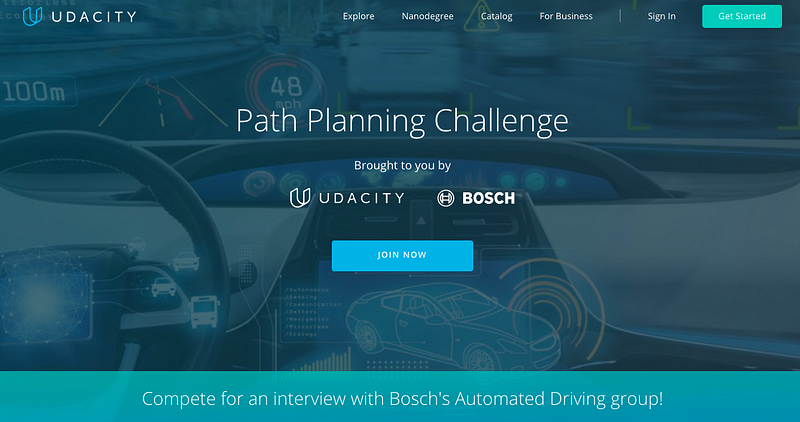
Today Udacity launched a Path Planning Challenge in conjunction with Bosch, the world’s largest automotive supplier.
The challenge is basically a competitive version of our Term 3 Path Planning Project. The goal is to navigate a simulated vehicle through highway traffic as quickly as possible, without violating speed, acceleration, and jerk constraints. And without colliding with any other traffic, of course 🙂
The top 25 entrants will get an interview with Bosch’s autonomous vehicle group.
If you’re enrolled in the program, especially if you’re already in Term 3 and working on the Path Planning project, you should take a look at participating!
And if you’re not enrolled yet, you should apply! We anticipate rolling out more of these in the future 🙂
Less well-known is the 2004 DARPA Grand Challenge, the year prior, in which no vehicle finished. In fact, no vehicle made it further than 7 miles. Most vehicles just died altogether.
The most impressive aspect of the 2004 race, really, is that there even was a 2005 race. After watching every vehicle fail in 2004, DARPA threw down the gauntlet again in 2005, and the rest is history.
A reporter asked, “Well, what are you gonna do?” I said, “We’re gonna do it again, and this time it’s going to be a $2 million prize.” It was so successful and yet so not successful, I had to do it again.
Having grown up in Virginia, I generally keep tabs on Virginia news, especially when it comes to self-driving cars.
This story from ARLNow about a fake self-driving car in Virginia is a little silly. But it’s also bizarre enough to make me wonder what on earth is going on.
I assume that the Virginia Tech Transportation Institute is running some study on whether drivers will even notice self-driving cars. Mission accomplished on that one.
The follow-up tweet by Adam Tuss of NBC is the best. “I’m with the news, dude!”