Self-Driving Car Student Applications

We had over 11,000 students apply to join the Udacity Self-Driving Car Nanodegree program, which launches its first cohort this month!

The quality of the students has been astounding. It’s both incredibly exciting and, honestly, intimidating to be teaching students this talented and accomplished. Many of students who applied already work on autonomous vehicles, and want to take the course to make sure they’re at the top of their game. Others are top engineers at companies like Google and Facebook, and still others are stars at universities (including professors!) in the US and abroad.

And many are just good engineers who are excited about self-driving cars, kind of like me not very long ago.

Thank you to everyone!

Dhruv has spent all of his waking hours this past week going through each application and organizing students into cohorts.

Udacity’s mission is to democratize education, so we will be trying to teach as many people as possible.

We’ll start small, with an initial cohort of 500 students, to give us a chance to scale up the program and iron out any wrinkles.

But we plan to be teaching thousands of students about self-driving cars by the end of the year.

See you in class!

(By the way, if you’re interested but haven’t applied yet, you can still do that! We’re taking applications now for our 2017 cohorts, so please apply!)
California Allows Unmanned Car Testing

Only at designated sites in Contra Costa County, but still:

…almost four years to the day since driverless trials on public streets were first approved, a new bill has been signed off by Governor Jerry Brown that permits autonomous car tests without a human passenger overseeing proceedings.

Rather than applying throughout the Golden State, the bill is specific to a pilot project headed by the Contra Costa Transportation Authority. At San Ramon’s Bishop Ranch business park, EasyMile’s 12-seater shuttles will ferry workers around the site, which will include travelling on some public roads. The approval also covers GoMentum Station: A ghost town within the Concord Naval Weapons Station where Honda has been testing its driverless car technologies. Recently, Uber-owned Otto also signed up to test self-driving trucks on the site.

I’m actually a little surprised this wasn’t already legal. I kind of thought you could do whatever you want on your own land.

Another article I read said that disabled-persons groups were key in getting the bill passed.

Policing in a Self-Driving World

I think one of the biggest areas of society that self-driving cars will change, and one of the least-appreciated areas, will be policing.

Most of the interactions I have had with police are related to driving, and once the car is driving for me, those interactions will go away. Maybe they’ll be replaced by other police interactions, or maybe not. But it will be different.

The Marshall Project has a thinkpiece up about this topic today:

So what’s the big deal if police can no longer make traffic stops? It’s about half of what police do, says [criminology Professor Joseph] Schafer. He estimates such stops, along with traffic accidents, account for nearly 50 percent of all police-public encounters.

The end of traffic stops would have surprisingly large implications.

For example, traffic stops were a key part of the race riots in Ferguson, Missouri:

Another aspect of this situation might stem from a system that burdens the poor and black in Ferguson. Minor traffic offenses are the starting point, and the costs spiral up rapidly if the offenders do not pay the fines on time or do not appear in court. The income from court fines represented the second largest source of revenue for Ferguson in 2013. On October 1, 2014, the city of St. Louis cancelled 220,000 arrest warrants and gave a three-month delay to the offenders to get a new court date before the warrants would be reissued.

Ferguson might be an outlier, but traffic fines provide a huge part of the budget of many police departments or even cities.

Police may be sanguine about self-driving cars until it really becomes obvious how deeply self-driving cars can hit their funding structure.

Artificial Intelligence, Machine Learning, Deep Learning

Udacity has separate courses on Artificial Intelligence, Machine Learning (actually we have two), and Deep Learning.

What is the difference between all of these? It can be a little hard to explain.

Fortunately, NVIDIA has a nice blog post up explaining these concepts as concentric circles:

The easiest way to think of their relationship is to visualize them as concentric circles with AI — the idea that came first — the largest, then machine learning — which blossomed later, and finally deep learning — which is driving today’s AI explosion — fitting inside both.

I guess if I had to explain, I would say that:

  1. “artificial intelligence” refers to techniques that help computers accomplish goals
  2. “machine learning” refers to techniques that help computers accomplish goals by learning from data
  3. “deep learning” refers to techniques that help computers accomplish goals by using deep neural networks to learn from data

But if you’re interested in these topics, then read the NVIDIA post. It’s good.

Udacity’s Self-Driving Car Curriculum

Udacity just increased the first cohort of the Self-Driving Car Nanodegree program to 500 students!

We are so excited to have over 10,000 students apply to join the program, and we hope to teach all of them.

We’re limiting the initial cohort to 500 students to make sure we have everything ready to go to scale up the program over time, but the goal is to be able to teach everyone who wants to learn.

With that in mind, you should apply today!

Here is a tentative (subject to change) overview of the first term:

Introduction: You’ll learn about the program, the student support available, and, most importantly, the ways we’ll help you land a job in autonomous vehicles. Within hours of starting, you’ll be writing code to find lane lines on the road.

Deep Learning: You’ll learn about deep neural networks and deep learning frameworks. In the final project you’ll build a deep neural network for end-to-end driving of a vehicle in a simulator.

Computer Vision: You’ll learn about how computers and cameras work together to see the world. In the final project you’ll use OpenCV and deep learning to identify vehicles on the highway.

I am super-excited about this program and I hope you are, too. Please join us!

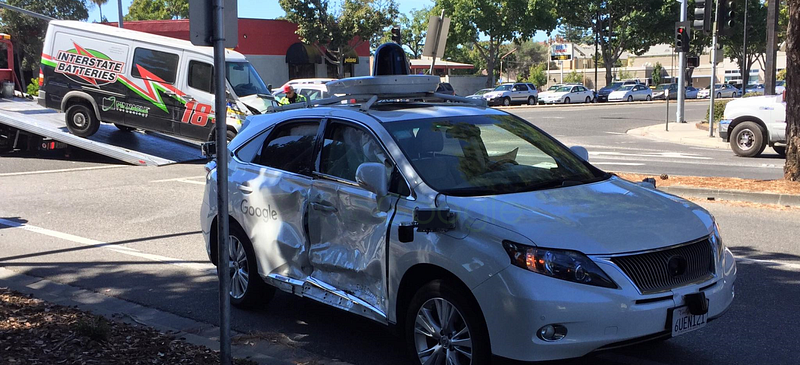
Van Runs Red Light, Crunches Google Car

A van in Mountain View, California, ran a red light yesterday and t-boned a Google self-driving car, resulting in what news outlets are calling, “one of the worst accidents in the history of the Google self-driving car program”.

To be clear, Google’s self-driving car was the victim — the human driver of the other vehicle was 100% at-fault.

A website called 9to5google.com has the best reporting I’ve seen, including a statement from Google:

A Google vehicle was traveling northbound on Phyllis Ave. in Mountain View when a car heading westbound on El Camino Real ran a red light and collided with the right side of our vehicle. Our light was green for at least six seconds before our car entered the intersection. Thousands of crashes happen everyday on U.S. roads, and red-light running is the leading cause of urban crashes in the U.S. Human error plays a role in 94% of these crashes, which is why we’re developing fully self-driving technology to make our roads safer.

This is just another reminder that however sexy and interesting the Trolley problem might be, it’s irrelevant, at least in the short-term. The immediate, real problem is that we humans are terrible drivers.

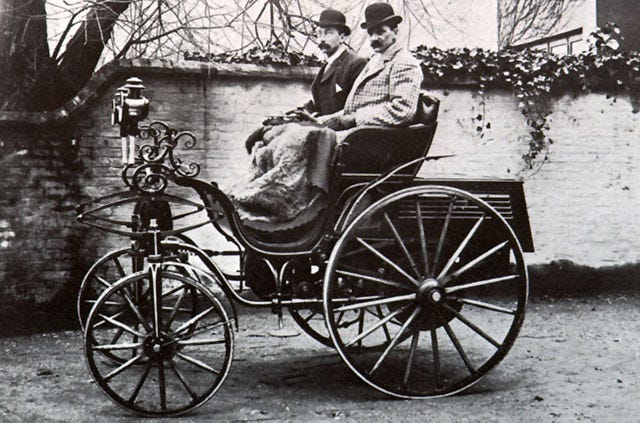
Horse-less Buggies

A Business Insider article just reminded me of something I had forgotten: the first automobiles were simply horseless carriages.

The context is an interview with Ken Lawson, an urban planner at MIT. Lawson argues that self-driving taxis will be great, but they won’t last for that long.

Most trips in the city, he said, involve individuals moving around their own neighborhoods far below the maximum speeds of cars.

“Why have a 4,000-pound automobile that seats five to move one person a short distance at low speed?” he said.

And this:

“It’s just like, you had the horse-and-buggy,” he said. “You got rid of the horse — it still looked like a buggy.”

Lawson doesn’t reveal what he thinks the self-driving equivalent of the Model T will be, though.

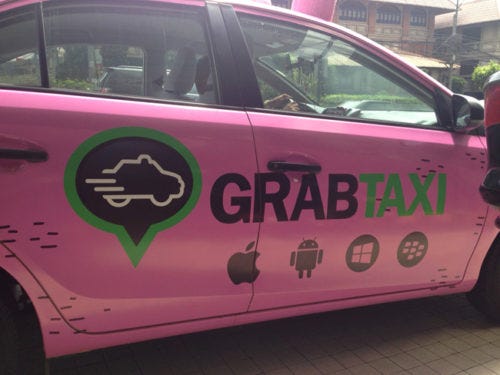
Grab

For months now there have been periodic reports of the race to put self-driving taxis on the road in Singapore.

First nuTonomy, then Delphi, said they were imminent.

Today ReadWrite reports that nuTonomy is partnering with a ride-sharing company called Grab, which I take it is an Uber competitor in Asia.

I’ve never heard of Grab before, but perhaps they are big in Singapore?

I presume it was a big win for them to get the nuTonomy partnership, but I wish I knew more. Does this make them an Uber-level competitor now? Or is it all press and no substance?

I’ll keep an eye out, but let me help me out if you live in that part of the world and know more.

Behavioral Cloning

One of the first modules in our Self-Driving Car Nanodegree program will be Deep Learning. This is such a fun topic!

We’ll be covering behavioral cloning, which is a technique whereby you drive the car (or the simulated car, in this case) yourself and then pass the data to a neural network. The neural network trains on your driving data and auto-magically learns how to drive the car, without any other information. You don’t have to tell it about the color of the road or which way to turn or where the horizon is. You just pass in data of your own driving and it learns.

By the end, students will be building their own neural networks to drive cars, just like in this video.