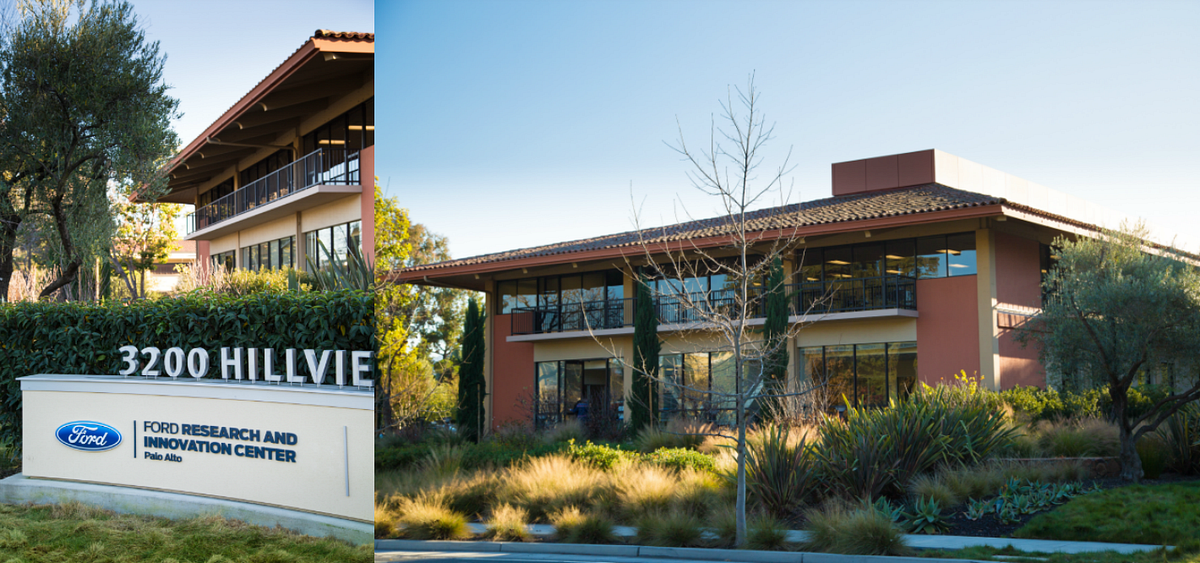
When I was at RICPA there were these two giant, beautiful, empty buildings across the street that were known simply as “the Goldman Sachs buildings”. Apparently Goldman Sachs built those buildings during the original dot-com bubble and but never occupied them. For 14 years!
Sounds like RICPA might be expanding to occupy those buildings, too.
Three of Ford’s top executives RICPA to highlight the growth: Mark Fields, CEO, Raj Nair, Executive Vice President of Product Development, and Ken Washington, Vice President of Research.
“From the very beginning of our autonomous-vehicle program, we saw lidar as a key enabler due to its sensing capabilities and how it complements radar and cameras,” Raj Nair, Ford’s executive vice president of product development, said in the statement. “Ford has a longstanding relationship with Velodyne, and our investment is a clear sign of our commitment to making autonomous vehicles available for consumers around the world.”
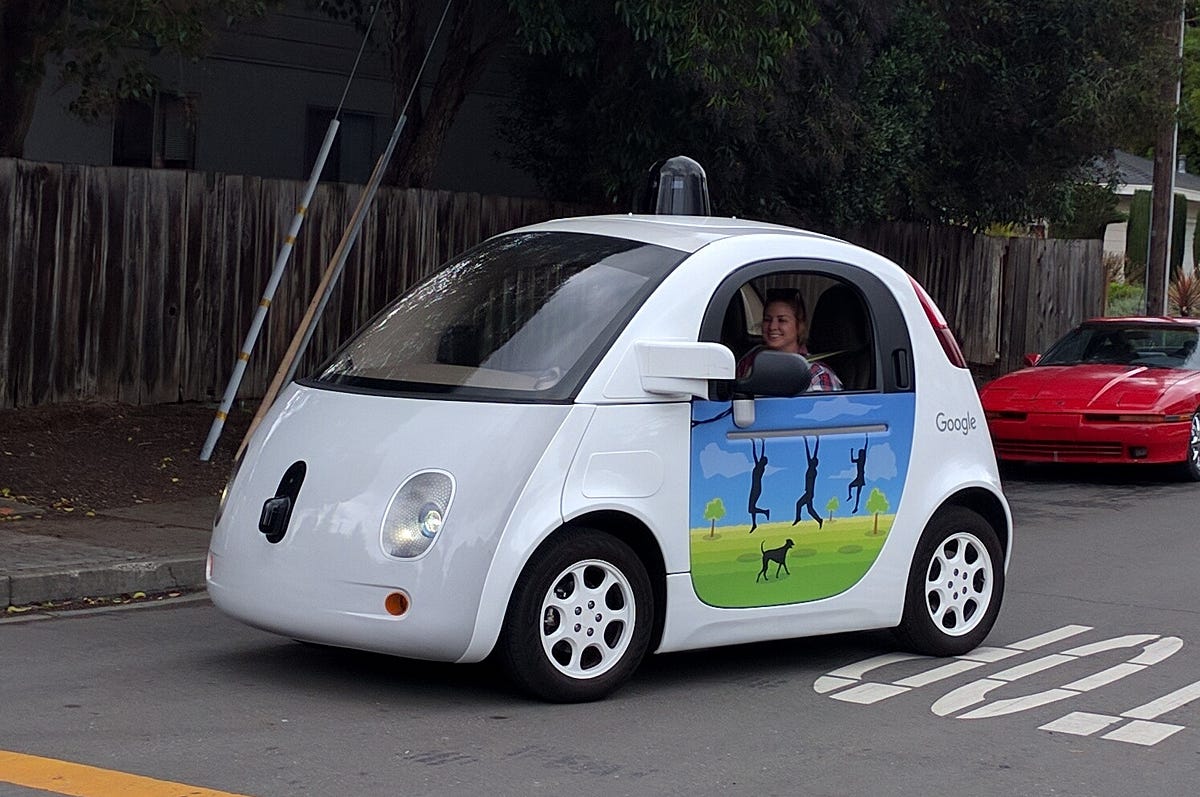
The interior of Google’s self-driving car puzzles me. With all the innovation going on under the hood, I would have expected the passenger area to look less like a normal car. For example, why are there still seat belts? (Safety regulations, I assume, but there’s clearly some sort of dispensation there for buses and subways — could that somehow be applied to autonomous vehicles?) Why do people still sit in forward-facing bucket seats? (Is that a safety thing, too? Since no one has to watch the road, why not have facing rows so people can talk? Or sectional-style seating that goes around the perimeter? Or cafe-style seating around a table?)
Good questions!
Washington Post writer Matt McFarland published photos of the car interior from a community event that Google held about a year ago.
In response to Kyle’s questions, I think a lot of the interior design decisions boil down to laws and regulations.
As Kyle presumes, Federal law requires that all vehicles except buses have seat belts for designated seating positions. I don’t see a specific definition for what constitutes a “bus”, but I think the Google car pretty clearly isn’t one.
My guess is that the Google car has its seats facing the road so that they can take over control manually. Apparently, state and Federal laws require driver control devices in the car, and I’m sure Google wants a human driver to be able to take control during testing. Given the size of the Google car, if the driver is facing forward, there really isn’t room for anybody else to face in a different direction.
But I think Kyle’s onto something once the cars move into production mode and become safer.
Right now, Google’s focus is on getting the self-driving technology to work, and that goal is best-served by a relatively familiar vehicle interior.
Once the cars work well, and consumers are comfortable with the concept, I think we might see some pretty cool interior designs.
Once those vehicles go on sale, the pace of adoption and transition will exceed any proposed speed limit, driven by compelling economics on both the demand side (us) and supply side (taxi, transit, shuttle services). Companies that are currently paying drivers can shed one of their most significant costs — Uber, for instance, can’t wait for self-driving cars and has invested in its own technology to make it happen. It’s only one of many players who will switch to autonomous as soon as they can. There will also be big savings for the trucking industry, so it’s no surprise that startups like Otto (founded by ex-Googlers) are already testing mammoth road carriers that drive themselves.
Consumers also can’t wait — just look at how quickly Tesla owners have taken the company’s “autopilot” features beyond prescribed limits. And there are millions who will appreciate new services that, without the cost of drivers, will give them speedy, reliable, on-demand travel.
Once it starts, there will hardly be time to shape how AVs are used. But we must.
The article, like the blockquote, is a long read. But it’s packed with interesting meditations on the benefits and costs of autonomous vehicles, especially for cities.
But today is Friday and I have a stack of meetings and I can’t quite bring myself to write anything deep, so I thought I’d just share some of the stats for this blog itself.
Followers
The big headline numbers are that ~1,800 people follow the Self-Driving Cars blog on Medium (which I edit), and ~3,900 people follow me personally. I try to publish other authors on the Self-Driving Cars publication, in an effort to extract myself from the content-creation process, but I haven’t yet been as successful as I’d like.
Of course there are readers who don’t officially “follow” the blogs on Medium, and “followers” who don’t actually read what we publish.
Clicks
So how many readers do we actually have?
For any given article, we get about 250 views.
We have a read-ratio of 80% (meaning 80% of clickers actually finish the article, I think), which seems pretty good to me. More than anything I bet that’s because my posts are usually pretty short.
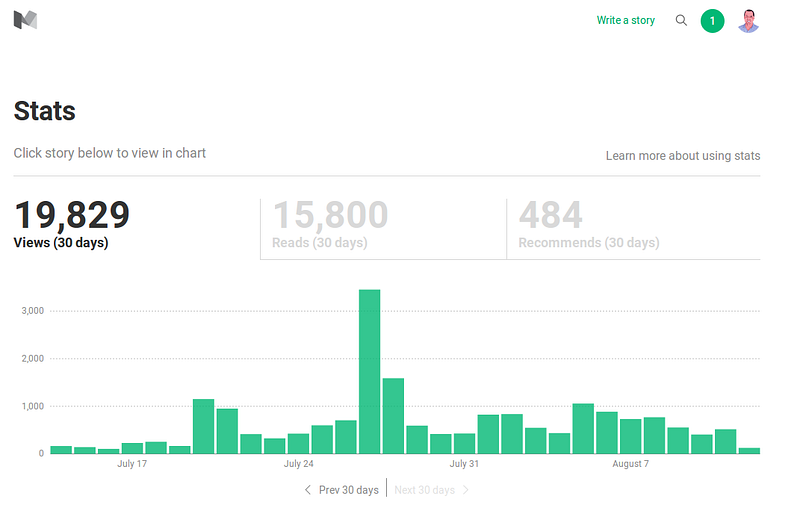
The image above are the stats for my personal feed, not the Self-Driving Cars blog. You can see that in the last 30 days I’ve had:
~20,000 views
~16,000 reads
~500 recommends
I’m rounding up, of course 🙂
Posts
Medium says I have 445 public posts, but a lot of those appear to be my comments on other people’s posts or my responses to comments on my posts. My guess is I have ~300 stories published.
The number of stories from other authors that I’ve published on Self-Driving Cars is probably less than 50. Please submit stories for me to publish there!
Viral
None of my posts have really “gone viral”, but the most-read post was Tesla’s Autopilot Crash. The staff at Medium actually wrote me right after that happened and asked if I planned to write on it, which was nice. Then they put it on the homepage, which was even nicer. It has 14,000 views.
I’ve written before that it’s a lot of fun for me to write them, and it’s even more fun to know that there are a few people out there reading them. It’s still true 🙂
I’ve had this blog going for about a year, I’m glad to have heard from so many of you over that time. If you haven’t already (or even if you have), please leave a note to say hello!
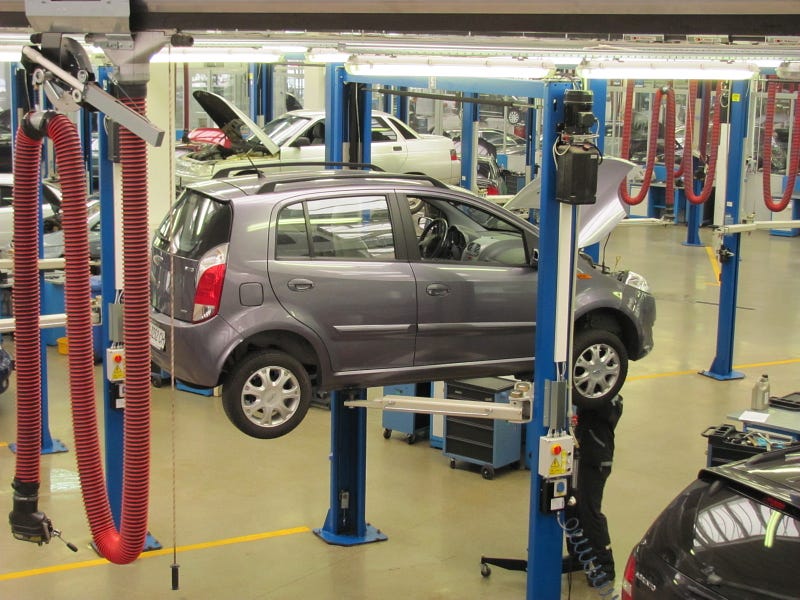
Before today, I had never seen a press release distributed by an independent auto repair shop. Goes to show that there’s a first time for everything.
The press release touts a trade column by New Jersey repair shop owner Jason Bigelow:
Today, the vehicles entering shops for maintenance or repairs sit parked 95 percent of the time. Tomorrow, fleets of driverless cars will spend nearly all their time on the road — with an increase in wear and tear and a proportionate need for maintenance and repair.
Bigelow contends self-driving cars will be a boon for the repair shop industry.
From a mechanical and electrical perspective, autonomous vehicles are not much different from the vehicles technicians already service on a daily basis. The autonomous features are just that — “features” designed to replace drivers, not cars. The goal is to add operational awareness and intelligence without replacing any of the components that make human-controlled cars operate.
That makes sense as far as it goes, but I wonder how the fleet economics will affect independent repair shops. Will Uber have its own repair shops, or will it outsource to independents?
Separately, I’ve also been listening to Malcolm Gladwell’s podcast, Revisionist History.
One of Gladwell’s recent episodes focused on creativity, and the popular notion that creativity is a product of youth and genius.
It turns out that notion is true!
But it is also true that creativity can be a product of a lifetime of tinkering, or so Gladwell contends.
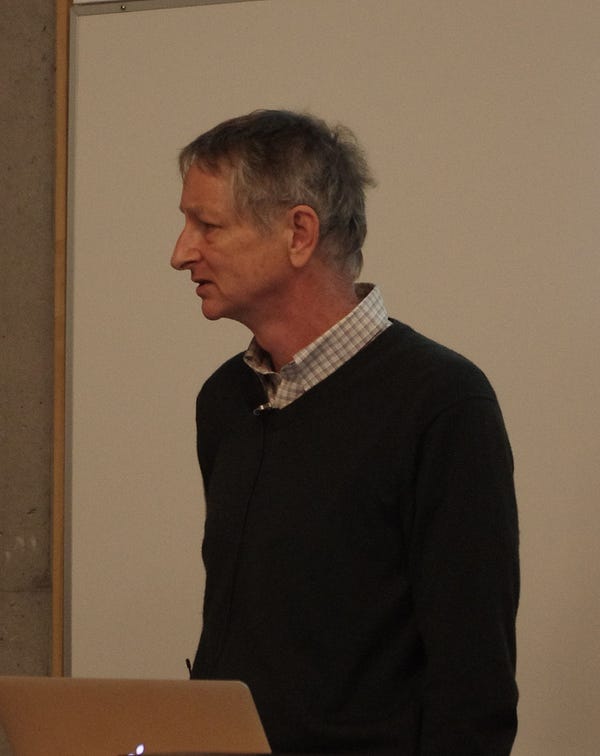
And that’s where I see the connection to Geoffrey Hinton.
Hinton was born in 1947, which made him 63 years-old in 2010, the year he and his graduate students developed and published AlexNet, the deep neural network that blew the machine learning field wide open.
This was the product of a lifetime of working on neural networks. Hinton was one of the original leaders in the field in the 1980s, and developed the practice of back-propagation, which is still a critical element of deep neural networks.
But neural networks faded into relative obscurity until AlexNet revolutionized the field with a GPU implementation in 2010.
It’s nice for the rest of us to remember that our engineering life doesn’t end at 30.
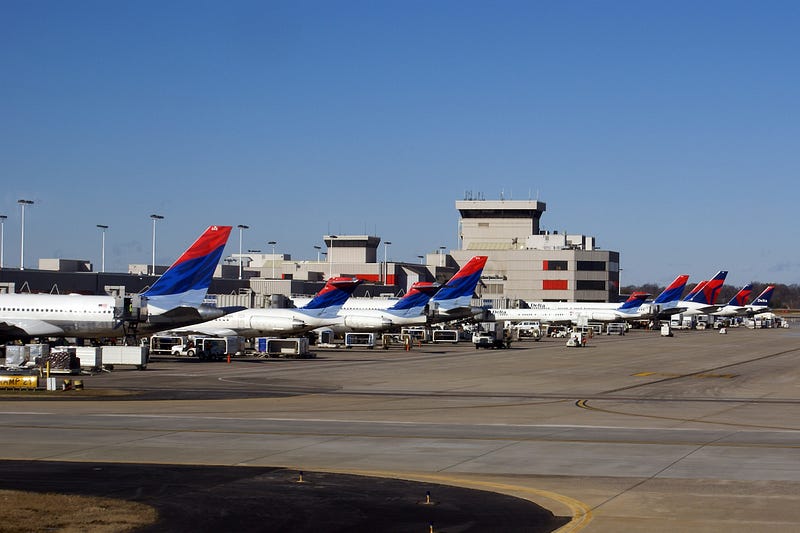
Delta Airlines grounded their flights worldwide today, due to a series of computer systems failures. This was all triggered by an overnight power outage in Atlanta, home to Delta headquarters.
This is a massive inconvenience for anyone who happens to be affected, but I’m not traveling by air this week, and certainly not on Delta, so I’m fine.
It’s not hard, however, to imagine a future world in which this happens with a transportation-as-a-service company, and it’s a massive problem for everyone.
In a world in which everyone gives up their cars, maybe when Uber goes down, Lyft is there to plug the gap.
Or, maybe people have signed up to long-term contracts with Uber and can’t switch over easily, kind of like wireless contracts in the US today.
In that world, TaaS is much more like the power or water company than like the airlines. Its performance needs to be nearly uninterrupted.
So far, Uber and Lyft seem to have something approaching that level of service. But just watching the airline industry shows what a hard feat that is to maintain.
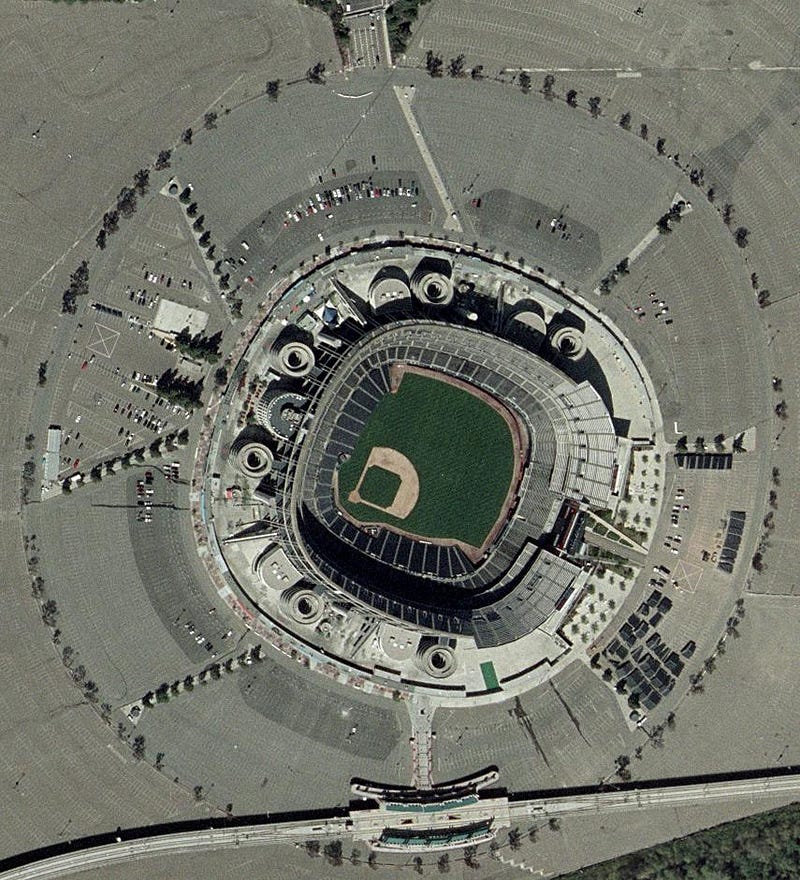
This is Qualcomm Stadium, not the Oakland Coliseum, but the problem is the same.
Today I took my two month-old son to see the Cubs beat the Athletics 3–1 (yay!) at the Oakland Coliseum.
As usual, I parked in my secret parking spot on a street just outside the Coliseum lots and walked in, saving $20.
But man those parking lots are immense.
They stretch for hundreds of yards in almost all directions away from the stadium.
The A’s don’t actually draw that big a crowd, and although the Warriors sell out next-door Oracle Arena, that’s not the reason either. Basketball arenas, like Oracle, are relatively small.
The reason is football.
Oakland Coliseum is the last remaining shared football-baseball stadium in America, and football stadiums draw upwards of 60,000 people per game.
Most of those people need to park their cars. Hence the vast parking lots.
This is what network analysts call “peak load” — the highest level of demand for a service over a time period.
Peak load for the Oakland Coliseum comprises the eight home games the Oakland Raiders football team plays every year (more in the rare years they host a playoff game).
And yet this entire infrastructure, including parking lots, access roads, signs, and more, is built to support those eight Sunday afternoons.
How will self-driving cars change this?
For starters, imagine that most people use a transportation-as-a-service provider, instead of driving themselves.
The parking spaces won’t be necessary, but stadiums will need multitudes more drop-off locations for the beginning of games.
And image the game endings, with 60,000 people streaming out of the stadium, each looking for their own ride-share.
Maybe it will wind up like the airport taxi system, where only one provider is authorized to operate on stadium grounds, and everyone lines up for that stream of ride-shares.
Or maybe it will look similar to that, but with designated locations for multiple providers.
The biggest change might be optimizing for throughput instead of storage. Twice as many cars might have to come in and out, and people will be less tolerant of waiting. But none of those cars will stick around.
Anyhow, it’s kind of an interesting problem in traffic engineering.
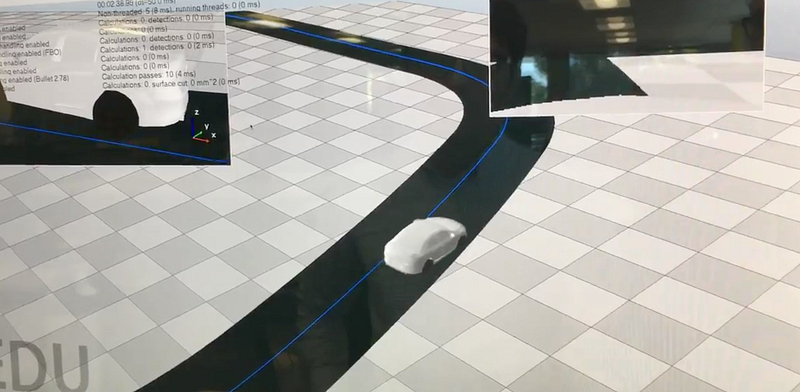
This is a project we started about a week ago, and it’s a lot of fun. We’re using the v-rep simulator package, because it comes with pre-built camera and radar objects that work nicely.
One of the surprises I encountered when we began working on this project was the lack of a standardized simulator platform in research or industry.
At Ford, we used a proprietary, in-house simulator.
In the public domain, there are a few simulator packages with moderate adoption, such as ROS and TORCS, but nothing that stands head and shoulders above the field.
There also exists the potential to build out a simulator using a game engine like Unreal, Unity, or Blender. But I worry we’ll spend too much time re-inventing the wheel if we go that way.
We’re taking a first pass with v-rep, and we’ll see how it goes, but if you’ve got a great solution for an automotive simulator, please let me know!



 David Silver