Recently a friend asked me why I decided to work on self-driving cars. I’m sure I’ve written the answer to this at some point, but I’m not sure I’ve done it recently. So I’ll do it here.
There are two reasons I decided to work on self-driving cars: changing the world and getting a win.
I’m a huge believer in the opportunity for self-driving cars to change the world in everything from real estate to agriculture to human resources to travel to childcare. Removing the constraint on our lives due to travel time and cost is going to change the world in ways we can’t even imagine.
My desire to get a win is perhaps less noble, but more personal. I’ve worked for different companies in networking software, enterprise software, mobile software, and recruiting software, and the common theme is that they have all had average performance. I want great performance.
Maybe I’m an average influence!
I think more likely it’s been a combination of bad luck and perhaps some poor decisions on my part as far as which companies to work at.
Smartpeople say that the best thing you can do for your career is to work in a good industry, for a good company.
It seems to me like self-driving cars are a great industry, or at least they will be one.
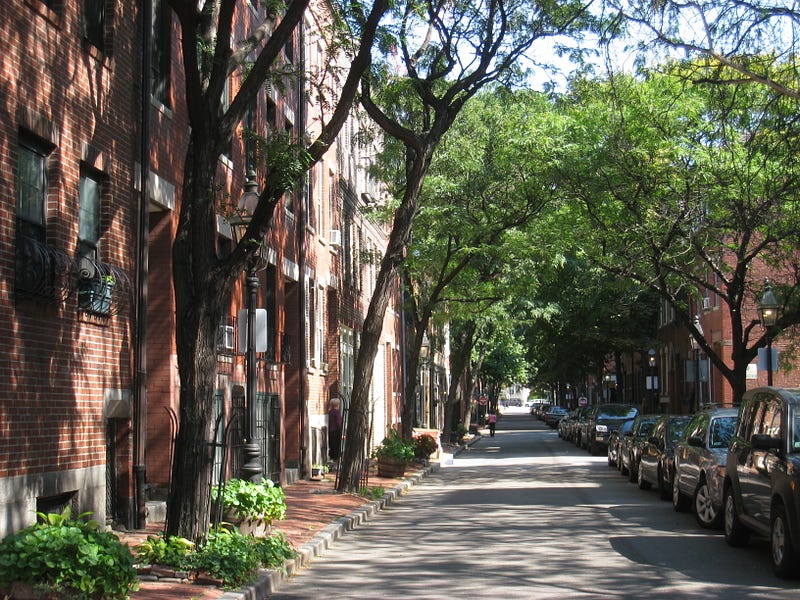
I live in Boston. All the roads here are frighteningly narrow and windy. The street I live on, for example, is technically a tw0-way road, but it’s so narrow (and so lined with parked cars — yet another problem that autonomous vehicles will solve) that, whenever two cars pass each other going opposite directions, one of the two drivers has to pull over well in advance of the meeting if they want to avoid a collision (or having to back up). Is this the sort of thing current self-driving cars can handle, or is this a problem for future iterations? (I recognize this is a corner case, but in Boston, it’s our status quo.)
I think of this as a two-part problem: partly communication and partly internationalization. I realize Boston is in the United States, but the driving customs that Kyle is describing as basically foreign to most American drivers.
Both of these problems are really hard, and so the short-term answer will probably be geo-fencing. Essentially, the self-driving system will refuse to go on certain streets if it knows it’s going to wind up in situations like Kyle describes.
Depending on how the car is designed, there may be an option to shift the car into human-driver mode, and let the human driver navigate the narrow streets. Or the computerized driving system might just treat that road as unnavigable, the same way a human driver would normally treat a bike path as unnavigable in a car.
Long-term, vehicle-to-vehicle communication will eventually solve the communication problem, although it’s possible some sort of vehicle-to-human communication system might emerge to help human drivers and computer drivers share those roads.
The internationalization problem is more a function of economics than anything else. Right now, cars are learning the driving customs of California and Michigan and Germany and Japan, because that’s where the self-driving car development is taking place.
Over time, cars will learn the driving customs and rules of the entire United States (which are mostly uniform, with some exceptions), and then expand internationally.
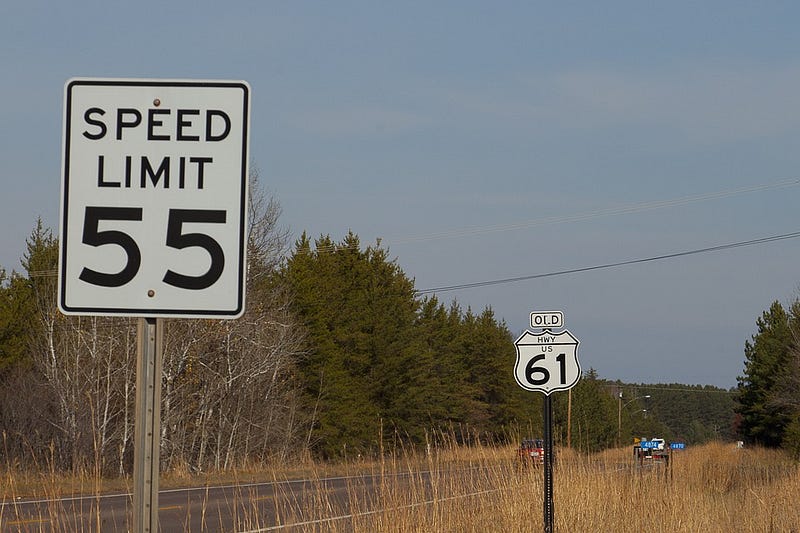
Where internationalization might become pretty difficult is in countries where the formal traffic laws diverge widely from accepted customs. For example, when I lived in Brazil, I quickly learned that it was custom to fit two cars into a single turning lane. Even in the US, it’s widely accepted to exceed the speed limit on the highway and to fail to come to a complete stop at stop signs.
Most of the time it will probably be okay to program the car to follow the letter of the law, but occasionally engineers will discover that trying to diverge from accepted driving patterns has a big cost.
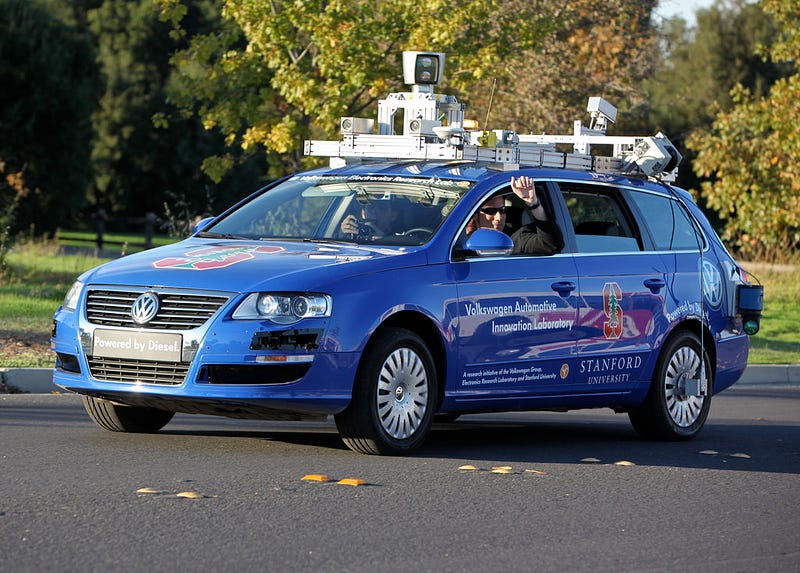
I think it’s fair to say that at a high-level of abstraction, there are two types of approaches to building self-driving cars.
I have been calling the approach that most companies use the “robotics” approach, or the “traditional” approach, or the “classical” approach. I just read a paper calling this approach “mediated perception”, a term I’d never seen before.
This approach combines computer vision, sensor fusion, localization, control theory, and path planning.
Unfortunately, the terms “traditional” or “classical” make this approach sound outdated— which it isn’t, in fact this is the state of the art. And, so far as I know, nobody uses the term “robotics” to describe this approach, except me.
The other, second approach is currently in vogue with Silicon Valley startups, and involves training a single deep neural network to take sensor inputs and produce steering, throttle, and brake outputs. This approach is sometimes called “behavioral cloning”, or “end-to-end driving”, or “deep learning”, or I just read a paper calling it “behavioral reflex”.
So we have a little bit of an issue with naming conventions. It would be nice if we could just use one term to refer to each approach, and maybe there are settled terms and I’m just missing them.
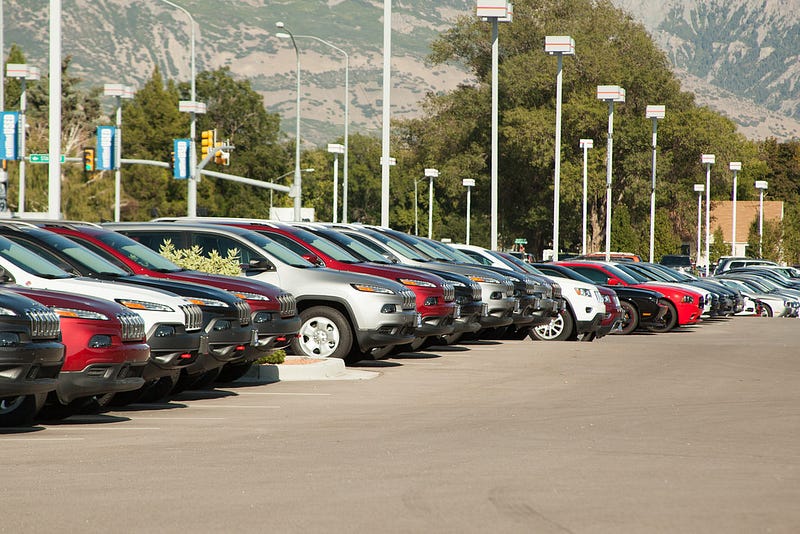
U.S. auto sales remained brisk in August but showed continuing signs of moving away from the blistering pace set a year ago, further fueling concerns the industry’s best days are behind it.
It’s hard to know whether this is signal or noise. There is certainly a story to be told that it’s a real trend:
Americans are migrating into urban cores, where costs to owning a car increase and benefits decrease
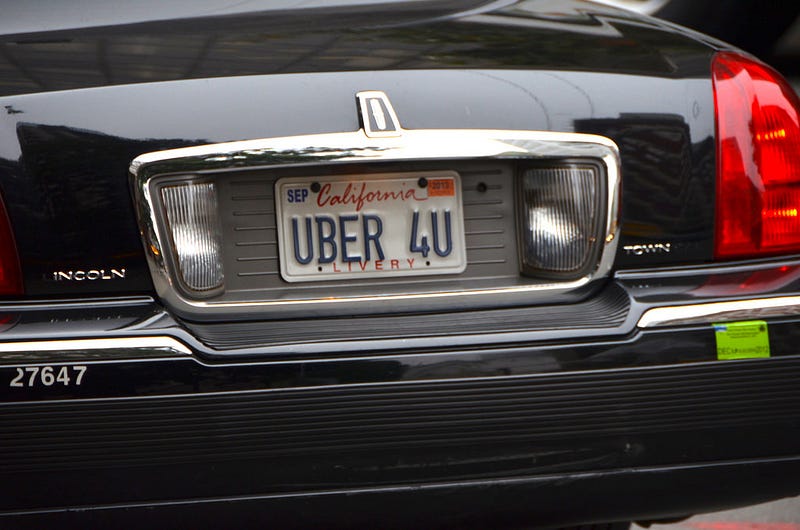
Ride-sharing services like Uber and Lyft are reducing demand for car ownership
Longer lives of existing vehicles reduce the need for new car purchases
Mass-transit is improving (I’m not sure that’s actually true, but maybe)
But it’s not obvious to me if that’s a real explanation or just one of many theories that happens to fit the facts.
What is true is that self-driving cars are really going to increase the power of that second bullet point.
A good model for this might be DVD sales. As the ease of streaming movies increased, DVDs sales dropped. Pretty classic substitution effect from business school.
As the ease of hailing a self-driving car increases, I expect car sales to drop, too.
And so do the automakers, which is why they are racing to become mobility companies.
The service is human-driven for now, but it’s pretty clear where this is going, and the destination doesn’t involve human drivers.
Google (Alphabet) will run the service through its Waze app, they’re calling it Waze Carpool. There are some wrinkles on the service for now — it’s limited to employees of certain companies, the rates are set too low to use it for income-generation — but it looks pretty clear that Google is going head-to-head with Uber in the future.
This is pretty exciting for consumers. Maybe less exciting for Uber.
I’ve heard it said that Uber’s survival depends on winning the self-driving car race, in a way that’s not true for Google, and that makes Uber a more dangerous competitor. On the other hand, I’ve seen Google winalotofmarkets that it didn’t have to win to survive, so don’t count them out. On yet another hand, Uber just acquired the hottest startup in the business.
Even if non-autonomous cars eventually get banned from the roads, there will probably always be some manned vehicles. Bicycles come to mind. And even just pedestrians. What will sharing the road look like when self-driving cars are the norm?
This, I think, has a much happier answer than the long and slow process of moving human-driven cars off the road.
The answer again is that self-driving cars will have to operate in the world as it exists today, but self-driving cars will make the world so much safer for pedestrians and bicyclists.
The number worldwide is presumably much higher, as I imagine biking is less popular in the US than in many other countries, due to our relatively sparse population density.
Self-driving cars which will literally carry lots of sensors, and figuratively carry lots of liability (assuming they are run by corporations, not individuals), will be much better at avoiding pedestrian deaths.
Hopefully the day will come when dedicated roadways enable self-driving cars to travel at hundreds of miles per hour, without interference from cyclists or walkers or human drivers. That’s the autonomous version of the Interstate highway system.
But in the near-term, self-driving cars are going to have to adapt to the world as it exists. They’ll just be much safer than the human-driven cars on the road now. And that will mean a lot, for pedestrians especially.
Someday, when all vehicles are autonomous, it seems to me that things like stoplights will no longer be necessary. If the vehicles are aware enough of each other, traffic could steadily stream through an intersection in all directions simultaneously without anyone having to stop. But in such a world, if some backwards traditionalist insists on driving the old-fashioned way, they’ll do nothing but cause accidents. Is there a specific tipping point where these larger-scale infrastructural changes can happen organically, or will we have to hold out until manned vehicles are banned from public roads (either by the government or by insurance companies)?
This is a good question and nobody really knows the answer.
My best guess is that we’ll see these changes happen organically, but also very slowly.
A good comparison might be with electronic toll tags, although admittedly these are a much less disruptive technology.
According to Wikipedia, electronic toll collection debuted in Norway in 1986, side-by-side with cash toll collection.
It took 27 years before cash toll collection ceased on San Francisco’s Golden Gate Bridge. To this day, 30 years into the ETC era, half the toll lanes on the San Mateo Bridge (the closest Bay Area bridge to me) are cash lanes.
Infrastructure moves slowly.
So how would this happen with self-driving cars?
Maybe vehicle-to-vehicle communication will get good enough that cars can talk to each other and synchronize their movements. At first, it might just be Teslas talking with Teslas, and Fords talking with Fords, but maybe they’ll converge on a protocol over time.
Getting traffic lights to change on-command is a harder problem that know little about, so I won’t speculate there.
But my guess is that self-driving cars will have to operate in the world as they find it, not in the world we might like to have.
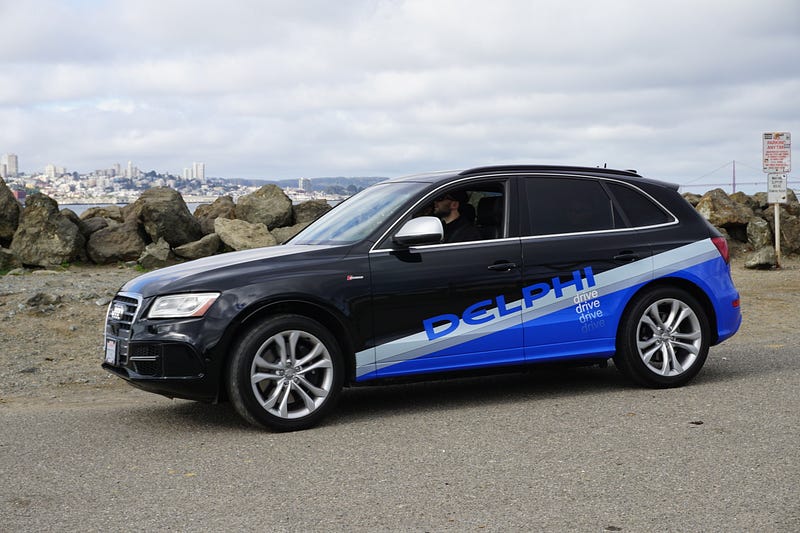
Delphi and Mobileye, two leading auto-parts suppliers, announced today that they are forming a partnership to develop a near-complete autonomous driving system by 2019. The plan is to create a mass-market, off-the-shelf system that can be plugged into a variety of vehicle types, from smaller cars to SUVs.
That’s interesting news. It sounds like they are going right at a market first attacked by Cruise and now by Comma.ai.
It’s unclear whether these systems will be sold directly to consumers, or to aftermarket automotive repair shops, or to OEMs.
And there’s this:
The companies say their Central Sensing Localization and Planning (CSLP) self-driving system will be Level 4 autonomous as defined by the Society of Automotive Engineers. That would mean the automated system can control the vehicle in all but a few environments such as severe weather, but only in approved areas. However, when the system is active, a driver would not be required to pay attention to the road.



 David Silver