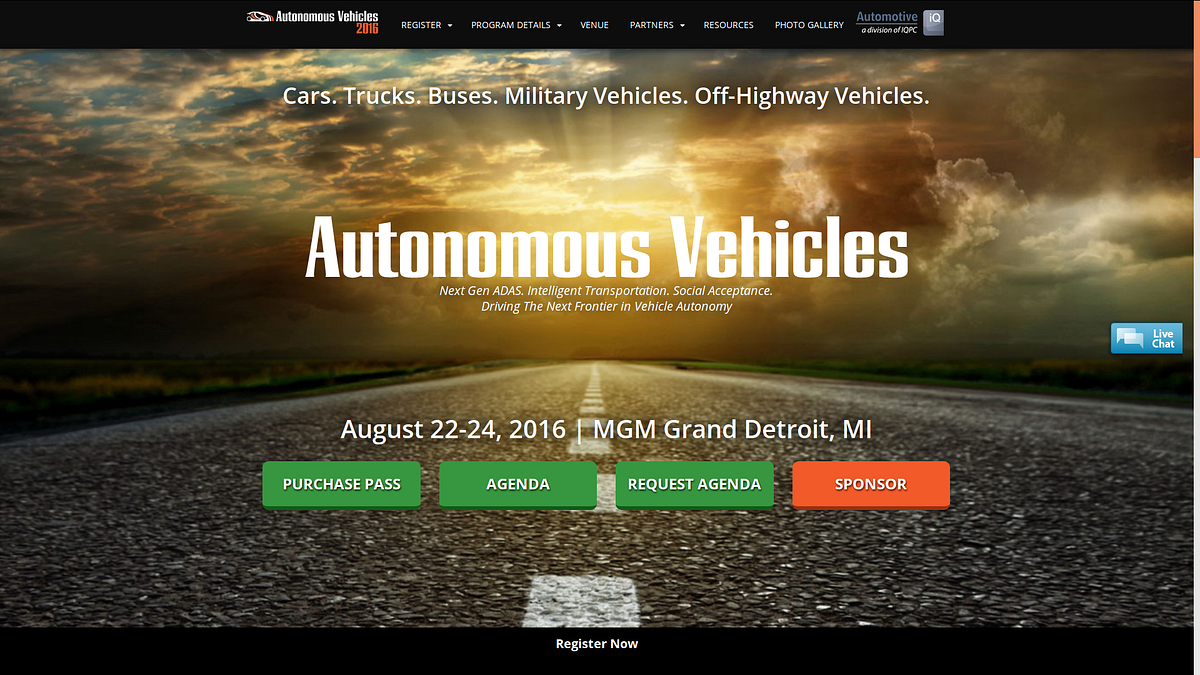
Today I will be speaking at Autonomous Vehicles 2016 on training autonomous vehicle engineers. If you’re in Detroit, come by the MGM Grand at 4pm (ticket required).
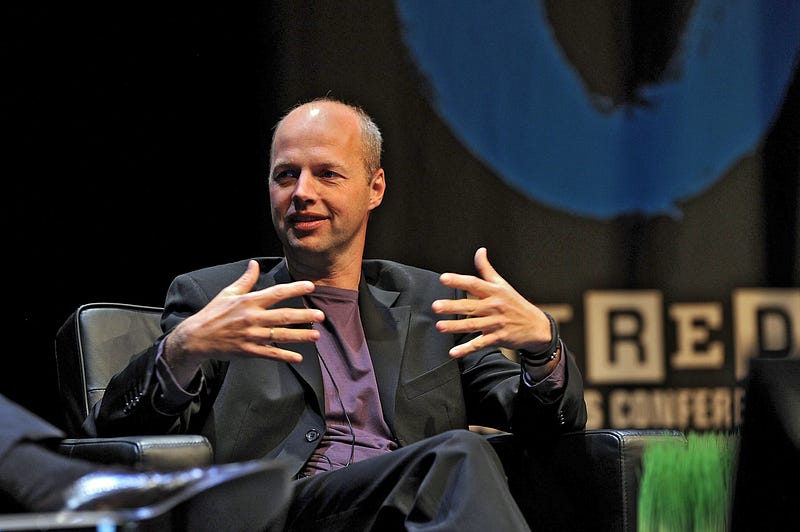
On Friday, Udacity will be hosting a self-driving car event at our Mountain View, California, headquarters, in conjunction with Silicon Valley Artificial Intelligence. The event will feature our co-founder, Sebastian Thrun, and NVIDIA Senior Director of Automotive, Danny Shapiro.
Sebastian will be talking about his self-driving car story, from the DARPA Grand Challenge, through Google X, and up to our Self-Driving Car Nanodegree program today.
Danny will be talking about NVIDIA’s deep learning work and their latest advances in autonomous driving research.
Please come!
I will check on video recording and distribution for both of these events, and I’ll update this post when I find out.
Update: We will be live-streaming the Silicon Valley Artificial Intelligence event with Sebastian and Danny Shapiro. It will start at 7pm PDT, and you can watch the stream here: https://www.youtube.com/watch?v=C2c8K-qp_xo
I’m headed out to Detroit this afternoon, where tomorrow I will be speaking at Autonomous Vehicles 2016, at the MGM Grand in Detroit.
My session will be at 4pm on Tuesday (tomorrow), and I’ll be speaking on training engineers to work on autonomous vehicles.
If you’re attending the conference, please come to this session! It will be fun and interactive, and you’ll leave with some great proposals for how to train yourself or your team to work on self-driving cars.
And please say hi after the session is over. I’d love to meet you!
If you’re not coming to the conference, maybe you should buy a ticket to Detroit and register for the event today!
Greg Ferenstein has a good summary of an OECD simulation published back in May.
“What if all conventional cars in a city were replaced by a fleet of shared self-driving vehicles”?
The results of this exercise were very interesting.
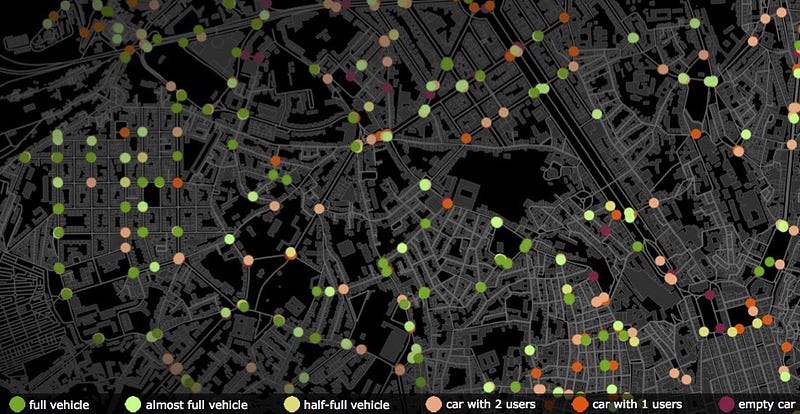
We carried out a simulation on a representation of the street network of the city of Lisbon, using origin and destination data derived from a fine-grained database of trips on the basis of a detailed travel survey.
The results were:
Total vehicles barely changed
Lots of land was freed up because parking was no longer necessary
Total vehicles driving at any one time decreased by 67%
Following up on Kyle Jepson’s second question from a few weeks ago:
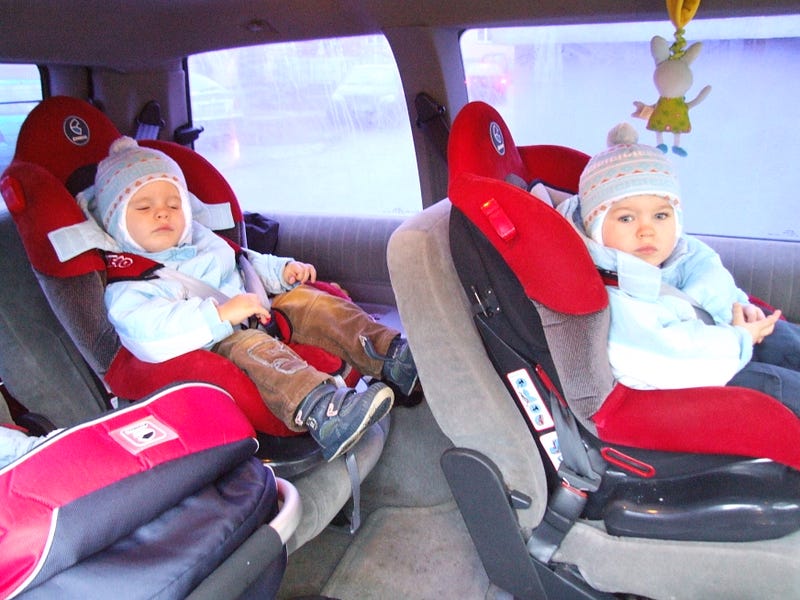
My wife and I used to use Zipcar, but we had to give it up once we had our second kid because carrying two carseats the mile-and-a-half to the nearest Zipcar was just not possible. For the same reason, we never use Uber or Lyft — installing and uninstalling carseats is a pain, and having to lug them around with us at the store/park/church/etc. is even worse. But we love riding the bus and train because carseats aren’t required, so our kids can just sit on our laps or on the seat next to us. In a world where nobody owns a car (which is the world I’m rooting for), what will child safety look like? Will it be like public transit, where things like carseats aren’t needed, or will some other solution be needed (like perhaps having carseats available in the trunk)?
This seems like a scenario where the goal is pretty clear, but the question is how long it will take to get there.
Utopia
The goal is that driving would be basically as safe as taking the train and nobody would need seatbelts or carseats anymore.
That world seems pretty distant, if only because human drivers will still be rear-ending self-driving cars for decades to come.
The Future
In the nearer term, the goal is to be able to hail a self-driving taxi with as many adult seats and child carseats as necessary.
And in some future world where there are lots and lots of self-driving cars swarming around, each with different configurations, this isn’t too hard to imagine. It’ll be kind of like how Airbnb lets me select the number of bedrooms and bathrooms I need for a rental, plus whether it has to be pet-friendly, have a pool, have WiFi, free parking, a fire extinguisher, and a host of other “amenities”.
Problem solved.
Except, of course, even that world might be a little ways off. In the meantime what will happen?
The Short-Term
My best guess is that parents will be out in the cold. Fully autonomous vehicles will come first for commercial applications — long-haul trucking and deliver vehicles — and then for urban transportation in a several geo-fenced areas.
Children do not factor largely into either of those scenarios.
As the parent of an infant, this is frustrating, but it’s also just economics. The first waves of self-driving cars will be like Uber but without a driver, and, as Kyle points out, Uber is not optimized for kids. Parents don’t have enough money and kids are too small and disruptive a user base.
But if the world moves to self-driving cars, the law might become a burden and parents might lobby to lower the carseat age.
It might even be safer for children. Who knows, maybe riding with an adult seatbelt in a self-driving car that rarely crashes will be safer than riding in a booster seat with a harried mother or father who wrecks the car regularly.
Uber plans to put passengers in actual self-driving cars, starting this month (!):
For now, Uber’s test cars travel with safety drivers, as common sense and the law dictate. These professionally trained engineers sit with their fingertips on the wheel, ready to take control if the car encounters an unexpected obstacle. A co-pilot, in the front passenger seat, takes notes on a laptop, and everything that happens is recorded by cameras inside and outside the car so that any glitches can be ironed out. Each car is also equipped with a tablet computer in the back seat, designed to tell riders that they’re in an autonomous car and to explain what’s happening. “The goal is to wean us off of having drivers in the car, so we don’t want the public talking to our safety drivers,” Krikorian says.
Furthermore, Uber just acquired Otto, the newest and hottest self-driving car (and truck) startup in San Francisco:
This fits perfectly into Uber’s strategy as the company doesn’t want to become a car manufacturer. Instead, Uber has been looking at partnerships with existing car manufacturers, such as Volvo, in order to turn their cars into self-driving cars using Uber’s proprietary technology. So get ready for Uber’s self-driving kit.
A month and a half ago I joined Udacity to build the Self-Driving Car Engineer Nanodegree program. Since then, we’ve been hard at work, and we’ll launch by the end of the year.
In the meantime, we quietly floated an announcement and asked about interest, just to make sure there would be somebody there to take the course when we built it.
True story: right before we launched Dhruv told me that we might cancel the program if we didn’t get 500 interested students, and I kind of freaked out a little.
Fortunately, we did a lot better than 500.
20,000 students from all over the globe have signed up to learn more about the program— Ushuaia to Hawaii to Tokyo to Tehran to Cabo Verde.
We even have somebody from my birthplace — Juneau, Alaska. If you’re reading this, hello, Juneau!
We are so excited to work with students from around the world.
I am particularly excited to see what students do with the tools we provide. I’m guessing there will be things to come out of this that we couldn’t have dreamed up.
So, thank you for signing up.
If you haven’t signed up yet, please sign up here! It helps keep me employed.
We’ll have the Self-Driving Car Engineer Nanodegree program out to you soon 🙂
When I was at RICPA there were these two giant, beautiful, empty buildings across the street that were known simply as “the Goldman Sachs buildings”. Apparently Goldman Sachs built those buildings during the original dot-com bubble and but never occupied them. For 14 years!
Sounds like RICPA might be expanding to occupy those buildings, too.
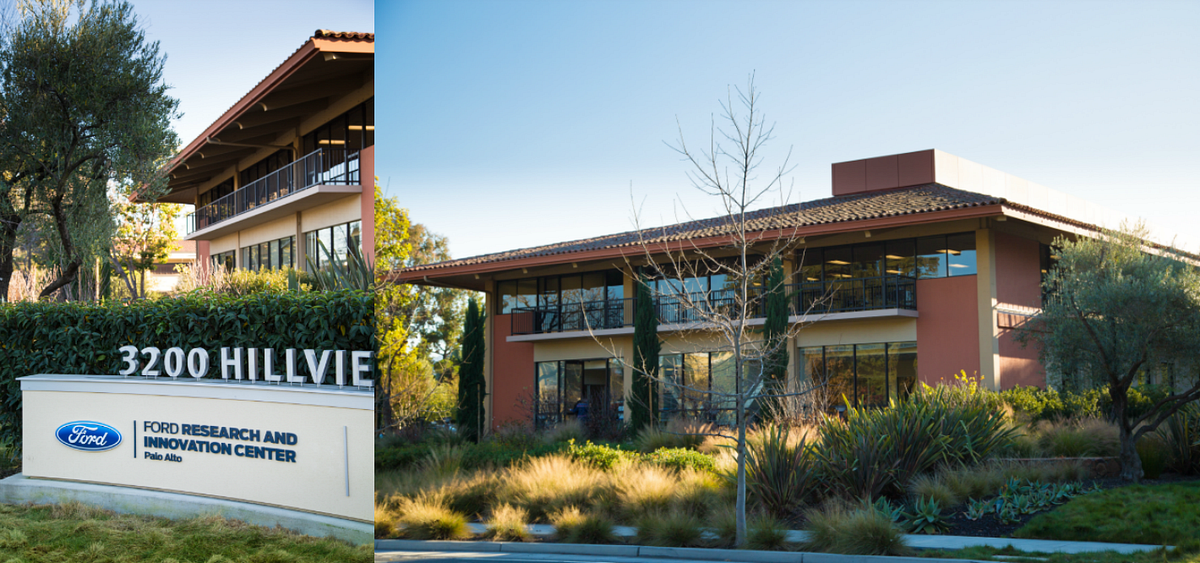
Three of Ford’s top executives RICPA to highlight the growth: Mark Fields, CEO, Raj Nair, Executive Vice President of Product Development, and Ken Washington, Vice President of Research.
“From the very beginning of our autonomous-vehicle program, we saw lidar as a key enabler due to its sensing capabilities and how it complements radar and cameras,” Raj Nair, Ford’s executive vice president of product development, said in the statement. “Ford has a longstanding relationship with Velodyne, and our investment is a clear sign of our commitment to making autonomous vehicles available for consumers around the world.”
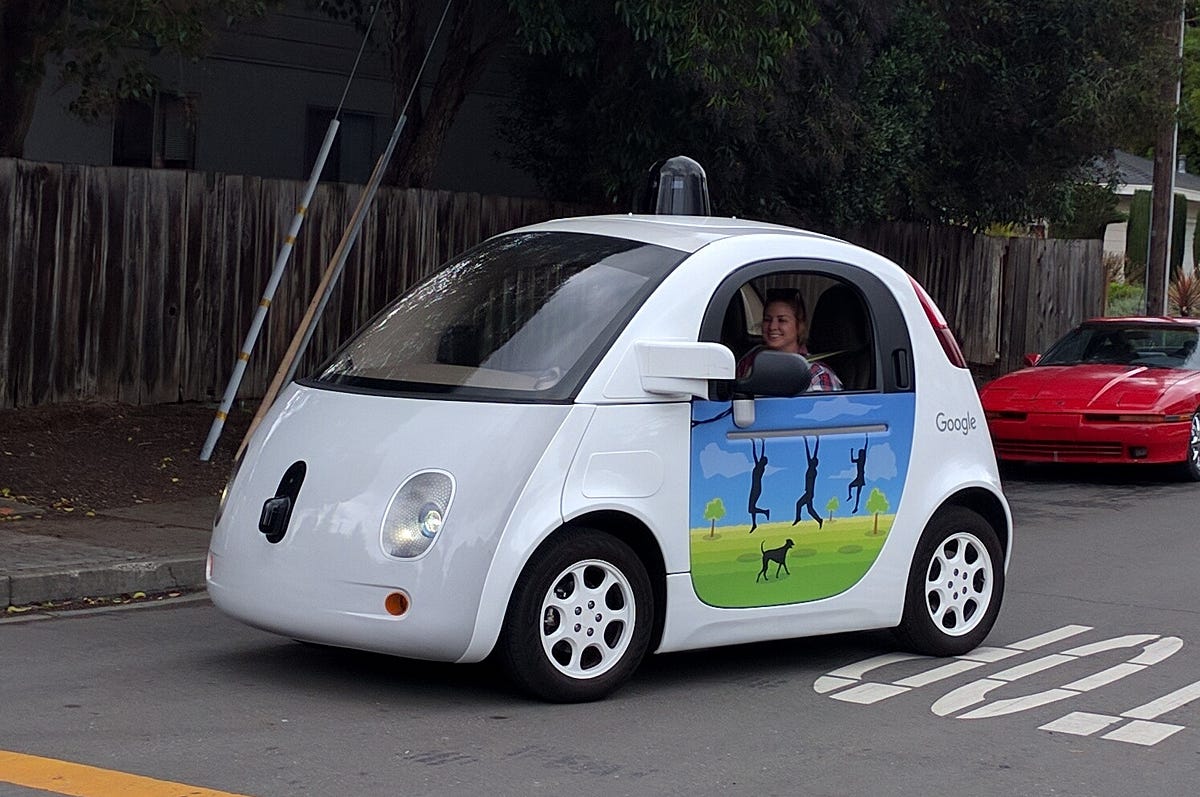
The interior of Google’s self-driving car puzzles me. With all the innovation going on under the hood, I would have expected the passenger area to look less like a normal car. For example, why are there still seat belts? (Safety regulations, I assume, but there’s clearly some sort of dispensation there for buses and subways — could that somehow be applied to autonomous vehicles?) Why do people still sit in forward-facing bucket seats? (Is that a safety thing, too? Since no one has to watch the road, why not have facing rows so people can talk? Or sectional-style seating that goes around the perimeter? Or cafe-style seating around a table?)
Good questions!
Washington Post writer Matt McFarland published photos of the car interior from a community event that Google held about a year ago.
In response to Kyle’s questions, I think a lot of the interior design decisions boil down to laws and regulations.
As Kyle presumes, Federal law requires that all vehicles except buses have seat belts for designated seating positions. I don’t see a specific definition for what constitutes a “bus”, but I think the Google car pretty clearly isn’t one.
My guess is that the Google car has its seats facing the road so that they can take over control manually. Apparently, state and Federal laws require driver control devices in the car, and I’m sure Google wants a human driver to be able to take control during testing. Given the size of the Google car, if the driver is facing forward, there really isn’t room for anybody else to face in a different direction.
But I think Kyle’s onto something once the cars move into production mode and become safer.
Right now, Google’s focus is on getting the self-driving technology to work, and that goal is best-served by a relatively familiar vehicle interior.
Once the cars work well, and consumers are comfortable with the concept, I think we might see some pretty cool interior designs.
Once those vehicles go on sale, the pace of adoption and transition will exceed any proposed speed limit, driven by compelling economics on both the demand side (us) and supply side (taxi, transit, shuttle services). Companies that are currently paying drivers can shed one of their most significant costs — Uber, for instance, can’t wait for self-driving cars and has invested in its own technology to make it happen. It’s only one of many players who will switch to autonomous as soon as they can. There will also be big savings for the trucking industry, so it’s no surprise that startups like Otto (founded by ex-Googlers) are already testing mammoth road carriers that drive themselves.
Consumers also can’t wait — just look at how quickly Tesla owners have taken the company’s “autopilot” features beyond prescribed limits. And there are millions who will appreciate new services that, without the cost of drivers, will give them speedy, reliable, on-demand travel.
Once it starts, there will hardly be time to shape how AVs are used. But we must.
The article, like the blockquote, is a long read. But it’s packed with interesting meditations on the benefits and costs of autonomous vehicles, especially for cities.
But today is Friday and I have a stack of meetings and I can’t quite bring myself to write anything deep, so I thought I’d just share some of the stats for this blog itself.
Followers
The big headline numbers are that ~1,800 people follow the Self-Driving Cars blog on Medium (which I edit), and ~3,900 people follow me personally. I try to publish other authors on the Self-Driving Cars publication, in an effort to extract myself from the content-creation process, but I haven’t yet been as successful as I’d like.
Of course there are readers who don’t officially “follow” the blogs on Medium, and “followers” who don’t actually read what we publish.
Clicks
So how many readers do we actually have?
For any given article, we get about 250 views.
We have a read-ratio of 80% (meaning 80% of clickers actually finish the article, I think), which seems pretty good to me. More than anything I bet that’s because my posts are usually pretty short.
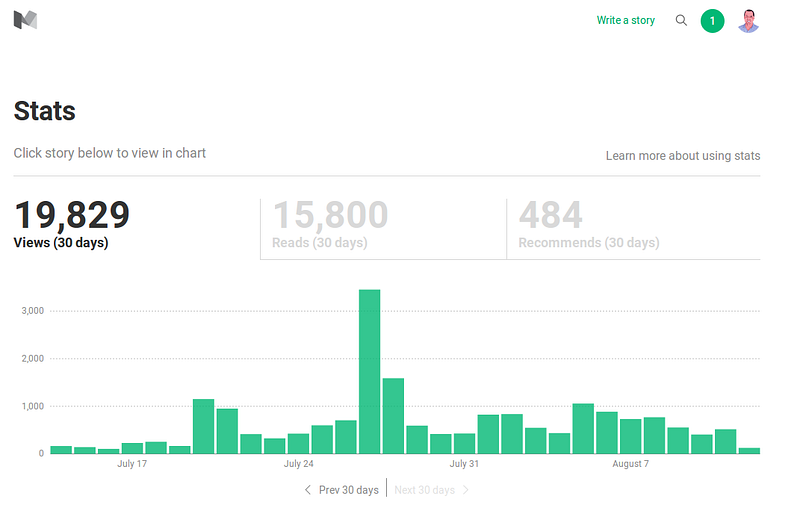
The image above are the stats for my personal feed, not the Self-Driving Cars blog. You can see that in the last 30 days I’ve had:
~20,000 views
~16,000 reads
~500 recommends
I’m rounding up, of course 🙂
Posts
Medium says I have 445 public posts, but a lot of those appear to be my comments on other people’s posts or my responses to comments on my posts. My guess is I have ~300 stories published.
The number of stories from other authors that I’ve published on Self-Driving Cars is probably less than 50. Please submit stories for me to publish there!
Viral
None of my posts have really “gone viral”, but the most-read post was Tesla’s Autopilot Crash. The staff at Medium actually wrote me right after that happened and asked if I planned to write on it, which was nice. Then they put it on the homepage, which was even nicer. It has 14,000 views.
I’ve written before that it’s a lot of fun for me to write them, and it’s even more fun to know that there are a few people out there reading them. It’s still true 🙂
I’ve had this blog going for about a year, I’m glad to have heard from so many of you over that time. If you haven’t already (or even if you have), please leave a note to say hello!




 David Silver