Ice Driving

A big challenge for self-driving cars (and for human drivers) is driving in sub-optimal conditions, especially snow. Everything looks different, the vehicles behave differently, and the mechanical components aren’t as reliable.

That’s part of why most autonomous vehicle testing has taken place in sunny coastal California. Mountain View has 260 sunny days per year, and 0 snowfall.

Of course, not everywhere has weather like Mountain View, and getting cars to work in the snow is important. And to build autonomous vehicles that work in the snow, developers want access to as much snow as possible. It’s unproductive to sit around for weeks on end waiting for snow to fall.

So perhaps it is unsurprising that Audi is planning to build a test track in Deadhorse, Alaska — the very northern end of the US road system.


Originally published at www.davidincalifornia.com on December 11, 2015.

Principal-Agent Problem

A Florida woman was recently reported to the authorities for a hit-and-run. The twist is that it was her own car that reported her.

The Ford car was outfitted with a program to automatically dial police in the event of an accident (the driver’s airbag deployed).

While this story has some bizarre twists to it — the driver committed the hit-and-run while fleeing a different, earlier accident — it’s representative of the world to come.

We’re used to thinking of computers as dumb machines that do what we want them to do. They’re turning into smarter machines that do what somebody else programmed them to do.

Generally speaking, that’s a good thing, but we’ll increasingly notice these kinds of principal-agent problems.


Originally published at www.davidincalifornia.com on December 10, 2015.

Will Autonomous Vehicles Disrupt Hotels?

A provocative article in Dezeen hypothesizes that self-driving cars will disrupt the hotel industry.

Cars will increasingly resemble mobile apartments, he said, and service stations along highways will evolve to support them, offering drivers facilities for washing, dining and shopping.

Hotels would change in response, Schuwirth added, with drivers using their facilities but returning to their cars to sleep. “Why should a hotel look like a hotel today?” he [Audi executive Sven Schuwirth] said.

An element of this is certainly true — some travelers will occasionally sleep in their cars. But I suspect this will be more like the way some travelers now sleep on red-eye plane flights. It happens, but it’s not that common (as a percentage of total nights spent on trips), and nobody likes it.

This does raise an interesting question about the ride-sharing industry, though. How much more specialized will vehicles become in the future?

In a world where people simply order up a ride, it’s possible to imagine specialty “overnight” vehicles that have beds instead of seats. And single-passenger pods. And a much wider range of delivery vehicle shapes.

Average will be over and specialized will begin.


Originally published at www.davidincalifornia.com on December 7, 2015.

Taxi Lenders: Another Disrupted Industry

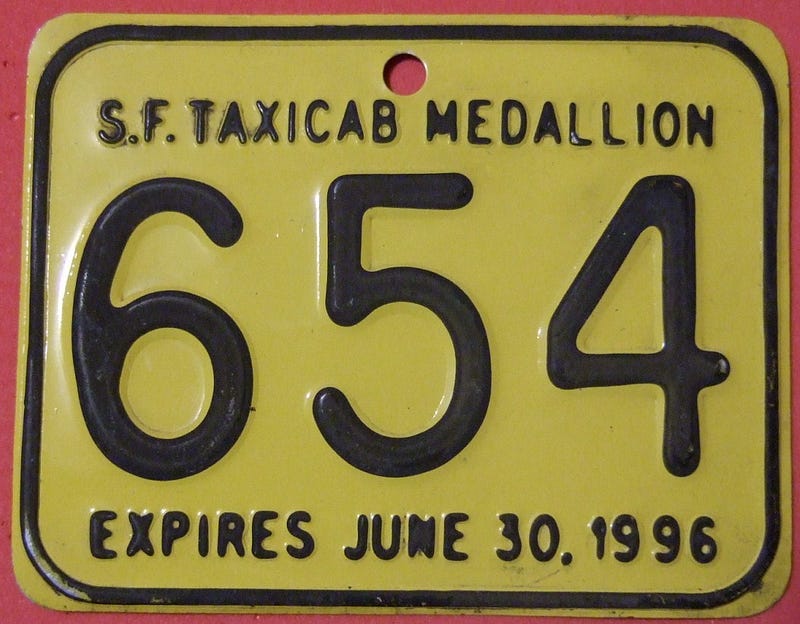
Other medallion lenders that have acknowledged being blindsided by the rapid rise of San Francisco-based Uber in New York City include Valley National Bank of Wayne, which said it is “closely monitoring” a $159 million portfolio of medallion loans; New York City-based Signature Bank, which added $2.4 million to its loan-loss reserve in the third quarter, partly due to concerns about its $600 million medallion loan portfolio; and Citibank, which is suing a New York City taxi mogul over alleged defaults on medallion loans.

This is from “Uber rise blindsides lenders” by Richard Newman in NorthJersey.com.

This of course is due to Uber’s defeat of occupational licensing, not autonomous vehicles. But I think these lenders are an interesting example of the first- and second-derivative business that collapse when an industry gets disrupted.

What will the autonomous vehicle corollaries be? Auto insurance? Auto lending? Auto repair? Fast food might be an interesting example, if autonomous driving changes the cost/benefit economics of drive-through windows.


Originally published at www.davidincalifornia.com on December 6, 2015.

The Driverless Future of Los Angeles

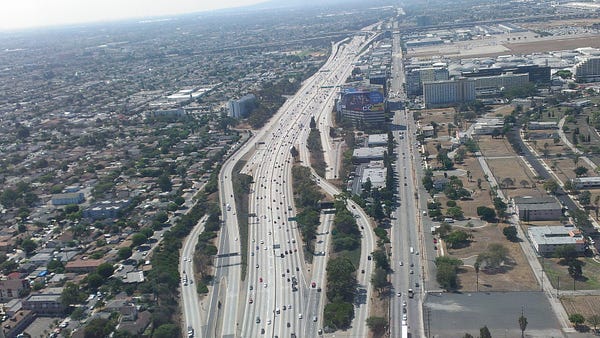
I landed at Los Angeles International Airport this morning, on the way to a friend’s wedding in Rancho Palos Verdes.

As the LA Basin spread out underneath our approach, I was treated to a wonderful view of the LA sprawl, which really can look beautiful in the morning sun, from thousands of feet up.

The 405 stretched from Beverly Hills in the north to Long Beach in the south, and the 5 shot from Downtown LA to Anaheim and beyond.

Los Angeles is the ultimate car city. Most sprawl, worst traffic, best status cars, largest parking lots. Everything.

What will happen when drivers are no longer needed?

Parking will be a big change. More so than any other city (I think), LA devotes lots of valuable land to parking. That prime real estate will become a lot more productive once the parking demand subsides.

Traffic will be another change. There are mixed views about whether driverless cars will improve traffic (better, faster drivers), or worsen it (more miles traveled).

Sprawl may actually change LA more than other cities. Southern California has already maxed out its sprawl capacity. Hemmed in by mountains to the north and east, the ocean to the west, it has sprawled south into Orange County and San Diego, but even there minimal rural land is available for further expansion. Unlike, say Houston or Phoenix.

So, in the optimistic case, maybe driverless cars spur infill and bring forth a denser but also less congested Los Angeles.


Originally published at www.davidincalifornia.com on December 5, 2015.

The Google / Tesla Approach vs. The Apple / Uber Approach

But in the fiercely competitive world of self-driving cars, Google’s strategy is the exception. Apple and Uber, both intensely secretive about their work on driverless cars, are the rule. “Apple’s aways been a very closed culture — and you have to believe that’s served them well, from a business standpoint,” said Larry Burns, a professor of engineering at the University of Michigan and a former General Motors executive who also serves as an advisor to Google. “But unlike a laptop computer, a car is a public-private good. A car drives on public roadways. A car has a side effect.”

So writes Adrienne LaFrance in The Atlantic. I think the dichotomy between Google / Tesla and Apple / Uber is spot on. It an interesting case study in the benefits and drawbacks of stealth projects.

I am less convinced by the Larry Burns quote about the “public goods” aspect of self-driving cars.

Cars certainly give rise to important externalities, but I don’t think that’s a strong reason to force their development cycle into the public eye.

Maybe Google and Tesla are right that a very public development process is ultimately good for the product. But that should stand on its own merits, not because society decides to outlaw stealth product development.


Originally published at www.davidincalifornia.com on December 4, 2015.

Autonomous Vehicle Engineering Talent

The Internet is a-twitter with gossip that Google just poached one of the leaders of Tesla’s autonomous driving program.

This is surprising, given the personal emphasis Elon Musk recently put on building out the autonomous driving team.

Nonetheless, I wouldn’t make too much of it, other than to say that competition is healthy.

There are a limited number of real experts in autonomous driving, and their value will get bid up by the relatively large number of companies currently trying to build autonomous driving systems.

Where the real value lies is in creating more engineering talent in this space. To that end, Elon Musk’s Tweet that autonomous driving experience is “not required” is great. He might even be able to hire engineers at below-market wages, just for the educational benefit of working on Tesla’s autonomous driving team.


Originally published at www.davidincalifornia.com on December 2, 2015.

The Mobility Trifecta

In Greentech Media, Julia Pyper neatly summarizes the intersection of Uber, Tesla, and Google as the “Mobility Trifecta”:

Some experts call the convergence of autonomous, electric and shared technologies “mobility’s trifecta” — a three-part solution for many of the world’s biggest transportation-related issues.

Nothing new there as far as information, but I think it’s often helpful to have a concise and accurate shorthand to refer to things, and “mobility trifecta” is a nice term.

I am on record as stating that autonomous driving is by far the most important leg of that stool, at least in the near-term, but the electricity leg is going to be necessary for environmental preservation, and the sharing leg is as much inevitable as necessary.

Interestingly, entering “trifecta” into Google Image search doesn’t return anything helpful, so the image today will be of the three-legged stool.


Originally published at www.davidincalifornia.com on November 30, 2015.

How to Talk to Pedestrians

One of the biggest problems with self-driving cars is how they can communicate with humans, both passengers in the vehicle and other drivers and pedestrians.

Google just received a patent for communicating with pedestrians:

The patent describes using electronic screens mounted on the side of the vehicle — including potentially the roof, hood and rear of vehicle — to tell a pedestrians if it was safe to cross. The displays might show a stop sign, a traffic sign, or just text. The car might react by coming to a complete stop, slowing down and yielding, or maintaining its speed.

It’s interesting how basic this technology is, compared to the dream of direct, vehicle-to-vehicle communication.


Originally published at www.davidincalifornia.com on November 29, 2015.