The Mobility-as-a-Service program in Guangzhou steps beyond previous deployments, in that it pulls together different transportation modalities and use cases into a single service.
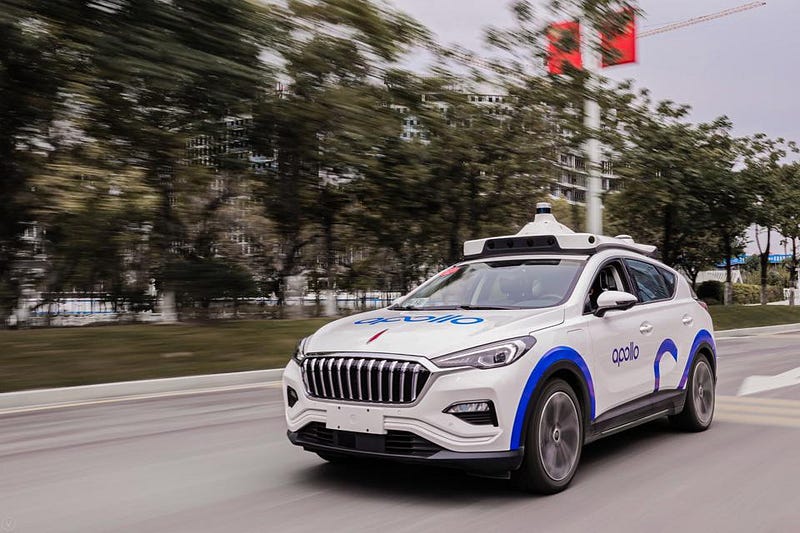
The service comprises 40 individual vehicles, of five different types: * FAW Hongqi Robotaxis * Apolong Shuttles * King Long Robobuses * Apollocop Public Safety Robots * “New Species Vehicles”, Apollo’s term for a robot that can perform a range of functions, from vending snacks to sweeping and disinfecting the street
Baidu is one of China’s most important Internet companies, and runs the largest search engine in the largest country in the world. They have also built, Apollo, an open-source self-driving car framework adopted by more and more companies around the globe.
This course is both free and English (with Chinese subtitles, of course). The course consists of 7 lessons:
Welcome
HD Maps
Localization
Perception
Prediction
Planning
Control
These are the fundamental components that comprise the autonomous vehicle software stack, and you can learn how they work by following along!
Self-driving cars are truly a global phenomenon, with centers of innovation in North America, Europe, and of course Asia. This course was built with Udacity’s US and China teams, and Baidu’s US and China teams. It is really exciting to watch engineers from around the world work together on some of the most amazing technology mankind has ever produced.
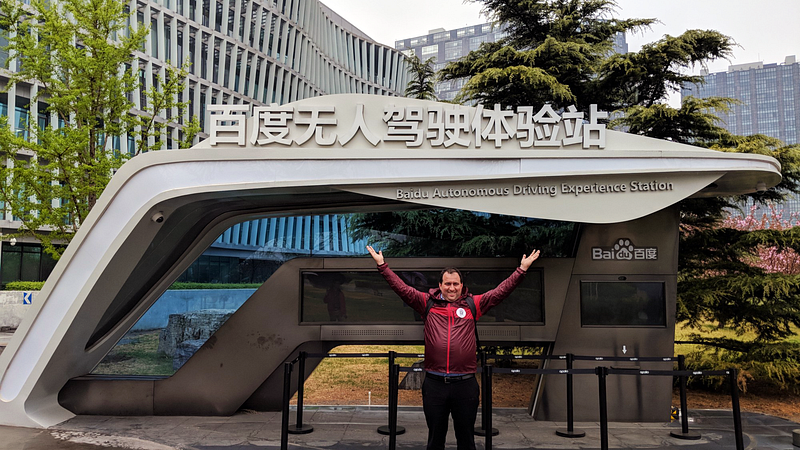
In April I had the great pleasure of visiting the Beijing campus of Baidu, China’s leading Internet company. Udacity is working together with Baidu on an upcoming free course that teaches how self-driving cars work through the lens of Baidu’s Apollo open-source software.
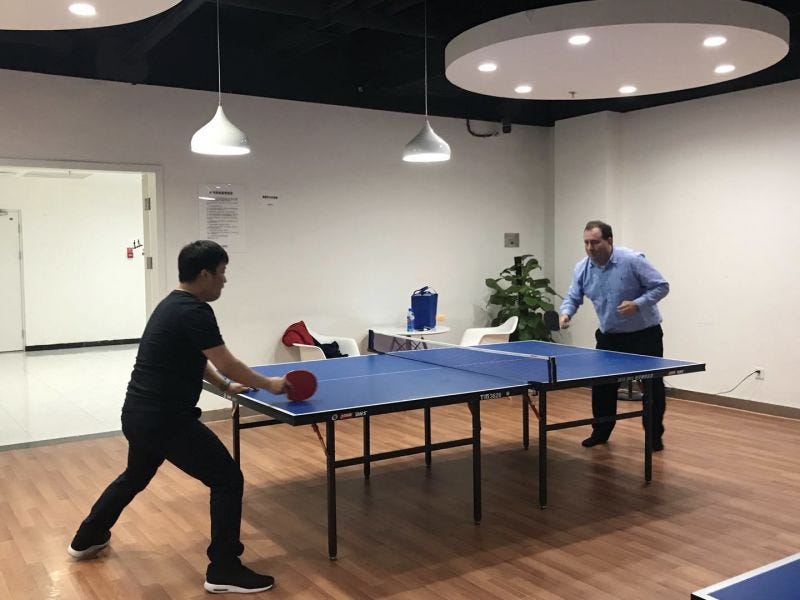
We got to see various Baidu self-driving cars, and we even played ping-pong. I went 1–1 in my ping-pong matches and was told I was the best American they had ever played against. They were the best Chinese opponents I had ever played against!
Talking Self-Driving Cars with Baidu’s Apollo team in China, and visiting Udacity’s offices in Shanghai and Beijing!
This past week I had the pleasure of visiting China for the first time in 20 years! I spent a few days working with colleagues at Udacity’s office in Shanghai, and followed that with several days at Udacity’s Beijing office. I was also able to take in some additional Beijing-based events. It was a whirlwind tour, and I loved it!
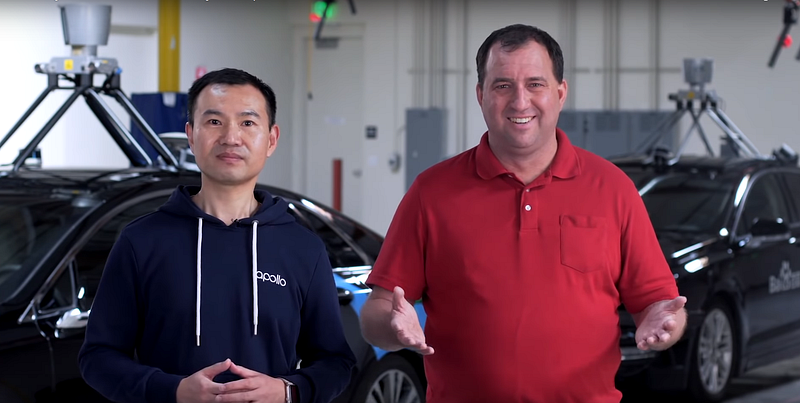
My traveling group was hosted by the terrific Apollo team at Baidu. Baidu is China’s largest search engine company, and one of the largest Internet companies in the world. And Udacity is building a free self-driving car course with them!
“Together with Baidu, we look forward to popularizing the Apollo system, and to giving everyone the opportunity to become a self-driving car engineer.” — Sebastian Thrun
This course will provide a conceptual overview of self-driving car technology, illustrated with the Apollo open-source self-driving car stack that Baidu is building.
Baidu has invested heavily in self-driving cars and has rapidly become an important player in the ecosystem. They are already testing vehicles on their Beijing campus.
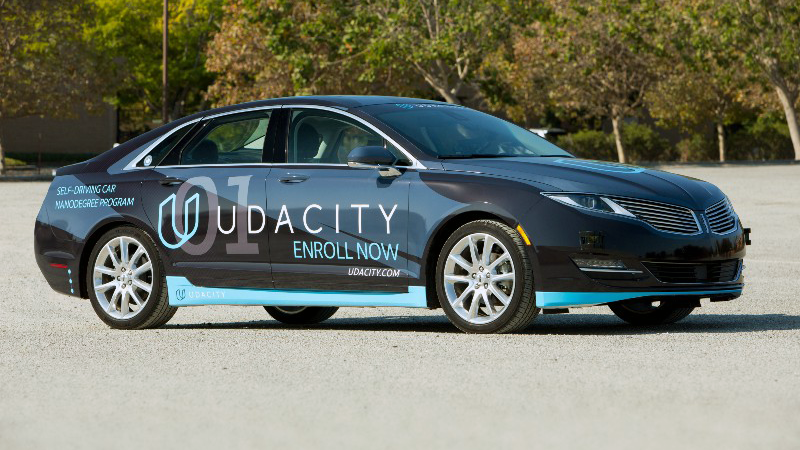
Their vehicles come in all shapes and sizes. Some of Baidu’s vehicles look like Carla, Udacity’s very own self-driving car.
Carla!
But Baidu has 13 different types of self-driving vehicles, ranging from small cars to big trucks!
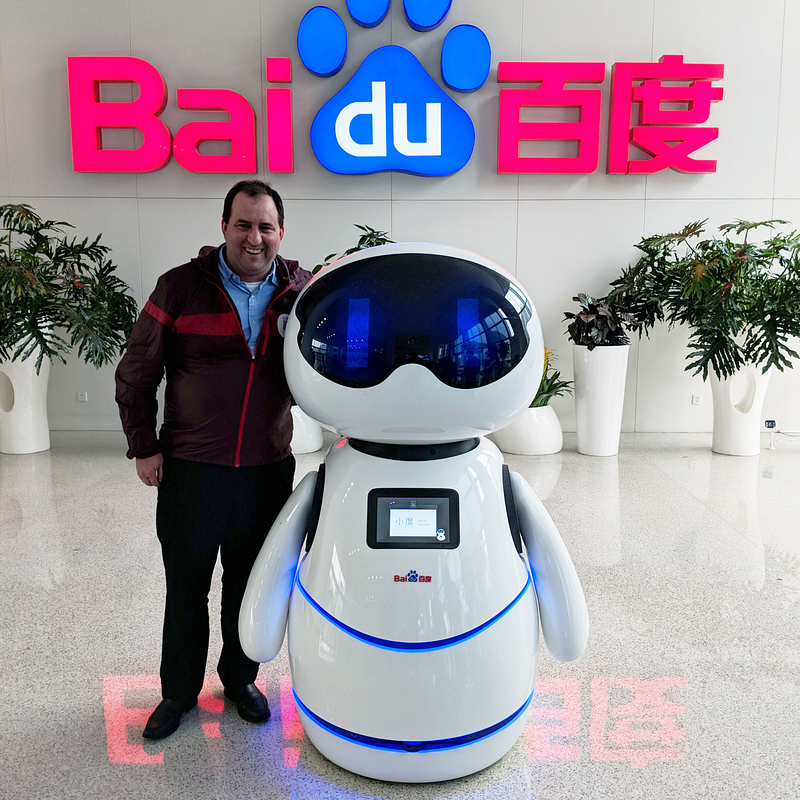
Beyond autonomous vehicles, Baidu has a world-leading artificial intelligence group. In their lobby I got to play with one of their robots, which talked, snapped my photo, and walked around with me.
The Baidu team was also kind enough to arrange and host an on-camera interview for me, with CSDN, a Chinese software developer network.
The most important part of the visit, however, were the ping-pong matches. I played two matches and went 1–1 in my first international ping-pong competition. No photos, you’ll have to take my word for it 🙂
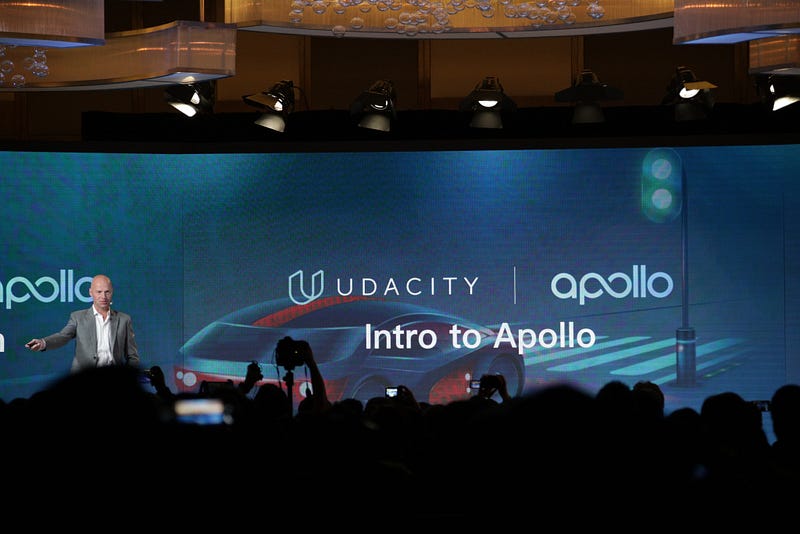
Udacity’s upcoming “Intro to Apollo” course will focus on the top two layers: Cloud Service and Apollo Open Software Stack.
The Course
Apollo is an incredibly exciting platform in the autonomous vehicle industry. We are thrilled to work with the Apollo team to teach students and engineers around the world how to build self-driving car software quickly using the Apollo stack.
I am especially delighted that this will be a free course, open to anyone with the desire to enter this amazing field. There is a huge demand for knowledge about how self-driving cars work, and this course will help educate the world on this topic. Our Self-Driving Car Engineer Nanodegree Program is an intense nine-month journey to becoming a self-driving car engineer, and it offers an amazing learning experience, but it is for advanced engineers. And while our Intro to Self-Driving Cars Nanodegree program is an excellent point-of-entry for aspiring learners newer to the field, it offers an equally immersive experience. This course offers adds something new and important to the range of learning options.
China
This is a special opportunity for us to collaborate with Baidu, one of the leading companies in China. China is a leader in the autonomous vehicle industry. And Chinese students currently make up 5% of enrollment in Udacity’s Self-Driving Car Engineer Nanodegree Program, and 20% of enrollments in all Udacity programs. A major focus for our Self-Driving Car Program in 2018 is to reach even more students in China.
The course will be developed jointly by Baidu’s Apollo team, the Udacity Self-Driving Car team in Mountain View, and the Udacity China team. The course will be in English, but this is a new experiment for us in developing course material in one of our offices outside of the US. I’m excited.
Did I mention I’m excited about this course? Because I’m excited!
Baidu has announced a plan to test autonomous cars in the United States, and to build commercially viable cars by 2016, according to The Verge.
The Verge notes that Baidu previously announced a partnership with BMW to launch a car by 2016, and that plan did not bear fruit. So, caveat emptor.
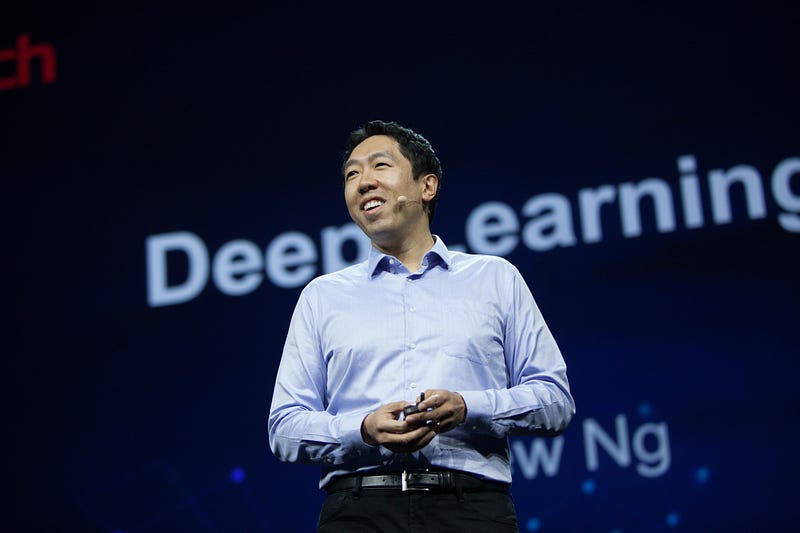
The current plan is interesting however, because Baidu’s chief scientist, Andrew Ng, is on-record as stating that self-driving cars are not yet technically feasible. Ng, by contrast, has favored self-driving buses on well-defined and limited routes.
Andrew Ng is a computer science professor at Google, the Chief Scientist at Baidu Research, and, most importantly, he re-taught me Machine Learning recently.
I hope we’ll have a large number of vehicles on roads within 3 years, and be mass producing them in 5.
But:
Machine learning is good at getting your performance from 90% accuracy to maybe 99.9%, but it’s never been good at getting us from 99.9% to 99.9999%. I think it is more promising to start with a different goal: A shuttle/bus that can only drive one bus route or just in a small region. If we can make sure that route’s road surface and lane markings are well maintained, that there’s no construction, etc. then we’re within striking distance of making that truly safe. This then lets us slowly add routes and gradually grow the regions in which we can drive safety. This is the approach we’re taking at Baidu; I hope other groups will also adopt this approach.
Read the whole thing. It’s very short, but anything from Andrew Ng is insightful.
Baidu is entering the self-driving car race, although it is setting a more basic goal for itself and is hopes to reach that goal more quickly.
While many top self-driving car companies are targeting a 2020 launch date, Baidu is targeting 2018 for “vehicles that will operate on fixed routes or fixed areas in select cities”.
That seems like a reasonable engineering goal, but of course the question is whether anybody will want that product.
The product sounds an awful lot like a bus, so perhaps Baidu is setting itself up for competition with ride-sharing services like Uber.






 David Silver