The Race to Build Tesla Autopilot

The Wall Street Journal, a publication I read daily and generally quite like, has a recent feature on the drama behind Tesla Autopilot that seems to me a bit unfair.

Indeed, the piece actually quotes Elon Musk saying the same thing:

“In an email, Mr. Musk said he was unhappy with previous Journal articles on the company. “While it is possible that this article could be an exception, that is extremely unlikely, which is why I declined to comment,” he wrote.”

The article dives deep into the internal strife at Tesla over how far and how fast to push Autopilot, Tesla’s suite of advanced driver assistance technologies.

The tone of the piece is that Musk pushed his engineers to release Autopilot beyond its safe capabilities, and as a result many of them objected and ultimately quit.

“Behind the scenes, the Autopilot team has clashed over deadlines and design and marketing decisions, according to more than a dozen people who worked on the project and documents reviewed by The Wall Street Journal. In recent months, the team has lost at least 10 engineers and four top managers — including Mr. Anderson’s [DS: Sterling Anderson was the Director of Autopilot] successor, who lasted less than six months before leaving in June.”

Despite all of the buildup, however, The Journal ultimately fails to make the case that Autopilot was released too aggressively or that it is unsafe.

Both named and unnamed sources are quoted from as early as 2015, stating that Autopilot isn’t ready for hands-free mode and that Musk pushed a product onto the public that wasn’t safe or ready.

And, to be sure, I favor a management style in which the people doing the work get to make the decisions, instead of Musk’s style, which seems to be to dictate decisions for employees to execute.

But Elon Musk has done pretty well for himself and for Tesla, and The Journal isn’t able to dig up any scandals since 2015, except for the one well-known Autopilot crash in Florida.

Tesla Autopilot may be inherently unsafe, and maybe Musk’s push to release it was reckless. Just because nothing’s gone terribly wrong yet doesn’t mean Musk made the right decision. Maybe Tesla’s just been lucky.

But if a newspaper is going to write a hit piece on a technology product, implying that it’s unsafe, it needs to bring more evidence to the table than uncomfortable quotes from engineers who quit.
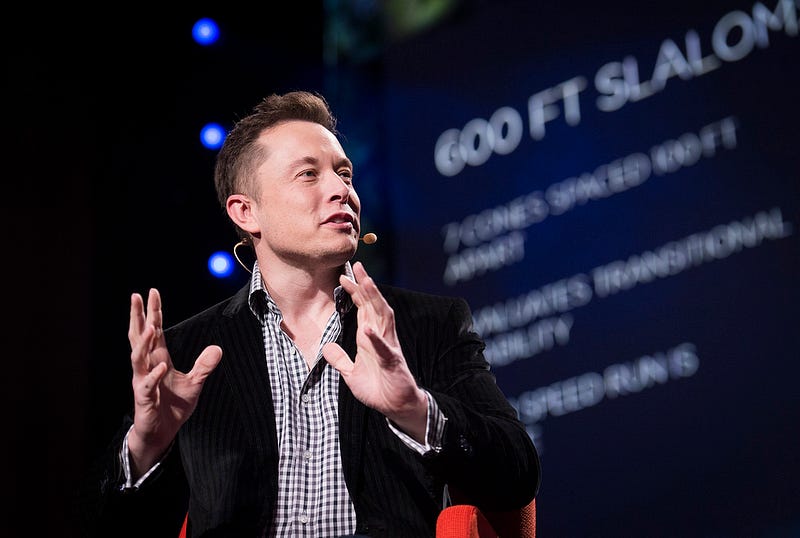
Elon Musk at TED

Elon Musk gave an interview today at TED. He ended the interview by asking, “You’ll tell me if it ever starts getting genuinely insane, right?”

The headline news, which isn’t really new news, is that Musk would like to build a new highway system, underground.

The man is nothing if not audacious.

On a more immediately feasible note, he also says, “November or December of this year, we [Tesla] should be able to go from a parking lot in California to a parking lot in New York, no controls touched at any point during the entire journey,”

That’s pretty awesome, although the catch with these things is how generalizable the solution is.

If the demonstration works only from one very specific parking lot in New York, to another very specific parking lot in California, and only over one precise cross-country route, that’s impressive but not groundbreaking. Delphi actually did something like that a few years ago.

If, on the other hand, Tesla builds a system that can drive over a wide variety of routes, that will be a huge step toward Level 5.

First They Came for the Electric Vehicles

There is a well-known playbook for disrupting an industry, and it was written by Clayton Christensen in 1997 and called, The Innovator’s Dilemma.

In particular, the book looks at the tendency of disruptive firms to first target the lowest-margin, least exciting parts of an incumbent’s business. This competition might annoy the incumbent, but nobody panics, precisely because that line of business is so low-margin and minor.

Over time the disruptor gradually eats more and more of the incumbents business, until the incumbent is left hanging onto only the most lucrative, highest-margin product lines.

And then those get eaten, too.

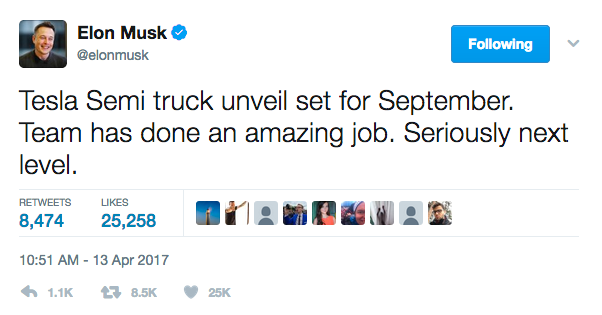
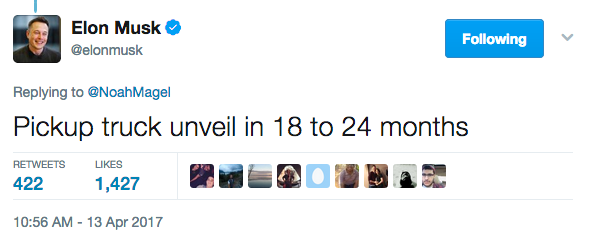
This is what I thought about today when Elon Musk announced that Tesla will be unveiling a pickup truck in the next two years.

Ford makes very nice mass-market sedans, and I own a Ford C-MAX Energi hatchback that I love. But Ford’s real profit-driver is the F-Series. Pickup trucks are what make Ford work as a business.

(All of this also applies to GM and Chrysler, but I feel this most personally when applied to Ford, so in this post I’ll use them as the exemplar of the Big Three.)

In 2008, when Tesla entered the market with a super-expensive, high-performance electric Roadster, it was no big deal. Ford barely makes that type of car.

Then in 2012, when Tesla expanded its product line to include a $80,000+ electric luxury sedan, that was hardly any closer to home. Ford makes vehicles for America. Tesla made vehicles for Silicon Valley millionaires.

Same story in 2015, when Tesla launched a $120,000+ electric Model X SUV.

Tesla only really threw down the gauntlet with the unveiling of the $35,000 Model 3 sedan, and that hasn’t even shipped yet.

But today’s announcement that Tesla is entering the pickup market?

That’s not business. It’s personal.

It’s also genius.

Teslas Now Have Self-Driving Hardware

According to the Tesla blog:

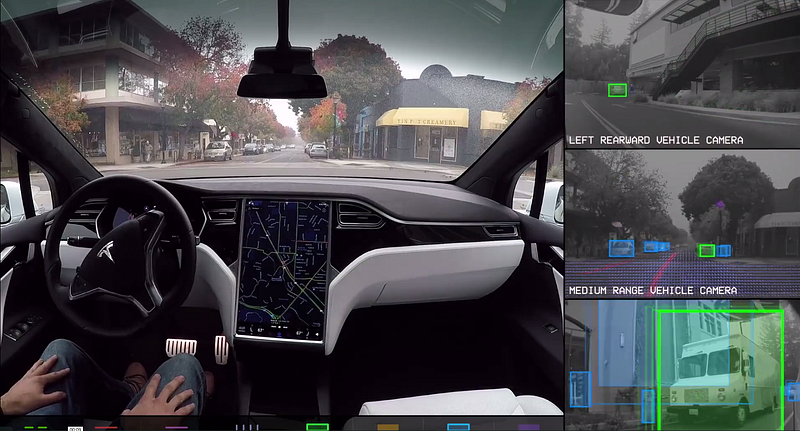
We are excited to announce that, as of today, all Tesla vehicles produced in our factory — including Model 3 — will have the hardware needed for full self-driving capability at a safety level substantially greater than that of a human driver. Eight surround cameras provide 360 degree visibility around the car at up to 250 meters of range. Twelve updated ultrasonic sensors complement this vision, allowing for detection of both hard and soft objects at nearly twice the distance of the prior system. A forward-facing radar with enhanced processing provides additional data about the world on a redundant wavelength, capable of seeing through heavy rain, fog, dust and even the car ahead.

This is an interesting announcement because it lays so much responsibility on the software. No other company working on fully autonomous vehicles (that I’m aware of) thinks it can be done with just cameras, ultrasonics, one forward-facing radar.

Most competitors are relying on lidar plus 360-degree radar.

If Tesla pulls this off, it will be a game-changer.

Tesla Makes Radar a First-Class Citizen

Tesla has announced that Autopilot will increase its reliance on radar, promoting it to first-class status within the sensor suite of Tesla vehicles.

The radar was added to all Tesla vehicles in October 2014 as part of the Autopilot hardware suite, but was only meant to be a supplementary sensor to the primary camera and image processing system.

After careful consideration, we now believe it can be used as a primary control sensor without requiring the camera to confirm visual image recognition.

The blog post does not mention the fatal accident back in May that occurred while the car was on Autopilot, although it’s easy to speculate that the Autopilot update may be related to that specific accident.

When the car is approaching an overhead highway road sign positioned on a rise in the road or a bridge where the road dips underneath, this often looks like a collision course. The navigation data and height accuracy of the GPS are not enough to know whether the car will pass under the object or not. By the time the car is close and the road pitch changes, it is too late to brake.

That is basically the same scenario that caused the May accident.

Tesla does relay some interesting information about why they initially relied much more heavily on camera than on radar.

This is a non-trivial and counter-intuitive problem, because of how strange the world looks in radar. Photons of that wavelength travel easily through fog, dust, rain and snow, but anything metallic looks like a mirror. The radar can see people, but they appear partially translucent. Something made of wood or painted plastic, though opaque to a person, is almost as transparent as glass to radar.

The blog post also covers at least one scenario in which Tesla is uploading driving data from its users and using that to teach the fleet to drive better. And that’s notable in and of itself.

So, all around, a blog post worth reading.

Tesla Crash Update

According to several news outlets, Tesla engineers testified in front of Congress that they are still uncertain what caused the fatal crash in Florida in early May.

There are two theories, one involving radar and camera, and one involving the brake system.

I tried to find a story to link to, but they all seem to open noisy videos, sorry.

This is a little bit of a puzzling outcome, and may explain why Tesla waited so long to announce the crash in the first place.

Standard practice would be to recover the sensor data leading up to the crash from the vehicle, feed that data into a simulator, and figure out what happened.

Surely Tesla has a simulator. So I can see at least two possibilities for the confusion:

  1. Tesla was unable to recover all of the sensor data from the crash.
  2. Tesla recovered all the sensor data, feed it into the simulator, and the simulator didn’t crash. That might leave Tesla at a loss to explain the discrepancy between the simulator and the real world.

The latter is more worrisome than the former.

Tesla and Mobileye Break Up

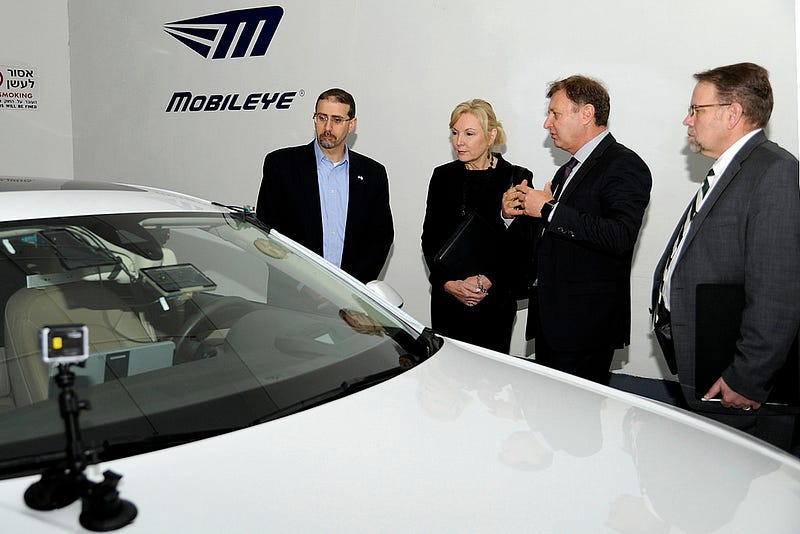
On an earnings call today, Mobileye announced that it will not be providing any more computer vision or sensing products to Tesla. This ends what had been perhaps the most prominent manufacturer-supplier relationship in the autonomous vehicle world.

Mobileye announced that it will move from focusing on driver assistance components to a focus on fully autonomous vehicle components. However, Mobileye CTO Amnon Shashua declined to state who broke up with who.

This is a huge surprise to me, although in hindsight there were some signs.

Immediately after the announcement of the first Tesla Autopilot fatality, Mobileye and Tesla issued conflicting statements about whether Tesla could have used Mobileye’s technology to prevent the crash. Mobileye said its products were not yet designed to handle that type of situation, whereas Tesla indicated the sensor data could be used to avoid future such accidents.

That was a surprising amount of daylight between two normally tight partners.

Tesla CEO Elon Musk also tweeted some positive statements about progress being made with Bosch, which is Tesla’s radar vendor. The absence of any such statements with Mobileye was conspicuous.

Finally, there have been on-again-off-again rumors about whether Tesla was looking for a different computer vision vendor for years.

Writing all that down, I’m thinking maybe this wasn’t such a shock after all.