Ride-Sharing Doesn’t Work with a Phone

The Cubs-Giants game went thirteen very long innings last night and ended in heartbreak (for me, at least), with the Giants knocking in a walk-off run in the bottom of the 13th inning.

It was also 11:45pm and the game had been going on for five hours.

As I stumbled out of the stadium, I realized my phone was totally dead. Five hours of emails and web browsing between innings had drained the battery.

If my phone had been working, I might have just hailed an Uber home and tucked into bed. But my phone wasn’t working.

No worries, though! In San Francisco, the train station is just blocks from the ballpark. I hustled on over to Caltrain, waited forever for the train to leave, and then learned I got on the wrong train. The train I was riding wouldn’t make its first stop until 8 miles past my house.

I disembarked the first chance I could and walked into an empty parking lot at the Belmont Caltrain Station at 12:45am. No taxis.

A gas station light flickered across the street and I rolled over and begged the attendant to call a cab. No cabs available.

Then I bought a charger from the station’s inventory and hailed an Uber, which took twenty minutes to arrive, being past midnight in the suburbs.

I finally tucked into bed at 1:30am.

So what’s the moral of the story?

Mostly that I shouldn’t have totally drained my phone battery, and I should look at train schedules.

But also that, in the days before ride-sharing, it was more common to have taxis circling around and you didn’t need a phone to hail them.

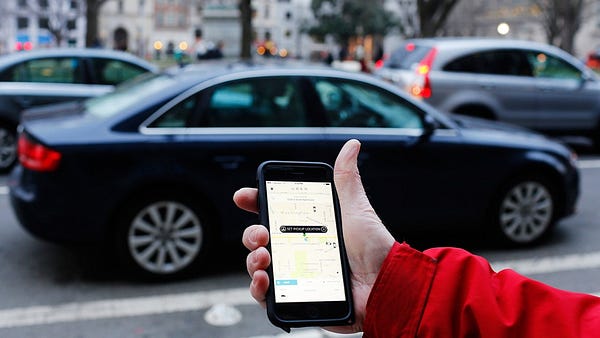
The world today is a better place because of Lyft and Uber, but it does require a phone to navigate.
Uber China and Didi Merge

Uber China (not global Uber) is merging with Didi Chuxing. These are the two biggest ride-sharing services in China, and they’re becoming one.

This news is really about the ride-sharing wars, and not so much about autonomous vehicles. But a lot of people believe that autonomous vehicles and ride-sharing services will be integrated in the future, so it seems worth noting.

Didi is by far the larger of the two competitors, and some news articles are calling this a sale by Uber, not a merger. But both Uber and Didi have been burning cash in an effort to subsidize drivers, lure riders, and keep up with each other.

In the US this type of deal might face regulatory scrutiny, but I haven’t seen any commentary on that in the coverage I’ve read.

It is notable that Uber CEO Travis Kalanick, in his email to staff announcing the merger, said the deal would free up cash to invest in “self-driving technology” among other things.

Uber’s Self-Driving Car

Uber won the Internet today with news that it is testing its self-driving car in Pittsburgh, the hometown of its Advanced Technology Center.

Kudos to Uber!

Testing a self-driving car is a big step, especially in real-world scenarios.

Photos of the car show an impressive array of sensors, which must make the car insanely expensive. In fairness, Uber ATC head John Bares is completely open that this is “nascent technology”.

It’s pretty exciting for me that they picked a Ford Fusion as the base for the car!

On-Demand Mobility Is Still Expensive

I needed to get home from work late last night and I didn’t have a car. Cry me a river.

So I went to the Palo Alto train station, only to discover that I had read the train schedule on my phone wrong. The next train wasn’t passing through for another 45 minutes.

So I looked up the cost of a ride-share home. The distance is a hair under 15 miles.

Lyft wouldn’t even quote me a price — apparently the ride was out of their service area.

Uber quoted me a price of $50.

The train is $5. I got two slices of pizza and waited for the train.

Maybe this isn’t a good use of time, running the cost benefit analysis. But it was just hard for me to pull the trigger on a $50 ride home.

Google’s Self-Driving Cars Graduate from X

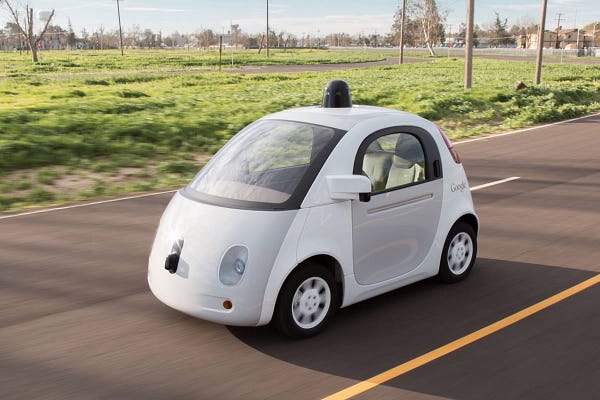
Astro Teller, the head of Google X, says that the self-driving car project may be ready to graduate from X.

The key takeaway here is apparently that the unit is ready to make money and stand on its own two feet, financially.

That, of course, raises the question of how the unit will make money.

The most likely scenario seems to be more-or-less direct competition with Uber. The unit might launch ride-sharing services first on geo-fenced areas such as college campuses, and grow out from there.

Google Applies a Little Pressure to Uber

Google Applies a Little Pressure to Uber

One of the elements of the self-driving car industry that fascinates me is the interplay of cooperation and competition between companies.

Google is the most interesting company in this regard, because Google is so large that it touches many different elements of other businesses.

For example, Google Ventures has invested money in Uber, Google Maps supplies Uber, [Google] Android is Uber’s largest platform, and yet [Google] X is building self-driving cars that might compete with Uber.

And recently, Google Maps began directing users to services that compete with Uber.

In some countries, searching for a route from one destination to another now prompts Google Maps to provide information about Uber and about competitive ride-sharing services.

Interestingly, the US is not in that list of “some countries”. Google Maps does not promote Lyft in the US, only Uber. So far.

Florida Town to Subsidize Uber

This isn’t strictly related to self-driving cars, but it came across the wire and is fascinating.

Altamonte Springs, Florida, (near Orlando) has chosen to subsidize Uber in leiu of building new roads.

The hope is that subsidizing Uber will encourage people to use mass transit.

“It is infinitely cheaper than the alternatives,” said Martz, whose city has a population of about 43,000 and median income of $50,000. “A mile of road costs tens of millions of dollars. You can operate this for decades on $10 million.”

The logic here is that Alamonte Springs is home to many commuters who ride public transportation into Orlando. However, just getting to public transportation can be a pain. The train and bus stops may not be close to a person’s house. So the city will subsidize Uber rides within town, to help people get to their bus stops and to the train station.

It might not be as crazy as it sounds.

For a while, my wife worked in a suburban office right next to the DC Metro’s Red Line, exactly between two Metro stations. Unhappily, the office was 1.5 miles from each station, which was just far enough to make Metro impractical. So she drove every day, even though her office literally overlooked the Red Line.

Maybe this service can solve that problem.

There are lots of objections to this project, but I suspect much of that is because people don’t like tax dollars “subsidizing” a huge company like Uber.

In this case, though, it’s probably more accurate to think of the city as contracting with Uber to offer a better in-town public transit service.

Almono

About a year ago, Uber more or less bought out the famed robotics department at Carnegie Mellon University in Pittsburgh.

The goal, of course, was to acquire a team capable of building autonomous vehicles.

Since then, however, not much news has come out of Steel City regarding Uber’s autonomous vehicle plans.

This week, though, Uber put forth a plan to turn an old steel mill into a vehicle test-drive site. The site, known as the Almono, is an exciting development for Pittsburgh.

There is some local opposition, however, mostly in the form of Pittsburgh-based Uber drivers who are not looking forward to being replaced by robots.

Ride-Sharing Monopoly

In business school we did a case on eBay that was teed up perfectly for the professors to disabuse students of a cherished notion.

The central question was what makes eBay such a successful marketplace? And the intuitive answer is “network effects”. The more people are using eBay, the more the next user wants to join eBay, instead of a competitor.

And the professors loved this answer because it is so easy to pop a hole in it.

Buyers don’t want to be with other buyers — the competition just drives up prices. And sellers don’t want to be with other sellers — the competition just drives down prices.

Instead, the professors argued, it was eBay’s reputation metrics that really drove its success. Buyers and sellers want to transact with counterparties that have solid reputations, and only eBay can provide that.

This is a good and correct answer, but it’s always seemed incomplete to me. eBay has a couple of other strengths:

  1. eBay has a thick market. There is no other market where you can find the Danish Christmas ornament from exactly 28 years ago that you just shattered and need to replace.
  2. eBay has an incredible brand.

The point about branding is especially easy to ignore, in business school and elsewhere, because it is so close to magic. How do you build a good brand? How do you know if you have one? How do you know if one brand is stronger than another brand? How do you quantify when a brand is strong enough to support a monopoly?

Warren Buffett was a famously late in life convert to the power of branding, in all its mystery.

Which brings us to ride-sharing and Uber.

Uber, like eBay, has power in its reputation metrics, in the thickness of its market, and in its brand.

So how do these stack up to eBay?

  1. Uber’s reputation metrics are less important than eBay’s. Uber’s ride-sharing flow is simpler than eBay’s asynchronous process of buying, and paying, and shipping, and receiving, so counterparty reputation matters less.
  2. Uber’s market thickness is more important than eBay’s. If an Uber driver or rider can’t find a match at any given moment, they’re much more likely to give up on the service altogether, than if an eBay buyer or seller can’t find a match.
  3. Uber’s brand is as important as eBay’s. But Uber hasn’t locked up the market yet. Lyft is on their heels. The question is, unlike with online auctions, is there room for two players?

One last note is that while eBay does not have a direct competitor, Craigslist serves as an alternative, albeit a distinct one.

Lyft is much more of a direct competitor to Uber than Craigslist is to eBay, but the existence of Craigslist raises the possibility that two firms could survive in the market.

H/T to Jared Myer and Daniel Pryor’s post in Forbes, which inspired this.


Originally published at www.davidincalifornia.com on February 16, 2016.