
Self-Driving Car Predictions for 2017

Self-Driving Car Predictions for 2017

On the first day of 2017, here’s what I think the year to come has in store for self-driving cars.

In the style of Scott Alexander, I attach confidence levels to my predictions.

  1. 1 Udacity Self-Driving Car Engineer Nanodegree Program student will start a new, permanent, full-time autonomous vehicle job: 99%
  2. Level 4 self-driving cars will be available for ridesharing on public roads somewhere in the world: 90%
  3. Level 4 self-driving cars will be available for ridesharing on public roads somewhere in the United States: 90%
  4. Ford will not push back its 2021 target launch for Level 4 vehicles: 90%
  5. 100 Udacity Self-Driving Car Engineer Nanodegree Program students will start new, permanent, full-time autonomous vehicle jobs: 90%
  6. No US highway will have a speed limit for autonomous vehicles that is faster than the speed limit for human-driven vehicles: 90%
  7. 1000 Udacity Self-Driving Car Engineer Nanodegree Program students will start new autonomous vehicle jobs (possibly contract roles or internships): 80%
  8. Level 4 self-driving cars will be available for ridesharing on public roads in Singapore: 80%
  9. A company will be acquired primarily for its autonomous vehicle capabilities with a valuation above $100 MM USD: 80%
  10. No company will sell a vehicle with autonomous technology that exceeds what Tesla offers: 80%
  11. At least 1 company that has not done so before will complete a continuous US coast-to-coast demonstration trip in a fully autonomous vehicle: 80%
  12. Level 4 self-driving cars will be available for ridesharing on public roads in California: 70%
  13. Conditional on Level 3 self-driving cars being legal somewhere, Tesla will enable Level 3 autonomy in that location: 70%
  14. Google will offer rides to the public in its self-driving cars: 70%
  15. No member of the general public will die in a Level 4 vehicle: 70%
  16. 2500 Udacity Self-Driving Car Engineer Nanodegree Program students start new autonomous vehicle jobs (possibly contract roles or internships): 60%
  17. Level 4 self-driving cars will be available for ridesharing on public roads somewhere in Europe: 60%
  18. Level 4 self-driving cars will not be available for ridesharing on public roads somewhere in China: 60%
  19. No company will be acquired primarily for its autonomous vehicle capabilities with a valuation above $500 MM USD: 60%
  20. A new autonomous vehicle startup will form and raise money at a valuation above $75 MM USD: 60%
  21. Ford will commit to launching Level 4 vehicles before 2021: 50%
  22. Level 4 self-driving cars will be available for ridesharing on public roads somewhere in the world, without a safety driver: 50%
  23. Level 3 self-driving cars will be available for private ownership somewhere in the United States: 50%
  24. Somebody will die in a Tesla Autopilot crash: 50%
  25. Level 4 autonomous vehicles will be available for public ridesharing when snow is on the ground: 50%

Note: Udacity has partnerships with several companies I mention here, and I used to work at Ford, but none of these predictions stem from non-public information.

Update: The SAE definitions are here: https://en.wikipedia.org/wiki/Autonomous_car#Classification

Basically, a Level 3 vehicle is fully self-driving, but the driver must be able to take control of the vehicle at a moment’s notice.

A Level 4 vehicle is fully self-driving in most situations, and the driver does not need to be ready to regain control of the vehicle.


Top Posts in 2016

This blog is a quantity-over-quality endeavor. I try to post every day, and hopefully a few things resonate over the course of a year.

Here are the posts that resonated most in 2016:

Term 1: In-Depth on Udacity’s Self-Driving Car Curriculum

We need to get the curriculum off my personal blog and onto our program homepage. But for now, this is where prospective students come to learn what’s in the program.

Tesla’s Autopilot Crash

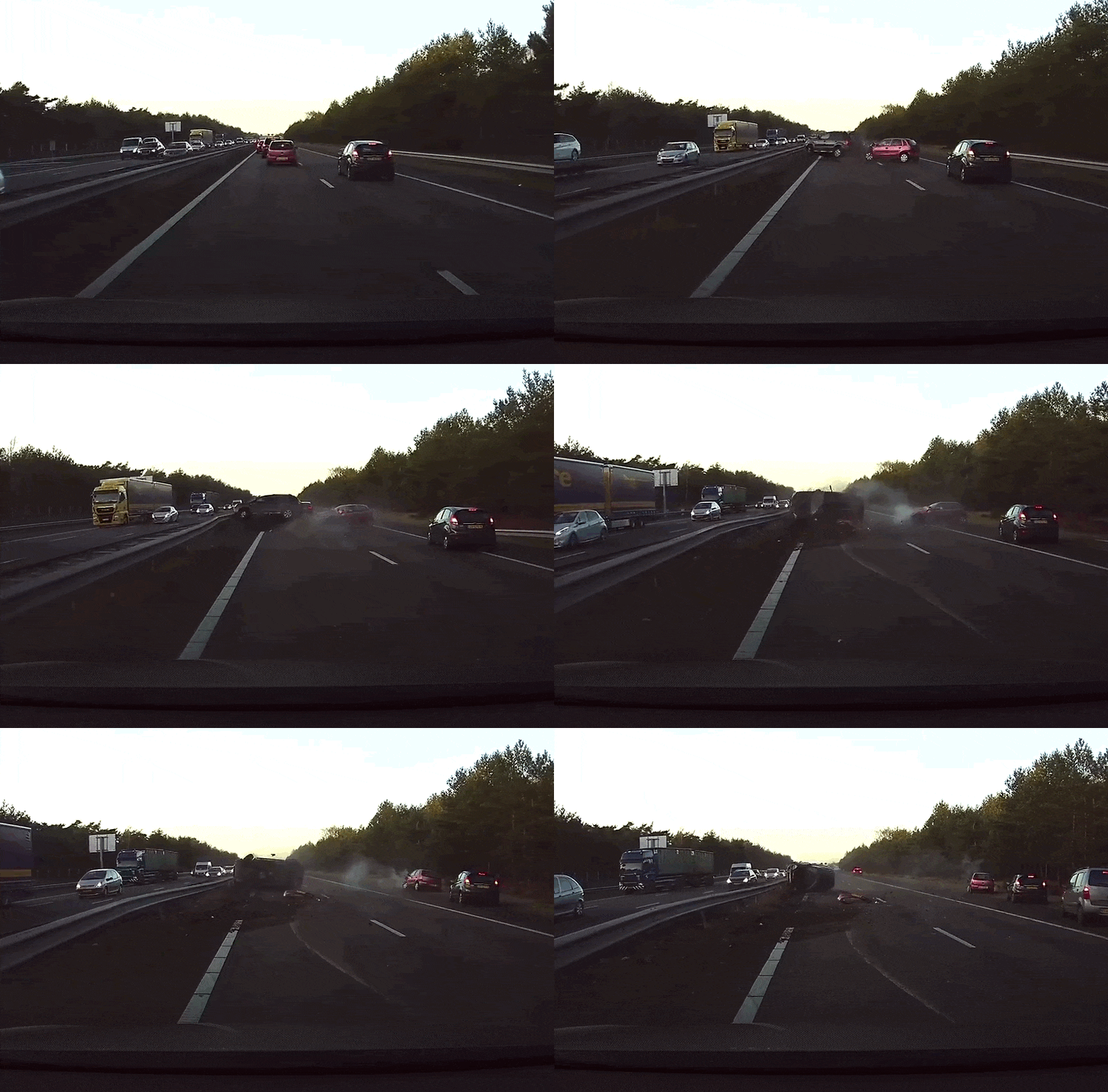
A meditation on why the very first self-driving car fatality might have happened, and what it meant for the industry.

Self-Driving Car Employers

If you want to work on self-driving cars, here’s who’s hiring, and why.

Udacity Self-Driving Car Nanodegree

I’m building a self-driving car curriculum with Sebastian Thrun! And many other great people and companies.

How to Land an Autonomous Vehicle Job: Coursework

Here are the online courses I took that helped me land a job with Ford’s Autonomous Vehicle team. You, of course, should just enroll in the Udacity Self-Driving Car Engineer Nanodegree Program 🙂

2016 in Review

Looking through my Medium posts from 2016, I wish I had sat down on January 1, 2016, and written predictions of what I thought the year would bring for self-driving cars, so that I could check those predictions now.

I’ll write that kind of post for 2017 this afternoon.

For now, here’s my take on 2016.

January: GM Invests in Lyft

February: Google Causes the First Self-Driving Car Crash

March: GM Buys Cruise

April: Self-Driving Car Companies Lobby for Consistent Federal Regulation

May: Uber Launches Self-Driving Cars in Pittsburgh

June: BMW, Intel, and Mobileye Partner on Self-Driving Cars

July: Delphi Tests Self-Driving Cars in Singapore

August: nuTonomy Launches Self-Driving Cars in Singapore

September: Apple Pulls Back on Self-Driving Cars

October: Tesla Announces Self-Driving Car Plan

November: nuTonomy to Launch Self-Driving Cars in Boston

December: Uber Launches, Then Cancels Self-Driving Cars in San Francisco

I pulled these headlines from Google News. Next year, I hope to see lots more launches. I’d also love to see Udacity make this list in 2017!

Self-Driving Cars and Organ Donation

Slate says: Self-Driving Cars Will Make Organ Shortages Even Worse. This will happen in two ways.

One, about 20% of US organ donations come from car accident victims. Presumably self-driving cars will reduce the number of organs available.

Two, a common place to opt-in to organ donation is at the DMV, while obtaining or renewing a driver’s license. Presumably self-driving cars will reduce the number of people who get driver’s licenses, and thus reduce the number of people who opt-in to organ donation.

The rest of the article is mostly about ways to improve the organ donation system in the US, irrespective of self-driving cars.

But it is an interesting case study a second-order effect autonomous vehicles will have on our world.

New Vehicle-to-Vehicle Communication Rules

Urban planner and historian Sarah Jo Peterson emails me that the US Department of Transportation just proposed a rule requiring automakers to include vehicle-to-vehicle communication hardware in new cars, and to use a common standard.

Of course, this is just a proposal. Before this could ever take effect, a new presidential administration will be in place and they might have their own views.

Peterson notes some concerns:

Are we moving to a world where bicycles need V2V and pedestrians need V2V? What does it mean for an act of mobility to require continuous government permission? (If you are not broadcasting, are you illegal? Will you be shut down in real time?)

I agree and would prefer if V2V arose as a de facto standard, instead of a de jure standard mandated by the government. This might be tougher for vehicle-to-infrastructure communication, which necessarily involves communication with government property, like traffic lights.

But if SMTP could rise as a de facto standard, the cause does not seem lost.

Meanwhile, Peterson points me to a Transportist blog post by David Levinson, arguing that in some scenarios, vehicle-to-vehicle communication may even be harmful in some scenarios.

The full blog post is hard to excerpt, but Levinson emphasizes that if we come to rely on vehicle-to-vehicle communication to navigate intersections (for example), a bug in the system or an unexpected event (he suggests a deer crossing the road) could bring traffic to a halt and possibly cause massive collisions.

I’m a little less pessimistic on that front, but Levinson is a professor of transportation and has been working on this problem for a decade, so I might defer to his logic.

How Ford Builds Autonomous Vehicles

Chris Brewer, the chief engineer for Ford’s Autonomous Vehicle Program, has a great post on Medium outlining the major components of Ford’s self-driving car.

Pay attention to the part where he talks about compute platforms and power consumption. That was my team!

Well, to make fully autonomous SAE-defined level 4-capable vehicles, which do not need a driver to take control, the car must be able to perform what a human can perform behind the wheel. Our virtual driver system is designed to do just that. It is made up of:

Sensors — LiDAR, cameras and radar

Algorithms for localization and path planning

Computer vision and machine learning

Highly detailed 3D maps

Computational and electronics horsepower to make it all work

It comes with a nifty video!

https://www.youtube.com/watch?v=6QJeaK7U87o

Should You Understand Backpropagation?

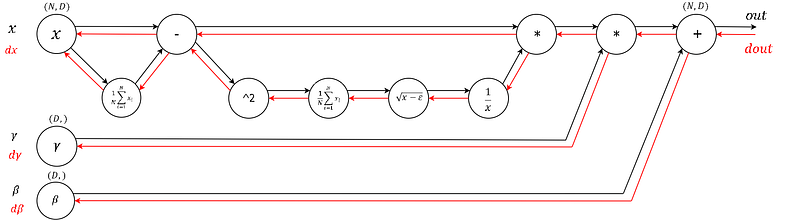
Backpropagation is a leaky abstraction; it is a credit assignment scheme with non-trivial consequences. If you try to ignore how it works under the hood because “TensorFlow automagically makes my networks learn”, you will not be ready to wrestle with the dangers it presents, and you will be much less effective at building and debugging neural networks.

That is from the excellent Andrej Karpathy, “Yes you should understand backprop”.

I say it’s possible to use deep neural networks quite effectively without truly understanding backprop. But if your goal is to specialize in the field and apply this tool to a range of problems, then “yes you should understand backprop”.

By the way, @karpathy is a prolific Twitter feed with 37,100 followers.

How to Become a Self-Driving Car Engineeer Talk

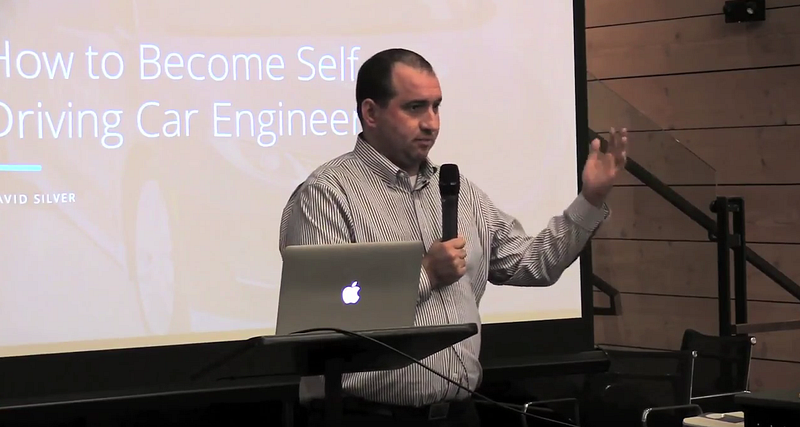
In November I gave a talk the Bay Area AI Meetup entitled, “How to Become a Self-Driving Car Engineer”. A fair bit of the talk was an overview of the Udacity Self-Driving Car Engineer Nanodegree Program. But we also touched on a variety of other topics related to autonomous vehicles, particularly during the question and answer session.

The slides for the talk:

The Lane-Finding demo:

The talk itself:

An interview I recorded after the talk with Alexy Khrabrov, the founder of Bay Area AI:

Thanks to the Bay Area AI team for having me!

Waymo

The Alphabet (Google) self-driving car unit is spinning out as a separate subsidiary within Alphabet, called Waymo.

This is not a surprise, because Google has been telegraphing this move for months.

That said, it’s not obvious what the practical implications of the move are.

TechCrunch speculates:

As an independent company under the Alphabet umbrella, Waymo will likely be less insulated from scrutiny regarding its progress and performance as a business, so its next steps in terms of partnership and sales or licensing model will be very interesting to watch.

It’s not obvious to me why that would be the case, unless Alphabet starts breaking out Waymo’s financial details in its annual reports. Alphabet hasn’t done that with other business units, though, so it seems unlikely they would do that with Waymo.