Electric Vehicle Monday: Utilization

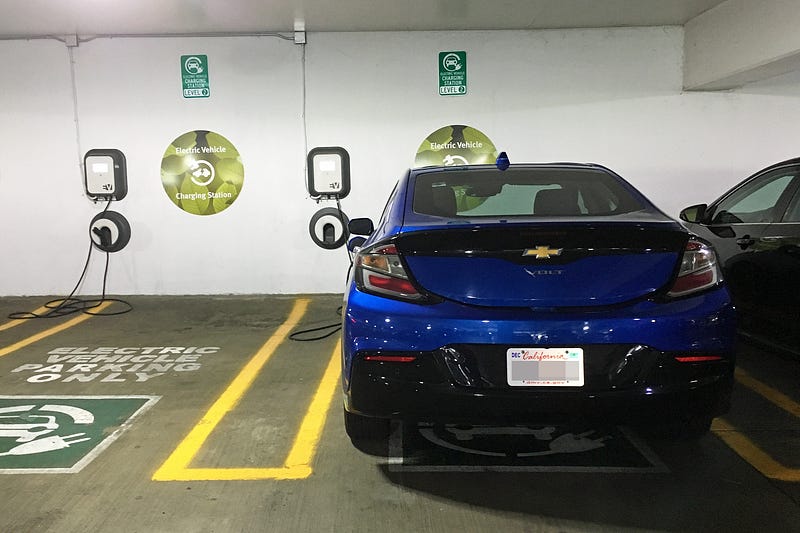
A team of economists contends that electric vehicles travel about half as much as their internal combustion engine (ICE) counterparts, about 5000 miles for EVs compared to 10,000 for ICEs. The researchers speculate that this information supports the hypothesis that EVs and ICEs are complements, rather than substitutes.

That is, EVs may not take over the world, but multi-car households may choose to own both an EV and an ICE, and utilize them for different types of trips.

The effort that went into the study is impressive — the team linked data from the California utility PG&E with data from the California DMV, in order to figure out which households owned EVs, how much more electricity they purchased, and thus how many miles they likely drove. There seem to be some careful corrections, for example, the data accounts for solar panel ownership and the resulting drop in demand from the electrical grid.

The results of the study seem plausible and maybe even intuitive — the type of households that purchase EVs seem plausibly likely to also be low-mileage households, generally, and also multi-car households.

Perhaps because of that plausibility, I’m hesitant to conclude too much from the study, other than electrification is still relatively new and limited technology. Presumably, as electrification expands, the types of households that purchase EVs will come to more closely resemble the median household. At the same time, EV range seems to be ever-increasing.

For now, EVs are still largely a status and luxury good for consumers that can afford the cost and other limitations. But they seem to be moving steadily mass-market.

Big News Day For Ford

Ford reported Q4 earnings this afternoon, posting a $2.8 billion loss, or a $1.3 billion dollar gain, depending on whether how we count “special items.” That’s a $4.3 billion swing.

The bigger news seemed to be Ford’s 2021 outlook. CFO John Lawler estimated Ford would book an annual pre-tax profit of $8 billion to $9 billion dollars in the coming year. That would be a great year for Ford, and potentially its largest profit in 5 years. Although given that this past quarter’s swing due to “special items” was $4.3 billion, there’s a lot of variability here.

Ford also announced a big investment in electric autonomous vehicles. The headline number is $29 billion through 2025, of which $22 billion will go to electric vehicles and $7 billion will go to autonomous vehiicles. Various tweeters explain some of this headline number includes some expenditures from previous years, so it’s not clear how much of this is new money.

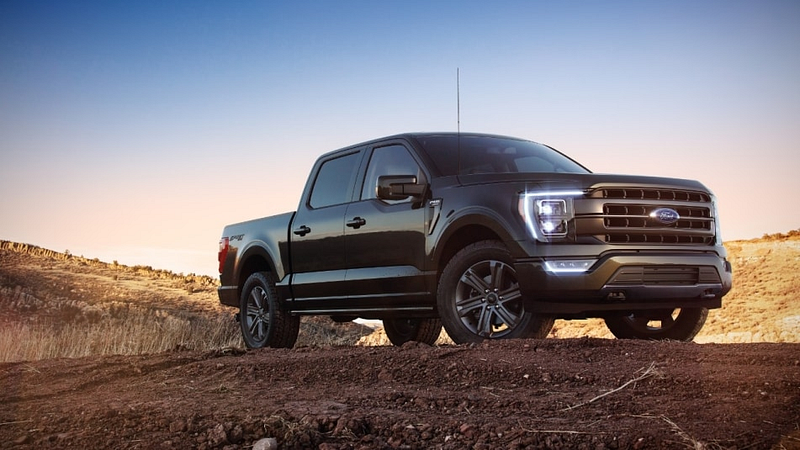
Meanwhile, The Wall Street Journal reports that Ford may under-perform expectations by a billion dollars or two, because of a global shortage of semiconductor chips. The shortage is already hitting both GM and Ford. Ford, in particular, is set to cut shifts at its F-150 plants in the coming weeks, due to the lack of chips. Since the F-150 is Ford’s profit engine, that’s expensive.

Electric Scooters

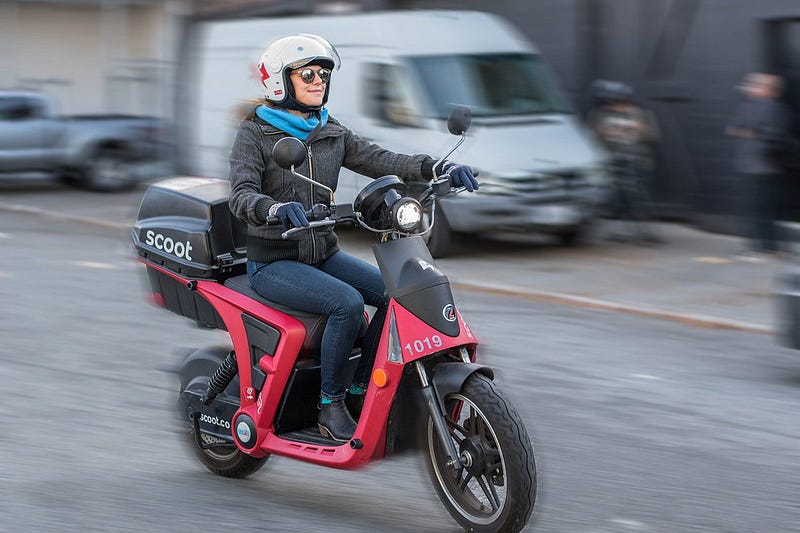
In the Before Times, I used to commute to San Francisco by car or train, drop my son at preschool in one part of the city, and take a short ride on an electric scooter to my office in another part of the city.

I really enjoyed the scooter ride, although I can’t defend why I would never purchase a motorcycle but I gleefully navigated a scooter through San Francisco traffic.

So I read with some interest a story in City Monitor called, “The future of transportation is small and electric.” The story is largely about the potential of electric scooters to dramatically reduce pollution in Asia.

“In India, people purchase 17 million motorcycles and scooters every year, and only about three million cars and trucks. The motorcycles can be quite cheap — and getting people to switch to electric can be strongly influenced by subsidies, tax advantages and other promotional policies.”

I’ve only taken a few trips to southeast Asia, but I have always been overwhelmed by the volume of motorcycle and scooter traffic. India, in particular, has some of the worst air pollution in the world due to these vehicles.

“It’s clear that getting gas vehicles off the streets can make a quick difference in air quality. Delhi, India’s capital, discovered this phenomenon in April, just a few weeks into the first Covid-19 lockdown. With most of its 5.5 million motorcycles sidelined, the city, deemed by the World Health Organization to be among the world’s most polluted, experienced something it hadn’t seen in decades — blue skies — and levels of harmful particles in the air fell by close to 60%.”

I look forward to a future world of blue skies and no (or at least much less) air pollution.

Tesla Talking With Samsung About 5nm Chip

According to a Korean website called Asiae, Tesla is talking with Samsung about building an infotainment chip based on Samsung’s 5nm technology.

I did not realize this, but Samsung is already building Tesla’s current, Hardware 3.0 custom chip. That chip is based on Samsung’s 14nm technology.

Apparently the 5nm technology is based on extreme ultravoilet lithography, a technique that only Samsung and TSMC utilize.

I’ve always thought about chip manufacturing as a kind of boring and commodity endeavor, but with all the analysis of Intel vs. Samsung vs. TSMC vs. NVIDIA vs. Hauwei, I should probably start reading more about extreme ultraviolet lithography.

Electric Vehicle Monday

A couple of interesting news stories crossed the wire recently, with respect to electric vehicles (H/T Reilly Brennan).

In The Drive, John Voelcker explains all the caveats around GM’s recent announcement targeting an all-electric light duty vehicle fleet by 2035.

“Many people and companies aspire to many things. I aspire to get back in shape after a year of mostly isolation, for instance. Whether it actually happens is a very different story.”

In Harvard Business Review, a trio of academics suggest that automotive manufacturers follow Tesla’s lead and divert a little bit (ahem, a billion dollars each) to building out an electric vehicle charging network.

There’s a fair bit to take issue with in the analysis, starting with this confident but unsupported assertion:

“The reason why consumers still choose Teslas over products like Audi’s eTron or attractive EVs from GM’s Buick, Cadillac, GMC, and Chevy brands is perhaps surprisingly simple. They can drive their Teslas for long distances in full confidence that they will find convenient locations at which to recharge their vehicle.”

But the article raises a question that seems obvious but hadn’t occurred to me (at least not in any deep way) — why don’t gas stations install electric charging units?

The HBR article makes passing mention of this:

“Many existing fossil fuel energy firms, for example, have gas station assets that will eventually become stranded and could be repurposed for electric vehicles.”

But the analysis doesn’t go much deeper than that.

This is a question that charging network startups like Blink must think about constantly.

For sure, the economics are different. Charging cars takes much longer, so vehicle turnover is much lower. Gas stations are often affiliated with oil extraction companies, which might complicate adding electric power stations connected to the normal grid. Probably there are permitting issues.

But none of these seem insurmountable, especially as electric vehicle sales begin to increase and seem poised to explode.

And yet…I don’t think I’ve ever seen a gas station with electric charging bays. So what’s the story?

Download Luminar Lidar Data

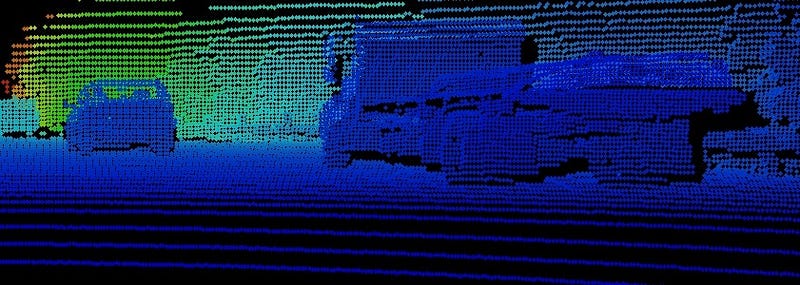
Volvo has just published a dataset called Cirrus which includes camera data and Luminar lidar data for 6,285 frames. The dataset includes 8 categories of annotations: “Vehicle, Large Vehicle, Pedestrian, Bicycle, Animal, Wheeled Pedestrian, Motorcycle, Trailer.”

I love how many companies are publishing datasets. This seems to especially make sense for a supplier like Luminar. Engineers anywhere can try out Luminar data without having to engage a sales rep or even convince their own managers.

The name of the dataset, “Cirrus,” highlights the range of Luminar’s lidar. At 250m, Luminar lidar is high range, just as Cirrus clouds are high altitude.

Driverless Robotaxis In China

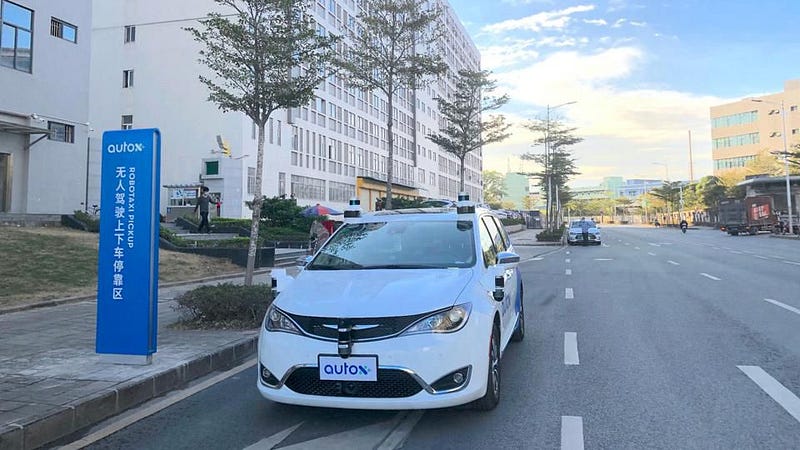
Yesterday, AutoX announced the launch of its driverless robotaxi service to the public in Shenzhen, China.

As I wrote in Forbes.com, the rollout resembles the process Waymo took to launch its driverless Waymo One service in Arizona, but AutoX is progressing much faster.

Whereas Waymo tested self-driving cars with human safety operators for a decade before advancing to driverless vehicles, AutoX was founded in only 2016 and just began testing fully driverless vehicles a few months ago.

This surprised me:

Also like Waymo, the base vehicle for the AutoX service is the Chrysler Pacifica minivan. The selection of an American automotive manufacturer for this initial program is notable because AutoX has partnerships with many Chinese manufacturers, including Dongfeng Motors, Shanghai Auto, BYD, and Chery Automobile.

There’s even an in-flight safety video you can watch. Read the whole thing.

Deep Dive on Mobileye REM Maps

Yesterday, I posted a brief overview of a couple of presentations Mobileye CEO Amnon Shashua gave at CES 2021 this month. I really enjoyed these presentations, in large part because over the years I’ve read less about Mobileye and know less about them than many other companies in the automotive technology ecosystem.

Today, I re-watched Shashua’s “deep dive” on Mobileye’s REM mapping approach. It’s quite informative, so I took notes.

  • REM is a Mobileye brand name that stands for Road Experience Management
  • The maps are generated from cameras. In the future, Mobileye’s lidar and radar will be designed to work with these camera-only maps, not the other way around.
  • In particular, even future lidar and radar systems will not use standard, point-cloud-based HD maps. Point clouds take up too much storage space to be practical, particularly for updating from a huge fleet of vehicles.
  • Instead of point clouds, REM uses “semantic” maps, that record sparse information, such as driveable paths, stop lines, and traffic signal locations.
  • Identifying this semantic segmentation and uploading it to the cloud takes 10 kb of data transfer per kilometer. This costs somebody (the manufacturer?) $1 per year, on average.
  • All of this begs a question, though — are maps even necessary?
  • In theory, maps aren’t necessary. After all, humans drive without maps (in many scenarios). Humans just figure out the road as we drive.
  • Artificial intelligence can do the same thing, but AI isn’t nearly as good as humans at this (yet). The Mean Time Between Failures (MTBF) for an AI will be low — lots of problems.
  • Solution: prepare a lot of this information in advance, and store it in the map.
  • Shashua says that everyone is using a map, even if they say they’re not. Pretty clear that this is a reference to Tesla.
  • Mobileye’s maps have three performance goals: Scale (consumer vs. robotaxi), Up-To-Dateness (real-time), Accuracy (cm-level)
  • Mobileye has a division which builds lidar-based HD Maps, so they know the pros and cons of this approach
  • Lidar-based HD maps are too detailed. The AI driver only need information for a 200m radius around the vehicle, but HD maps contain very detailed information about the entire world.
  • On the flip side, point clouds are just coordinates in space. AI needs semantic meaning: drivable paths, priority, crosswalks, stopping & yield lines.
  • Calculating this in real-time is theoretically possible, but practically impossible: too many conflicting signs and signals, too much noise, too much going on
  • Mobileye is now creating AV Map, which are not HD Maps: Scalability everywhere, Accuracy in 200m radius, Semantic features generated from wisdom of crowd
  • Map creation process: Harvesting -> Alignment -> Modeling & Semantics
  • In the photo above, only data marked by yellow lines in the photo is uploaded to the cloud. That’s the important information.
  • Mobileye extracts semantic meaning from the data and uses splines to represent driveable paths.
  • Currently, Mobileye maps 8M km of roads every day (6 countries). Unclear if this is 8M unique km, or the same 1km mapped by 8M vehicles every day.
  • By 2024, they’ll be mapping 1B km of roads every day (the whole planet).

Mobileye: Redundancy, Mapping, Safety

At this month’s virtual 2021 Consumer Electronics Show, Mobileye presented a lot. CEO Amnon Shashua sat for a friendly interview with Ed Niedermeyer, and Shashua also gave a standalone hour-long presentation about Mobileye’s technology.

Shashua highlighted three areas of differentiation that provide competitive advantages for Mobileye:

  • Redundancy
  • Mapping
  • Safety

Redundancy

The plan seems to be that Mobileye will build a camera-only driver assistance system, and then layer radar and lidar on top to get to Level 4 autonomy by 2025.

Mapping

Mobileye has worked to identify minimal amounts of high-valuable semantic mapping data that it can collect from each customer vehicle. Shashua says that uploading this data back to Mobileye costs about $1 per vehicle per year.

Safety

Several years ago Mobileye published RSS: Responsibility-Sensitive Safety. This is Mobileye’s approach to safety. Shashua views this framework as a key advantage for Mobileye. I confess I don’t understand how this approach compares to other efforts to validate AV safety.

I’m not sure how much to believe in the power of these advantages. But Mobileye is the world’s premier ADAS vendor and in the past I’ve found Mobileye a bit hard to learn about. So it’s a step forward to even get a sense of how they view their own advantages.

Argo’s 4th Generation Hardware

In Ground Truth, Argo’s autonomous vehicle publication, CTO Brett Browning provides an overview of their new hardware stack.

“Our new SDS [self-driving system] leverages customized components — not off-the-shelf stuff — including high-resolution cameras, lidar, radar, microphones, and inertial sensors, that meet rigorous industry safety standards.”

A few points struck me.

Microphones

Argo’s new setup includes three microphones, “to effectively listen for emergency responder vehicles.”

Waymo includes these sensors as well. I wonder how else Argo might be able to use audio, beyond first-responder detection.

Sensor Cleaning

“The new lidar base contains water jets for cleaning and fans for cooling, allowing the sensors to efficiently operate in extreme temperatures and for the optical windows to be automatically cleaned if they’re ever obstructed by rain or dirt.”

Making sure that all of the sensors is clean is one of those operational details that engineers could ignore a few years ago. But for production vehicles, this becomes critical. Argo must care about this even more than most companies, given its focus on operating in a wide variety of climates.

Redundancy

The post mentions several times that the new stack has computation redundancy.

“We have two independent computing systems that serve to maintain safe operations.”

The description is a bit vague on some important details. It’s unclear whether the secondary stack (labeled Complementary Autonomous Vehicle System — CAVS) is “fail-safe” or “fail-operational.” That is, if the primary system fails, can CAVS complete the vehicle’s route, or does it simply pull to the side safely and wait for assistance?

The post is also a bit unclear as to whether CAVS is a separate and redundant system, or whether it participates in the functionality of the primary system.

“… the computers use different detection algorithms so the backup computer has a unique perception ability which improves the robustness of response in an unexpected situation.”


Regardless of the nitty gritty details, it sounds like this system is a big step forward for Argo!