Startup Watch: By

Six months ago I wound up on a plane next to an executive from BYTON, an autonomous vehicle startup targeting the Chinese market.

At the time, I was unfamiliar with the company. But since then, BYTON has appeared more in the press. Most recently, they announced a partnership with Chris Urmson’s Aurora to power the autonomous stack in BYTON vehicles.

BYTON is notable for a few things.

First, the company seems to be a hybrid of China, Europe, and Silicon Valley, with leaders coming from all three locations. I wonder if more startups will be organized that way in the future.

Second, the are raising a ton of money. $200M so far, and they’re rumored to be raising a $400M round right now. Designing and manufacturing cars is capital-intensive.

Third, they are betting big on China’s electric vehicle mandate. The exact number or percent of vehicles that must be electric is a little hard to pin down, but it seems to be on the order of ten percent by 2020. BYTON is presumably hoping that being an electric-first vehicle company will give them an advantage.

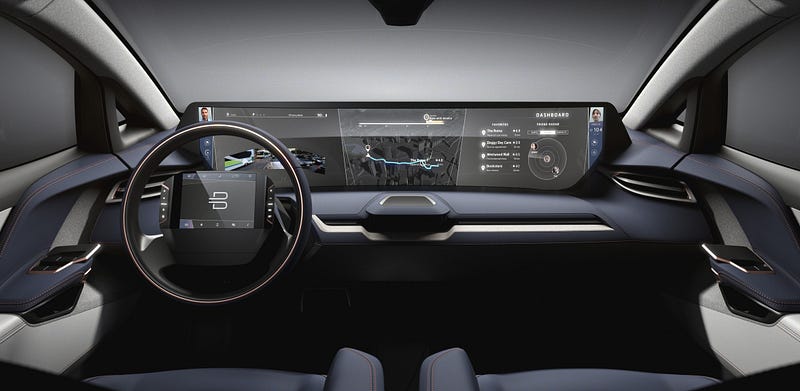
Fourth, look at that dash screen.

Waymo v. Uber is Over

They settled for $245 million in Uber stock and Uber denies using Waymo’s technology.

Per Uber CEO Dara Khosrowshahi:

To our friends at Alphabet: we are partners, you are an important investor in Uber, and we share a deep belief in the power of technology to change people’s lives for the better. Of course, we are also competitors. And while we won’t agree on everything going forward, we agree that Uber’s acquisition of Otto could and should have been handled differently.

And hopefully that will be the end of that.

The Gap

My wife’s car is finally showing its age. At 14 years and 216,000 miles, it’s starting to remind us that it needs replaced.

So we’ve been car shopping, which has called my attention to the gap between the self-driving cars the world is gearing up for, and what’s actually out on the market.

Some major brands just got their first adaptive cruise control this year. In other cases, in order to get ADAS features, you have to step all the way up to the highest trim level.

Want an Autopilot-like experience? There are a few options, but they’re all on cars that sell for $60,000-plus.

I’m excited for where self-driving cars are taking us, and how quickly we are getting there. But going car shopping illustrates how far this must seem to people who don’t work in the space very day.

The “Traffic Sign Classifier” Project

Traffic Sign Classifier is the second project, and the ninth lesson, in the Udacity Self-Driving Car Engineer Nanodegree Program.

In this project, students build and train a deep neural network to classify images from the German Traffic Sign Recognition Benchmark dataset. There are about 40 different types of German traffic signs in the dataset, each 32×32 pixels big. That’s not very big!

Nonetheless, each image is big enough for students to train a convolutional neural network to recognize what type of sign it is, with 95%+ accuracy. That’s close to, or even better than, the accuracy that humans like you and I reach when we classify images by sight.

The lesson starts out with a tour of LeNet, one of the canonical network architectures for image classification. We step through how to implement LeNet in TensorFlow, highlighting data preparation, training and testing, and configuring convolutional, pooling, and fully-connected layers.

We also show students how to spin-up a GPU-enabled EC2 instance from our partners at Amazon Web Services. Thank you to AWS Educate for providing free AWS credits to Udacity students!

At the end of the lesson, students get to apply, tweak, or completely revamp LeNet to train their own classifier. If you want to compare yourself to Yann LeCun, here’s how he did with the same dataset:

Ready to start learning how to build self-driving cars yourself? Great! If you have some experience already, you can apply to our Self-Driving Car Engineer Nanodegree program here, and if you’re just getting started, then we encourage you to enroll in our Intro to Self-Driving Cars Nanodegree program here!

Are Ridesharing Companies the New Airlines?

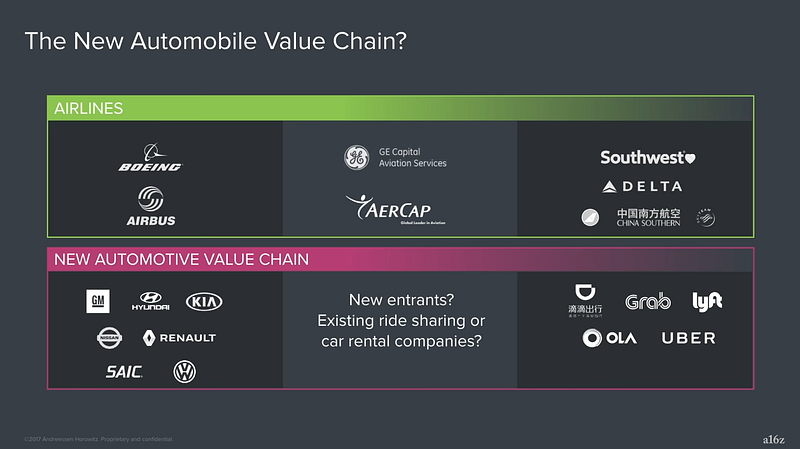
Reading through Frank Chen’s terrific eight-part series on self-driving cars and the world, I was struck by his comparison of ridesharing companies and airlines.

“The first structural change is to imagine whether the car value chain becomes a little like the airplane value chain. When you book a flight today your primary loyalty is to a carrier. Does the carrier go to the city that I want does it go, when I want, and is the price right? And so you think mostly about a relationship that you have with Southwest or Delta or China Southern, depending on where you live and what loyalty plan you belong to. You don’t make a decision primarily on the type of aircraft because that’s a decision the airline makes.

The car value chain is not like that at all today. We make very personal decisions about the cars that we drive and the models that we drive and the options that we put into our cars.

But if we shift to self driving, this value chain could actually look a lot like the airline value chain. Your primary decision about who will drive you around will have to do with brand loyalty and safety and whether the fleet operator has the type of car and whether it’s close enough and how long it’s going to take for them to come pick you up and price and that type of thing. The make and model of the car will become the least important; in fact you don’t care about that decision in the same way that most of us don’t care about whether we’re riding in a Boeing or Airbus or Embraer airplane. So the value chain could end up looking a lot like the airline value chain.”

That’s a really interesting, and easy-to-grasp, take on the future of the mobility industry.

Flying Cars

Recently I got to talk with Raffaello D’andrea about flying cars.

Raff is a co-founder of Amazon Robotics and a professor at ETH Zurich. Most importantly, though, he is one of the experts behind Udacity’s upcoming Flying Cars and Autonomous Flight Nanodegree Program.

Our discussion ranged from whether flying cars are just self-driving cars that get up in the air, to what a world with self-driving cars will look like.

Enjoy!

Me on TV

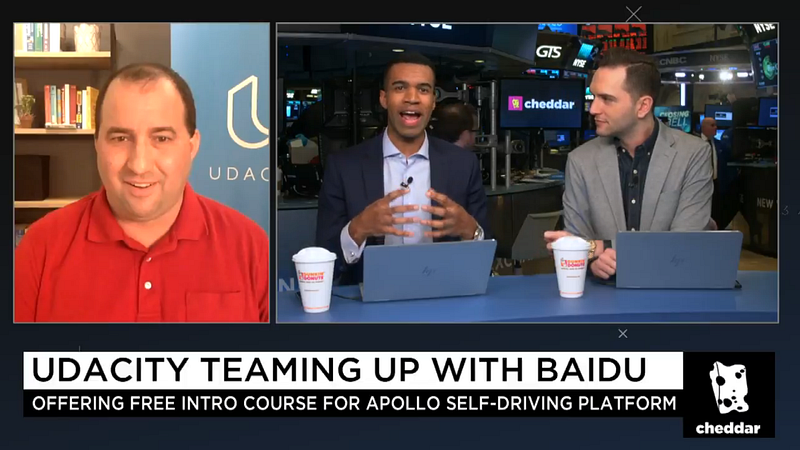
I did a live TV interview on Friday with Cheddar, which broadcasts live from the floor of the New York Stock Exchange.

We talked about Udacity’s Flying Car Nanodegree Program, our upcoming free course on Baidu’s Apollo open-source self-driving car stack, why now is a great time to be in the industry.

Live TV is its own animal, and I’ve got some room for improvement (crisper and more concise, in particular), but it was a good first outing.

Demographics and Safety and the Tesla Model 3

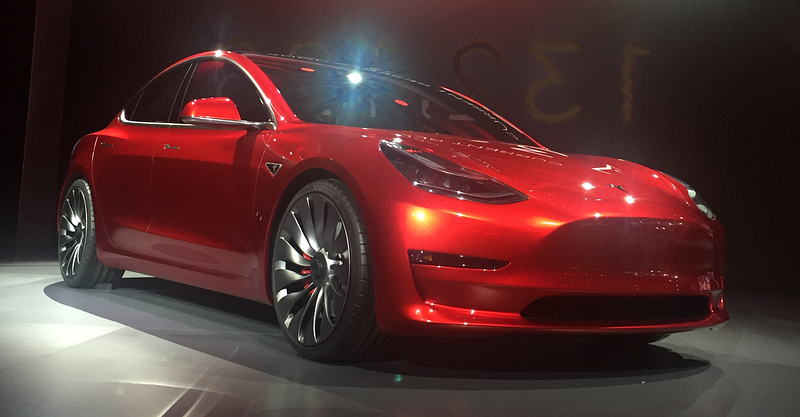
Will the Tesla Model 3 bring an uptick in Autopilot-related traffic fatalities?

It seems like that question can be broken into two parts: how many new cars will be sold, and how safe will Model 3 drivers be relative to Model S and Model X drivers?

To the first question, there are approximately 300,000 Tesla Model S and Model X vehicles on the road. Meanwhile, the Model 3 waitlist is about 400,000 people long. Of course, not every person on the waitlist will ultimately purchase a Model 3, but it seems likely Tesla will at least double its installed base over the next couple of years.

Since there has been one fatality attributed to Autopilot in the past two years, maybe with a doubled installed base Tesla will experience two fatalities over the next two years?

Maybe fewer — one or zero — since presumably Autopilot has gotten better over time.

As an aside, Tesla Autopilot is amazing. It is (along with GM SuperCruise) the best Advanced Driver Assistance System on the market. My guess is that it has saved a lot of lives.

But every time there is a crash involving Autopilot, the safety of self-driving cars gets evaluated.

So the question of how safe Model 3 drivers will be seems important.

The Model S and Model X are high-price luxury vehicles, on the order of $100,000 out the door. The Model 3, on the other hand, is designed for a decidedly lower price-point buyer: $50,000 out the door.

On average, older Americans are wealthier, and my guess would be Model S and Model X buyers are quite a bit older than Model 3 buyers.

Older drivers are also, on average, safer drivers (this changes somewhere above age 65, but it’s true for most ages).

If a lot of Model 3 buyers are younger, less safe drivers, it’s possible that we’ll see an uptick in Autopilot-related fatalities in the coming years. Intuitively, think of more younger drivers watching Netflix while Autopilot drives the car.

Of course, all of this is pretty speculative. I imagine both Tesla and automotive insurers have much better models for how this is likely to play it. But it seems worth watching.

Flying Cars at Udacity

Udacity just opened up applications for the Flying Car Nanodegree Program. It’s going to be amazing.

Sign up for the free preview!

I’m still focusing on Self-Driving Car, but I’ve watched the Flying Car team develop this program and I’m especially excited for the simulation environments they’re building. The projects students will get to construct in those simulation environments are incredible.

Here’s a quick summary of the curriculum:

Term 1: Aerial Robotics — You will learn the fundamental concepts required to design and develop robots that fly. You’ll work with the quadrotor test platform and our custom flight simulator to implement planning, control, and estimation solutions in Python and C++.

Term 2: Intelligent Air Systems — You will delve into the specifics of flying cars and coordinated autonomous systems. After an intro to fixed wing aircrafts, you will learn how to update and optimize vehicle parameters and routes over “flying car length” missions. From there, you’ll learn to coordinate entire fleets of flying cars as you leverage cutting-edge technologies, learn real-world systems and regulations, and complete projects culminating in an entire “flying city” finale.

Self-Driving Cars in the Real World

Between the new year, CES, and the North American International Auto Show in Detroit, there have been a lot of announcements about deploying self-driving cars in the real world.

Voyage will expand it’s self-driving car service to The Villages in Florida:

“Voyage is bringing self-driving cars to a retirement community (and city) like no other: The Villages, Florida. With 125,000 residents, 750 miles of road and 3 distinct downtowns, The Villages is a truly special place to live. Today, we’re excited to announce that Voyage has started testing its self-driving fleet within the community. Beginning in early 2018, we’ll start rolling out a door-to-door self-driving taxi service to residents.”

Uber is planning to remove the safety driver from its vehicles:

“Uber plans to carry passengers in autonomous vehicles without human backup drivers in about the same time frame as competitors, which expect to be on the road at the latest sometime next year, the service’s autonomous vehicle chief said Wednesday.”

“The ride service now has 1,600 people working on autonomous vehicles in the four test locations.”

Aptiv and Lyft will continue the self-driving car service that made such a splash at CES:

“Now, both are announcing that they’re definitely extending the project beyond the timeframe of CES in Las Vegas, and that they’re already in talks to expand a second pilot to another market located elsewhere in the U.S.”

GM is seeking a permit for Cruise to operate nationwide:

“If granted, the waiver would allow GM to launch as many as 2,500 self-driving vehicles a year into a form of taxi service and help pave the way for fully autonomous vehicles to move from niche testing fleets into broader commercial applications.”

“GM has announced plans to test the cars in Arizona, California and Michigan. It is expected to expand to New York City in 2018.”

The race is on.