A major property manager just let slip that both Apple and Google are looking for large spaces, specifically for their autonomous vehicle efforts.
The comments come from Victor Coleman, the CEO of Hudson Pacific Properties, which is apparently a major Bay Area landlord.
The news is a little bit more revelatory for Apple, whose autonomous vehicle efforts have been mysterious to the point that many people (or least I) wonder whether Apple is making any headway.
“We’re seeing the Toyotas of the world, the Teslas of the world, BMWs, Mercedes. Ford now is out in the marketplace looking for space,” he said on the landlord’s quarterly investor call. “I haven’t even mentioned the 400,000 square feet that Google’s looking to take down and the 800,000 square feet that Apple’s looking to take down for their autonomous cars as well.”
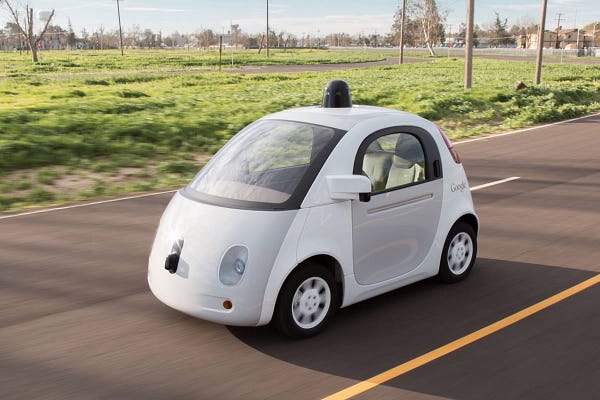
That Google is looking for major space isn’t so surprising, given how public they have been about moving their AV team out from under the X umbrella.
At first I thought this third-party mash-up of the Google Car and Grand Theft Auto would be funny. And I guess it is, sort of.
But it also involves mowing down a lot of virtual pedestrians, which doesn’t seem quite so amusing, although I realize that’s part of the attraction of the GTA franchise.
The reports have been pretty light on details, so there’s not much comment on.
One thought is that this would be awesome.
Another is that I’d love to see some firmer details around this prediction. For example, how many cars will there be and how tightly geo-fenced will the routes be?
I was trying to think of how likely I believe this prediction is to come to pass, but it’s impossible to put a finger on that without firmer details.
A third thought is that this would show a remarkably successful and fast integration of the Cruise acquisition into GM.
My last thought is that asking people take a ride in an autonomous vehicle is probably a smaller lift than asking them to purchase one outright. So this seems like a smart way for Lyft to introduce their AVs.
Along with the rest of the public, I learned this morning that Ford invested $182.2 million in Pivotal, a software consulting firm with offices worldwide.
I am super-excited about this partnership, although I confess I don’t understand the logic for investing in Pivotal as opposed to simply contracting with them.
But Pivotal is one of the leaders in the craft of software development and in Agile product development, and I think we can learn a lot from them that will make Ford a better place to build software.
In particular, I associate Pivotal with three great software engineering practices:
Pair Programming: Everybody at Pivotal works in pairs, even the non-developers. Two people, two monitors, two keyboards, two mice, one computer.
While some people view this as inefficient, I think it’s hyper-efficient. Most people subscribe to the believe that one great software developer is worth more than two average developers, and maybe more than ten average developers.
Well, pairing together two average developers is kind of like creating one great developer, or at least one very good developer.
Even better, the developers learn from each other and leave the pairing session better than they were when they came in.
Test-Driven Development: Test-Driven Development is the art of writing a software test, then writing the production code to pass the test, and then refactoring the code so that it’s clean. Rinse, repeat.
I have found this to be my favorite way of developing software — it makes hard problems much more tractable and bite-sized.
It’s also a great way to guarantee solid test coverage, much more so than “plain old testing”.
Agile Development: Pivotal is the creator of Pivotal Tracker, a service to track project development, milestones, features, and stories.
Having Pivotal Tracker is not, by itself, a replacement for product managers, but it’s a great tool, and cheaper and faster to get started than hiring a product manager.
Even when I’ve worked as a PM, I’ve found Tracker to be a terrific tool for building software products.
Ford is targeting autonomous vehicles by 2020. These will be Level 4 autonomous vehicles, that provide fully autonomous driving in certain conditions — mostly notably favorable weather and geofencing.
Favorable weather is clear enough, but what is “geofencing”?
Geofencing is the act of limiting automotive autonomy to certain geographic areas — most notably well-mapped roads like highways and major thoroughfares.
Cars will (I assume?) be able to leave the geofenced area, but outside that zone, full autonomy is not guaranteed. This means the cars would need steering wheels, gas and brake pedals, and the full complement of human driving controls we associate with cars today.
It’s a little bit tricky to make that work, but not nearly as tricky as so-called Level 3 autonomy, where the computer and the human are passing control of the car amongst themselves, ping-pong-style.
Or maybe not quite. The New York Times reports that, “Google said it would expand its testing of autonomous vehicles by installing its technology in a fleet of minivans made by Fiat Chrysler.”
That quote sounds more mundane.
This raises a couple of horse-race questions and one larger ecosystem question.
How much does this help Google?
It helps Google.
I’m not sure that Chrysler is specifically a great fit, nor am I sure that they’re a poor fit. It seems like if it weren’t Chrysler, it would be another car company. Perhaps partnering with an American-based manufacturer will help Google politically.
That said, this is a step forward, but maybe not a giant leap. 100 test vehicles is a great start, but it’s still a long way from a production model sold to consumers.
How much does this help Chrysler?
Hopefully it helps Chrysler.
FCA, as the company is known, has had less autonomous vehicle activity underway than many other manufacturers, so this puts them in the game.
But my mind immediately makes the comparison to mobile phone manufacturers, and here the record is not so promising. HTC was the first company to use Google software on its phones, and since then LG has produced Google’s Nexus line. In neither case has the Google partnership set the company up for huge success. Rather, Samsung has dominated the Android market.
How much does this help move forward autonomous vehicle technology?
Time will tell, but I view this as incremental, so far. If Google and Chrysler are able to work together mass-produce Level 4 autonomous vehicles on an accelerated schedule, that would be amazing.
But that’s a big if and so far it looks like small steps.
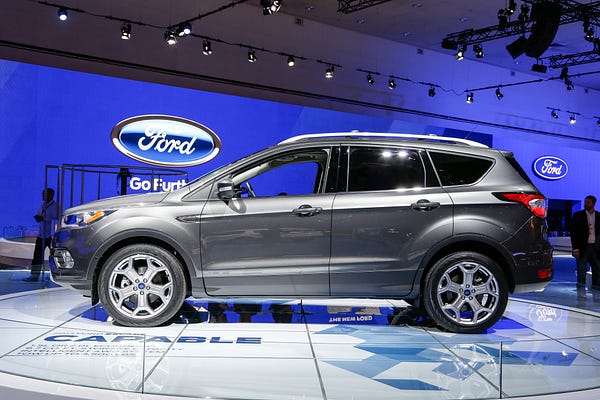
I took the 2017 Ford Escape for a test-drive yesterday and it is awesome!
Ford has revamped the interior, making it feel more spacious, but of course what really excited me are the self-driving features.
The 2017 Escape comes with self-parking for both left- and right-hand parallel park, and left- and right-hand perpendicular park. The driver still has to work the brakes, but the car will steer itself into the spot, including executing a three-point turn, if necessary.
The 2017 Escape also comes with true adaptive cruise control for the highway — it will slow down and speed up with traffic, at least at highway speeds.
I also noticed a little bit of steering assist for staying in the lane, and sure enough the owner’s manual describes the lane-keeping system as working above 40mph.
Of course, I’m most excited for 2020, when Ford has announced launching a Level 4 autonomous vehicle. In the meantime, I’m excited for the ADAS features on the 2017 Escape Titanium to make their way to other models. Eventually, I’d love to see these features available outside of the Titanium trim level and all the way down to base models.
This is a terrific car, and I’m not just saying that because I work for Ford. 🙂
The idea is to achieve the same effects as a suicide bomber, but without the unreliability or cost of a human terrorist.
Firstly, building self-driving cars seems well beyond the technological capability of ISIS.
Secondly, self-driving cars will be far less autonomous then the Model T. They will be connected back to the manufacturer, and presumably subject to government search warrants.
Thirdly, they are expensive.
On a related note, the FBI worries that self-driving cars will be uses for criminal activity generally.
I think the truth might be closer to the opposite. In a world where your car is constantly communicating with the Internet, who would want to use a car for crime?
“It gives you the impression that it’s doing more than it is,” says Trent Victor, senior technical leader of crash avoidance at Volvo, in an interview with The Verge. “[Tesla’s Autopilot] is more of an unsupervised wannabe.” In other words, Tesla is trying to create an semi-autonomous car that appears to be autonomous.
Volvo has promised death-proof cars in the past.
Other related news is that Volvo will launch fully autonomous, Level 4 vehicles with 100 test drivers in Sweden next year. The feature will be called Drive Me.
Also, Elon Musk says crashes occur 50% less frequently when drivers are in autopilot mode, although it’s not clear if this counts cars that exit autopilot mode only to crash seconds later.
The key takeaway here is apparently that the unit is ready to make money and stand on its own two feet, financially.
That, of course, raises the question of how the unit will make money.
The most likely scenario seems to be more-or-less direct competition with Uber. The unit might launch ride-sharing services first on geo-fenced areas such as college campuses, and grow out from there.









 David Silver