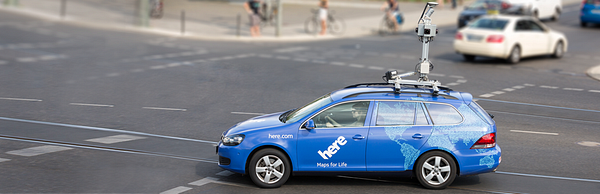
According to Reuters, most players in the self-driving car world are mulling an investment in HERE, a digital mapping company.
HERE has a colorful history, dating back to the 1980s and involving Nokia, Audio, BMW, Mercedes, and other parent companies.
The driving logic appears to be the need for high-quality maps, particularly in adverse weather conditions.
HERE is presently controlled by the big three German auto manufacturers. Reuters reports that Amazon and Microsoft )as well as potentially many other auto manufacturers and suppliers) might pile in, as well.
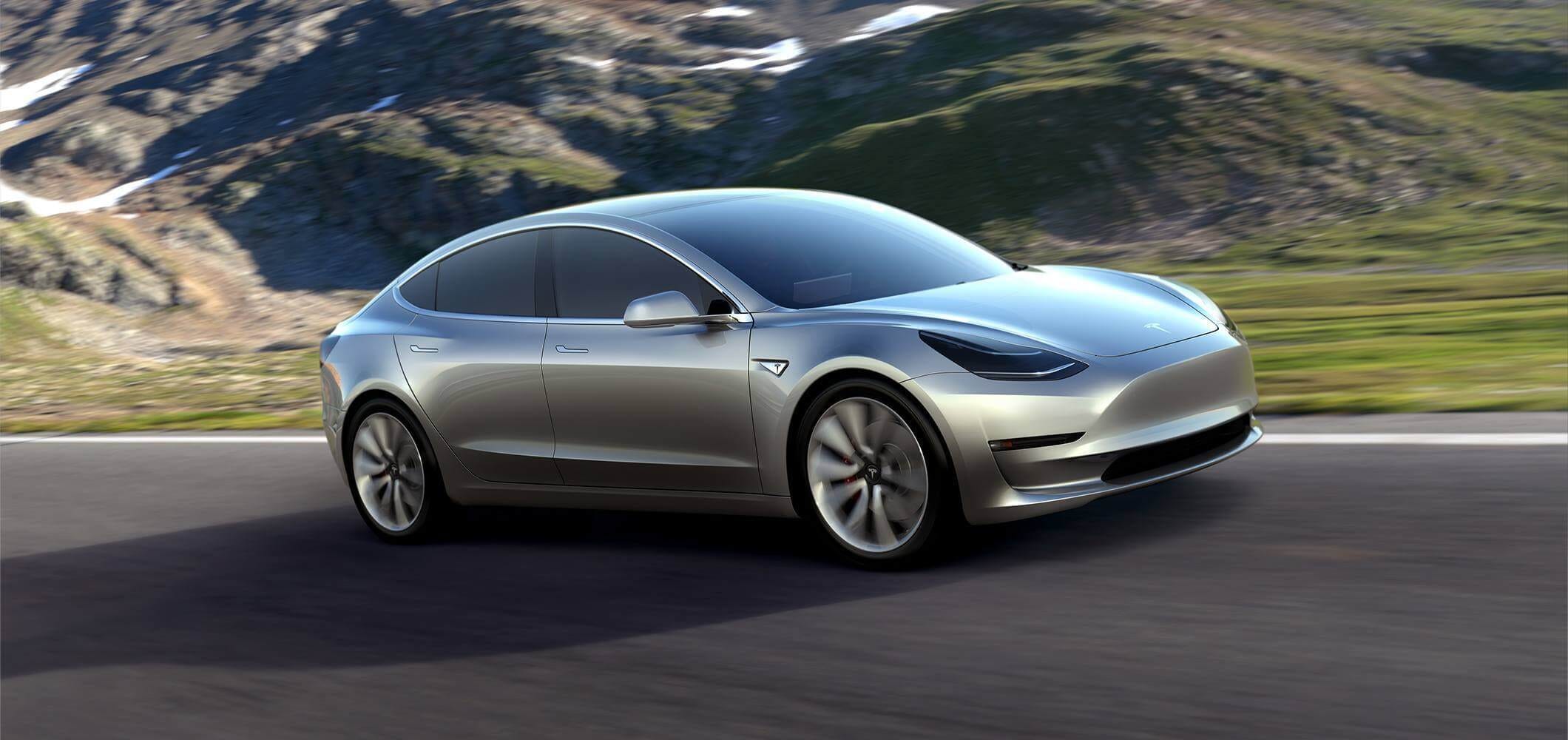
The Model 3, with a base price of $35,000, is Tesla’s first offering at a price point within range of most American cars. Actually, with federal and state-level tax incentives, the out-the-door price for the car might be below the $33,500 average price of a new US car.
115,000 people have already placed $1,000 reservations for the car, securing $115 million dollars in revenue for the company.
Autopilot will come standard on the Model 3, but the big selling points seem to be the electric (gasoline-free) engine and the general appeal of Tesla.
Big questions remain, including:
When will the car will actually launch? The target date is late 2017, but that could slip.
Will Tesla be able to mass-produce mass-market cars? Tesla’s Fremont, California, plant has capacity for 500,000 cars per year. But Tesla only built 50,000 cars last year. Ramping up by an order of magnitude may cause problems.
Will other automakers beat Tesla to market? The Chevy Bolt, with a similar spec sheet, is slated to launch in late 2016.
Will the Model 3 be able to maintain its $35,000 price target? The Model S pricing jumped somewhat from where it was announced initially, and the same could happen for the Model 3.
Nonetheless, yesterday was a pretty great day for Tesla Motors.
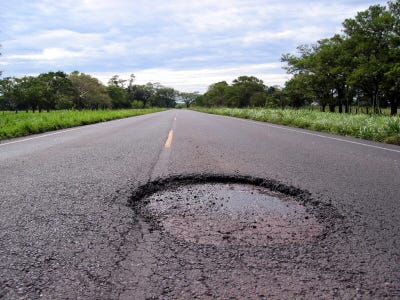
The poor quality of roads in the United States will be a major impediment to the launch of self-driving cars, according to Reuters.
The article quotes sources from Tesla, Toyota, and Volvo bemoaning the state of US roads, and the lack of lane markers, in particular.
Volvo’s North American CEO, Lex Kerssemakers, lost his cool as the automaker’s semi-autonomous prototype sporadically refused to drive itself during a press event at the Los Angeles Auto Show.
“It can’t find the lane markings!” Kerssemakers griped to Mayor Eric Garcetti, who was at the wheel. “You need to paint the bloody roads here!”
Top marks go to the UAE, Hong Kong, Singapore, the Netherlands, and Japan.
Perhaps the best thing the US government could do to boost self-driving cars wouldn’t actually be subsidies or competitions or even regulatory streamlining. Maybe they could just repaint the roads.
With surprisingly little fanfare, Sunnyvale, California, appears to be experimenting with connected cars.
According to auto connected car news, Sunnyvale and Nissan just teamed up to deploy connected infrastructure to 130 square miles of roadway.
The article uses a new-to-me term: V2X. This stands for “vehicle-to-X (communication)”. More concretely, V2I=”vehicle-to-infrastructure”, V2V=”vehicle-to-vehicle”, and so forth.
The article is jargon-laden and a little hard to follow, but it appears that Nissan, Sunnyvale, and UC-Berkeley jointly set this up last summer as a test bed for connected infrastructure.
I mentioned earlier that Nissan has been fairly quiet on the autonomous vehicle front until recently, when it made a bold claim that it will launch lots of different autonomous vehicle models by 2020. This is further evidence that they’re serious.
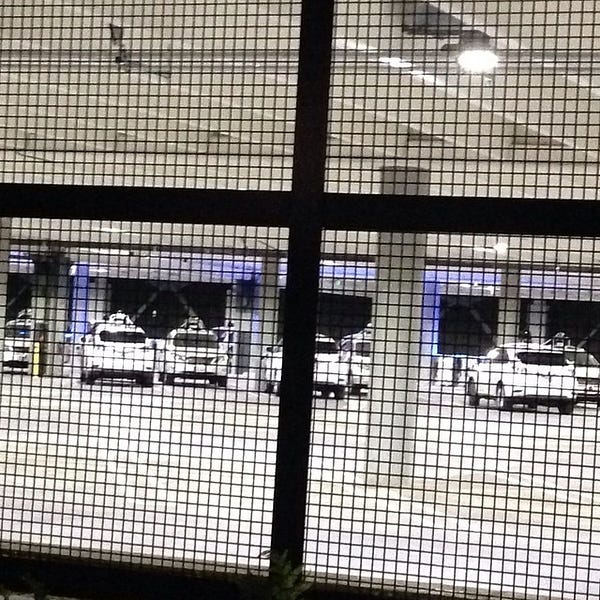
This appears to be a parking garage, not a mechanical garage, so there’s no opportunity to see path-breaking work up-close.
But it seems like an easy garage to swing by and peer into, maybe a little bit like the famous HP Garage in Palo Alto. It’s funny how they’re both garages, although Google is using its garage in a more traditional sense.
Hopefully I can stop by the next time I’m in the area.
When Jack Dorsey first conceived of the payments company Square, he realize that the smartphone was, in fact, a supercomputer. That computing power obviated the need for cash registers.
I wonder if something similar will happen with self-driving cars.
For the moment, the focus of self-driving cars is on powerful computational devices, sometimes liquid-cooled, in the trunk of a car. This is especially important for GPU-based systems, which are the backbone of deep learning.
But what if we can get the computational needs of a car to run on a smartphone? Or an array of smartphones?
The video capability is there. The accelerometer is there. Can we streamline the computations to the point that the compute power is there?
That would truly enable self-driving cars for the masses.
Internet pioneer and robocar afficionado Brad Templeton has a post up questioning whether self-driving cars will increase or decrease auto manufacturing.
The conventional wisdom is that self-driving cars will decrease the number of cars produced, because we can share cars, instead of purchasing lots of cars and then leaving them parked most of the time.
Templeton makes the excellent point that there the total volume of cars produced will be equal to:
Total Vehicle Miles per Year / Average Vehicle Lifetime in Miles
Both the numerator and the denominator are likely to change as we shift toward self-driving cars.
Total Miles will increase as people opt to ride in self-driving cars instead of fly, walk, bike, or stay put.
Average Lifetime is harder to predict, since some factors will drive lower lifetimes and others will drive higher lifetimes.
Of the factors above, sharing rides and making longer-lived cars could reduce the number of cars needed, and the reduction in car cost reduces the total the world spends on cars (as well as the energy required to build them.) Perhaps those factors might counter the additional travel and the empty miles.
One factor will overwhelm all of this, however. Cheap robotaxi service under 50 cents/mile will suddenly make personal car transportation economically accessible. Drop to 30 cents/mile or even 10 cents/mile in poorer economies, and we’re talking vastly more accessible to billions of new people. The market may already be mostly saturated in the United States which has vast car ownership, but the global average is about 15%. It’s going to grow, and by a lot. The car industry is facing a boom, not a bust from this technology.
This may sound like a nightmare to those who blame private cars for many of our environmental and urban woes. Fortunately the picture is not quite the same with these cars which are far more likely to be efficient, low-emitting and sustainable, indeed more sustainable than the transit systems we use today. (Indeed, they could be combined with a new vision of even more sustainable transit during peak times.)
The entire post is difficult to excerpt and covers a number of interesting points. Read the whole thing.
This is an interesting approach that has some distinct advantages and disadvantages.
The advantages include a target user base of young, tech-savy passengers, a clear geo-fenced area, and slow speeds.
The disadvantages include pricing, volume, and mapping (I’m assuming college campuses are not as well mapped as roads, and suffer from more obscure desire paths).
The company is currently touring college campuses in California, and it’s worth keeping an eye on.
A team from MIT has proposed a system for removing stoplights from intersections. By using wireless connectivity between cars, intersections can advise drivers — human or computer — to adjust their speed an enter the intersection at exactly the right time.
This seems like an example of why path-dependence matters and how human drivers and computer drivers might need or at least want different infrastructure.
It would be awesome for computerized drivers, or at least human drivers in networked cars, to be able to travel through intersections without stoplights. But there are hundreds of millions of non-networked vehicles in the world, and they’ll be with us for a long time.
So the real challenge isn’t even building intersections that work without streetlights. It’s building intersections that work with both networked and non-networked cars.
That seems unbelievably large, especially with the technology of self-driving cars so uncertain.
The news reports do make the point, however, that one of Uber’s biggest current problems is its drivers. Computer drivers don’t kill passengers, kidnap passengers, or stage protests.