Ford and Google vs. The World

The FT has a good article breaking down the dichotomy between Ford’s approach to self-driving cars and GM’s.

For self-driving car enthusiasts, this is the Level 4 vs. Level 3 distinction.

In layman’s terms, this is the difference between fully autonomous vehicles, and vehicles that have self-driving features but require a human driver.

The Level 4 (fully autonomous) approach is championed by Google and Ford:

Ken Washington, Ford’s head of research and advanced engineering, insists there is no alternative to the company’s approach. There is “no reliable model” for handing control back to drivers in semi-autonomous vehicles at short notice, he says, as systems like GM’s Super Cruise demand in certain situations.

“If you’re told you don’t need to pay attention to something, you could go to sleep and, in a matter of a few milliseconds, you could be told you have to wake up, have your wits about you, that the vehicle needs you to take control,” he adds.

Of course, GM believes differently:

GM’s incremental strategy on self-driving cars is similar to that of most automakers, including Sweden’s Volvo. Germany’s Daimler and Tesla of the US, the electric car manufacturer, already offer systems similar to Super Cruise on some vehicles.

…

Eric Raphael, GM programme manager for Super Cruise, says the company is building up from existing systems such as cruise control because it is a “big step” to start entrusting even limited driving entirely to vehicles.

I find both approaches exciting. Ultimately, though, the sooner we can get to Level 4 and all of its attendant benefits, the better.
ADAS Test Drive: Subaru Outback

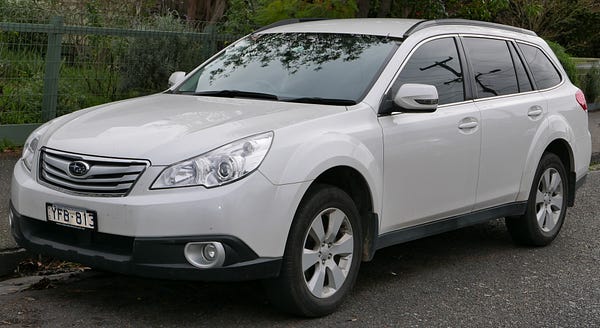
Over the weekend my wife and I drove to Putnam Subaru in Burlingame, California, and took a test-drive in both a Subaru Impreza and an Outback.

Both models come with Subaru’s EyeSight ADAS technology, but the Outback carries a slightly more extensive ADAS feature set, so I’ll cover that here.

Adaptive Cruise Control: EyeSight includes an impressive adaptive cruise control feature that has the vehicle both accelerate and decelerate on the highway. It can hold a much slower speed indefinitely, if there is traffic, and then will re-accelerate when traffic clears.

Distance Control: The cruise control comes with a neat feature that allows the driver to set the minimum distance between their car and the car ahead. The distance can be toggled from close, to not that close, to far.

Backup Camera: This is a standard feature on modern cars, but still great.

Lane-Keeping: This system keeps the car in its lane if the driver starts to drift. My experience was that this would help correct minor drifts, but didn’t work for larger drifts, like those a distracted driver would encounter.

Blind-Spot Assist: I didn’t get a chance to test this out, but it was there.

Acceleration Cut-Off: Supposedly the car will cut off acceleration if the driver hits the wrong pedal and starts to speed into a rear-end collision. Curiously, though, it will not automatically apply the brakes — that has to be done manually.

Overall, EyeSight seems great. I am surprised they don’t have a parallel parking feature, but perhaps that is coming on future models. It would be great to see Subaru roll out these features across all of their models.

ADAS Test Drive: Ford Fusion

A few days ago I wrote about my visit to the local Ford dealer, where I learned about Ford’s ADAS features.

I also wrote that I wasn’t able to test-drive the features, because only the Escape Titanium has them, and the dealer didn’t have the right model in-stock.

Well, that wasn’t quite right.

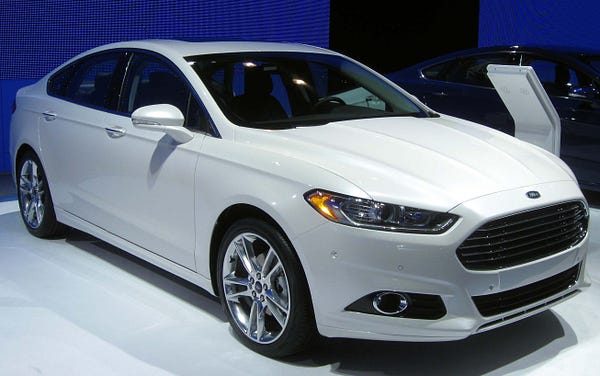
I called another dealer and learned that several other Ford models have the ADAS feature, so I drove to the next-nearest Ford dealership and test-drove a Ford Fusion Titanium with all the bells and whistles.

Parking Assist: This is so cool! The car told me when it identified a parallel parking spot next to me, had me pull up, and then took over for steering into the spot.

Adaptive Cruise Control: We passed President Obama’s motorcade on our test-drive (he was in town for fundraising), which meant that on the way back there was severe stop and go traffic. The cruise control would sense when we would approach too close to the car in front of us, and then cut off the cruise control.

Lane Assist: At speeds of 35mph or higher, the car would detect the lane lines on the road, and then alert me when I drifted.

Blind Spot Assist: The side mirrors have a blinking light if a car crept into my blind spot.

Pretty cool!

Project Nightonomy

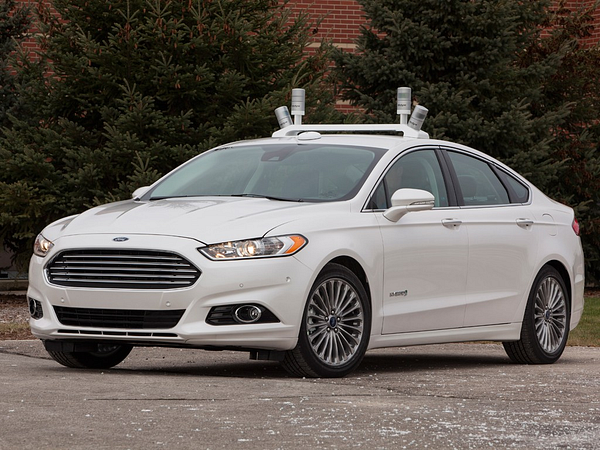
Ford just posted a kind of amazing and funny video on YouTube, showing their Fusion Hybrid self-driving vehicle making the laps around the test track at Ford’s Arizona Proving Grounds.

The catch? This exercise was at night, with no headlights.

Lidar sensing enables the vehicle to drive autonomously without any ambient light, which is pretty neat.

Of course, part of the function of headlights is so that other cars can see you, so it’s not clear if Ford would ever intentionally turn off the headlights on its production vehicles.

But it’s a pretty cool proof-of-concept.

https://www.youtube.com/watch?v=cc15Ox8UzEw

Toyota’s Guardian Angel

The head of the new Toyota Research Institute, Gil Pratt, recently discussed the manufacturer’s Guardian Angel system, which will take over from the human driver in the moments prior to a crash.

This is an interesting digression from the standard industry trends in Level 3 and Level 4 autonomy.

“Our plan is to see how humans will respond when the car temporarily takes control because it knows better,” said Gill Pratt, CEO of the Toyota Research Institute, during his keynote address Thursday. “So far the steering wheel always points in the direction the wheels go; that’s always been true up until now.”

Ford’s Self-Driving Escape Titanium

Yesterday I visited my local Ford dealership to check out their self-driving car.

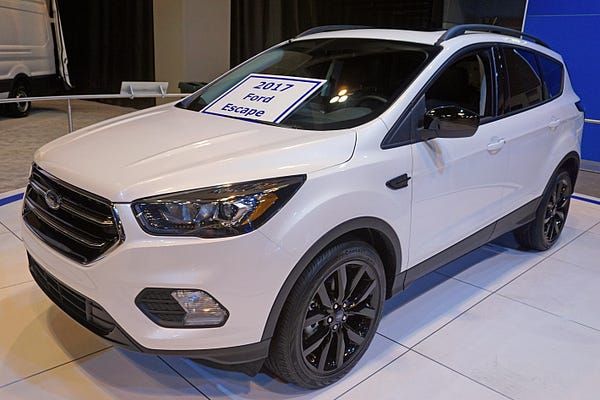
Ford’s most advanced ADAS (autonomous driver assistance system) features are offered on the Ford Escape Titanium, which is Ford’s premier cross-over SUV.

The features include parking assist, blind-spot information system (BLIS), adaptive cruise control, and lane-keeping.

At a feature spec level, those features match up well with Tesla, Volvo, and other car makers. I wasn’t able to test-drive an Escape to see how well the features performed on the road (my local dealer is relatively small and didn’t have the model in-stock), but I’m starting to get a better sense of how ADAS features exist in the world today.

It seems that while Tesla gets a lot of the best press coverage for self-driving technology, the gap between Tesla and other manufacturers is pretty small.

LG vs. Samsung

The Korea Times has an article disclosing that Hyundai is ditching Samsung to work with LG on new self-driving car initiatives.

This all sounds very “inside Korea” and I doubt I have the context to understand it, except that the participation of both LG and Samsung in the self-driving car world is interesting.

For a while now, traditional auto manufacturers have been wary of being subjected to a repeat of the mobile phone wars, with the OEMs (Toyota, GM, etc.) playing the part of Samsung, LG, and other handset manufacturers.

The issue is that car makers don’t want to be relegated to producing commodity hardware while Google captures all of the software value, a la Android.

The participation of LG and Samsung in the self-driving car world is a sign that maybe some variation of the mobile phone wars will replay itself, but with LG and Samsung maintaining their existing roles. Which, presumably, they are pretty good at by now.

The WhatsApp Effect vs. The Tesla Effect

Yesterday Chris Dixon announced Andreesen Horowitz’s investment in Comma.ai, the self-driving car company founded by hacker protegy George Hotz.

In the brief announcement, Dixon highlighted “The WhatsApp Effect”:

WhatsApp was able to build a global messaging system that served 900M users with just 50 engineers, compared to the thousands of engineers that were needed for prior generations of messaging systems. This “WhatsApp effect” is now happening in AI. Software tools like Theano and TensorFlow, combined with cloud data centers for training, and inexpensive GPUs for deployment, allow small teams of engineers to build state-of-the-art AI systems.

That all seems plausible, but it’s an interesting contrast to Elon Musk’s take on autonomous vehicle software:

“I expressed some skepticism here, like, look Mobileye has got hundreds of engineers and they’ve been working on this problem for quite awhile and I think they’re pretty smart guys,” Musk says. “He wanted to make a bet, and he said ‘well how much is that worth to you?’ And I said, ‘well I mean if it were true, it would be worth millions of dollars, but I don’t think it’s true.’”

Further on, Musk advises:

The path of success for Hotz — if he wants to create a competing product to Mobileye — is to build a small company, get funding, increase its size so it can conduct verification and validation testing, Musk advises.

“There’s a ton of hard work and bug fixes, and it’s kind of like painful work, and it’s not fun and after doing that for a few years, if George, is prepared to do that, I think he would have a product that would be competitive with Mobileye,” Musk says in a tone you might hear from a parent or older sibling.

Now, to be fair, Comma.ai is on said path to success — creating a small company getting funding, increasing its size.

But I get the sense that Tesla (13,000 employees) and even Mobileye (450 employees) are different from the vision Chris Dixon has for Comma.

When GM recently acquired Cruise for a cool billion, the startup had under 50 employees. So it’s certainly decidedly to build a billion dollar self-driving car company with under 100 employees.

I guess the next question is can 50 employees create a $10 billion self-driving car company.

Volvo XC90

Last night I rode in a friend’s brand-new Volvo XC90. What a great car!

I didn’t know Volvo did luxury, or that they had advanced ADAS systems in production.

In addition to the plug-in hybrid features, and the leather interior, and the moon roof, the car has some cool self-driving features.

My favorite is the lane-assist, which the car uses to automatically keep itself in a lane. It’s not 100% yet, but it worked probably 80% of the time we tried it on the highway last night.

There is also a cool Blind Spot Information System, a self-parking feature, and a fighter-pilot-esque heads-up display.

Self-Driving Bicycle

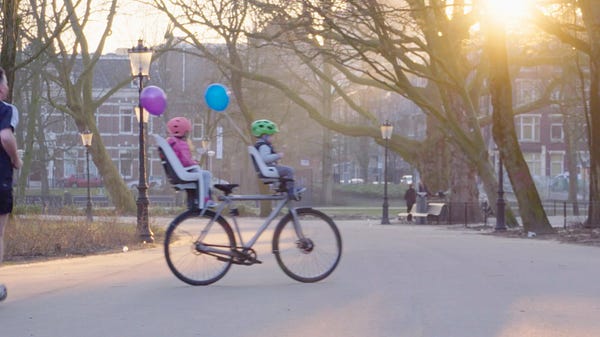
Keeping up its tradition of great April Fool’s Day pranks, Google Netherlands gently spoofs Dutch culture by hyping the Google Self-Driving Bike.

The YouTube video features the Deputy Mayor of Amsterdam boasting, “I think the self-driving bike could really give a boost to the economy because people could even work on their bicycle.”

The director of the Dutch Cyclists’ Union states, “This is the biggest invention since the invention of the bicycle itself.”

Thumbs-up 🙂