First They Came for the Electric Vehicles

There is a well-known playbook for disrupting an industry, and it was written by Clayton Christensen in 1997 and called, The Innovator’s Dilemma.

In particular, the book looks at the tendency of disruptive firms to first target the lowest-margin, least exciting parts of an incumbent’s business. This competition might annoy the incumbent, but nobody panics, precisely because that line of business is so low-margin and minor.

Over time the disruptor gradually eats more and more of the incumbents business, until the incumbent is left hanging onto only the most lucrative, highest-margin product lines.

And then those get eaten, too.

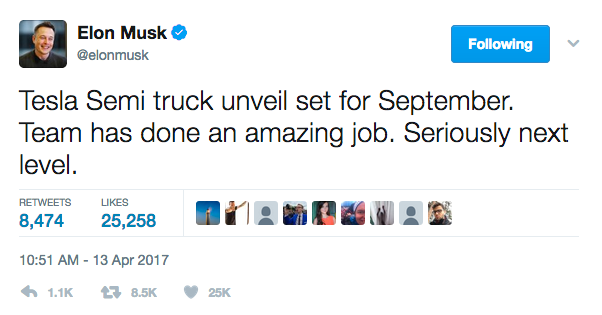
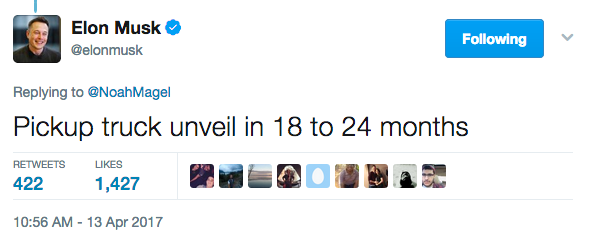
This is what I thought about today when Elon Musk announced that Tesla will be unveiling a pickup truck in the next two years.

Ford makes very nice mass-market sedans, and I own a Ford C-MAX Energi hatchback that I love. But Ford’s real profit-driver is the F-Series. Pickup trucks are what make Ford work as a business.

(All of this also applies to GM and Chrysler, but I feel this most personally when applied to Ford, so in this post I’ll use them as the exemplar of the Big Three.)

In 2008, when Tesla entered the market with a super-expensive, high-performance electric Roadster, it was no big deal. Ford barely makes that type of car.

Then in 2012, when Tesla expanded its product line to include a $80,000+ electric luxury sedan, that was hardly any closer to home. Ford makes vehicles for America. Tesla made vehicles for Silicon Valley millionaires.

Same story in 2015, when Tesla launched a $120,000+ electric Model X SUV.

Tesla only really threw down the gauntlet with the unveiling of the $35,000 Model 3 sedan, and that hasn’t even shipped yet.

But today’s announcement that Tesla is entering the pickup market?

That’s not business. It’s personal.

It’s also genius.

Startup Watch: Luminar

Last fall, I went with some Udacity colleagues to a Silicon Valley Artificial Intelligence event that hosted a panel of speakers from startups in the world of self-driving cars.

One of the speakers was Austin Russell from a then-stealth company producing lidar. We asked his colleague about the name of the company and were told it was a secret.

Later in the event, the crowd started goading another attendee, George Hotz, into grilling the speakers. George rose to the occasion and asked Austin, “So, this all sounds great, but when is Luminar going to ship?”

So much for keeping the name secret.

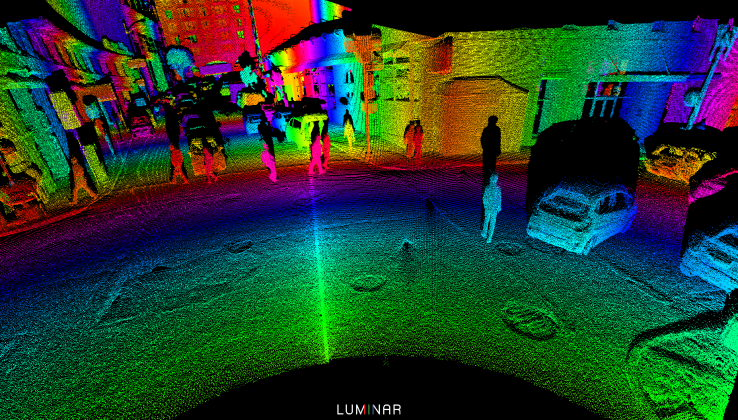
This week, Luminar went public with all sorts of details about the company, their product, and the first-ever production run of sensors, starting this year.

Austin is a colorful and likeable character, and most of what I’ve read about Luminar quotes him stressing the superior performance of Luminar’s lidar sensors.

That’s awesome, but the main issue with lidar right now seems to be cost and volume, not performance.

Since Luminar has already talked about building 10,000 units, my question might be, what’s the cost?

Autonomous Security

Wired has a good article out about hacking autonomous vehicles, and about “autonomotive attack surfaces” in particular.

The article centers on Charlie Miller, who several years ago hacked a Jeep and took it over remotely while it was driving on the highway (don’t worry, it was a demonstration, not a malicious attack).

Miller talks about the interesting problem of securing vehicles from ride-sharing passengers. In a world where anybody can hail and hop into a self-driving Uber or Lyft, securing those vehicles from hackers who are physically in the car can be a huge challenge.

One example is a hacker who gets into a self-driving car, uses the OBD-II port to install software on the system, and then gets out. Later on, the hacker might use the latent software to take over the car when other riders are inside.

Gives a whole new meaning to “carjacking”.

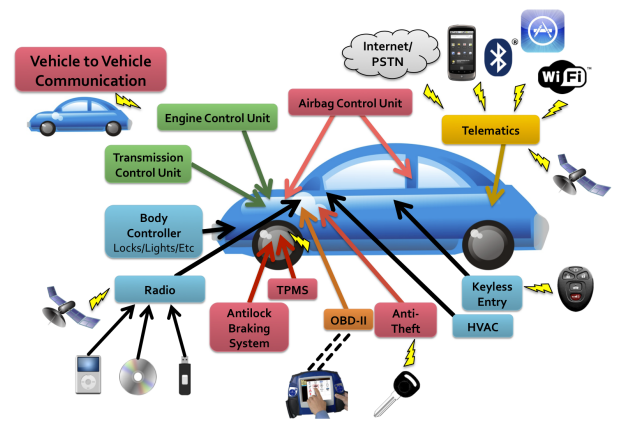
Miller talks about the “attack surface” of vehicles, which encompasses any opening an attacker can use to hack a vehicle. A quick search for “automotive attack surface” led me to the graphic above, which comes from an academic research paper by Checkoway, et al.

“We discover that remote exploitation is feasible via a broad range of attack vectors (including mechanics tools, CD players, Bluetooth and cellular radio), and further, that wireless communications channels allow long distance vehicle control, location tracking, in-cabin audio exfiltration and theft.”

The further complication is that ridesharing companies are often layering their self-driving software and hardware on top of production automotive vehicles, built by somebody else. It creates a situation where the manufacturer may not design the car to be secure in the same ways that the after-market modifier (in this case, the ridesharing company) needs.

Udacity Students on Computer Vision, Sensor Fusion, Deep Learning, and More

All sorts of interesting topics in this set of student posts, including some inside stories from the creator of ALVINN!

Emphatic Camera Calibration With OpenCV

Chris X Edwards

While trying to undistort his camera images, Chris walked into a store and asked to take a photo of their floor. Then things got really weird.

“I wrote a program that iterated through all possible grid sizes and looked at all images. Now I was finding grids. Ah ha! Turning to the documentation to figure out what exactly was going on, I noticed the function had a parameter, flags, which could be set to enable certain grid finding techniques. I set one of the flags and the grids I could detect changed quite a bit. Now I added to my program another inner loop to iterate through all the detection modes.”

Output Appearance Reliability Estimation

Dean Pomerleau

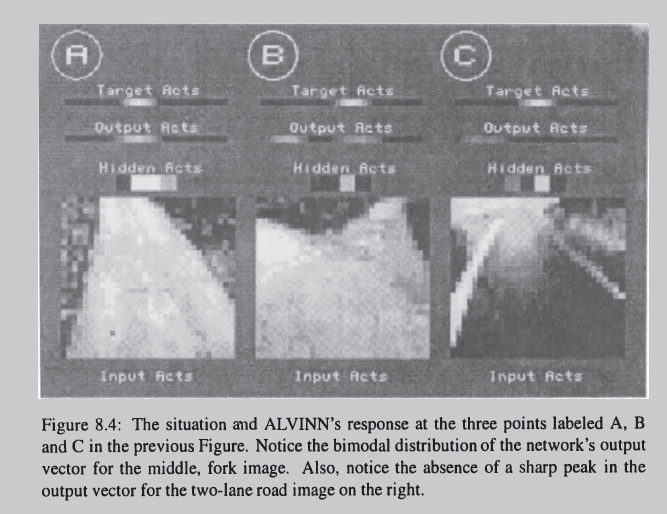
Dean Pomerleau, the creator of ALVINN, responded to Param Aggarwal with some cool stories about how ALVINN took advantage of confusion in the network to estimate how confident it was about its own steering ability:

“Using the OARE technique and a related one called Input Reconstruction Reliability Estimation (IRRE), ALVINN was able to localize itself (e.g. ‘I’ve reached the fork in the road!’), tell the human safety driver (me) when it needed help, arbitrate between networks trained on different road types, and even tell when there was crap on the windshield in front of the camera obstructing its view of the road.”

Cutting-edge (high-tech) career path.

Uki Dominique Lucas

Uki riffs here on all of the various projects he could be working on, how he chooses to spend his limited time, and where that intersects with career development.

“The next part of the career development is keeping up with the computer science basics. Honestly, it does not matter how much programming you do on daily basis, you will not pass the “whiteboard hazing” without any preparation. I lost countless of interviews with fine companies like Amazon, to what I thought was a “power trip” of some engineer without any social skills in a cookie factory — for years I was saying, “Why do I need that? I can make good money on my own”. Only later, I have read books and articles on interviewing and realized that the “whiteboard” is simply a thing they do and that people prepare for it for months.”

Vehichle detection using LIDAR: EDA, augmentation and feature extraction (Udacity/Didi challenge)

Vivek Yadav

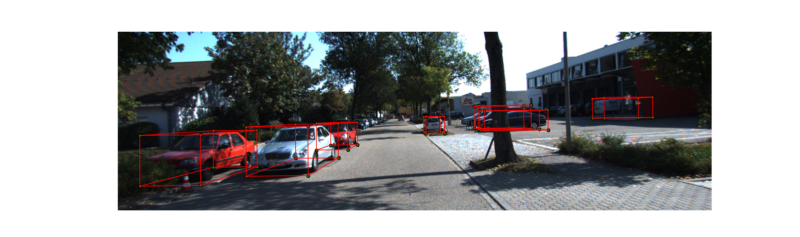
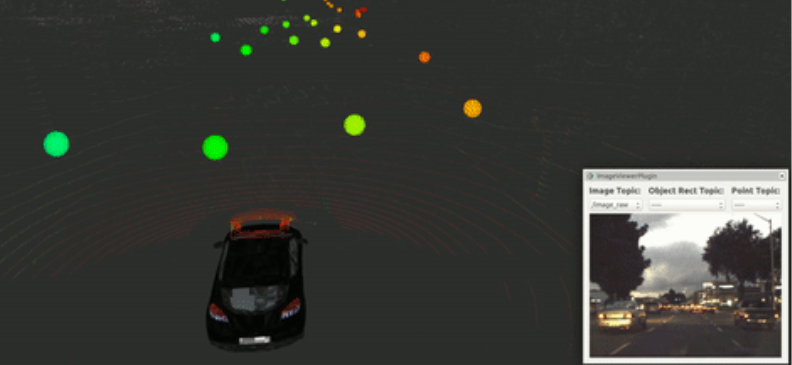
Vivek goes into detail on his voxel-based approach for identifying cars based on the KITTI dataset for the Udacity-Didi Challenge. If you don’t know what a voxel is, read on:

“A voxel is a volume unit in space, similar to pixel in 2D images. I first constrained our space so x-dimension (front), y-dimension (L-R) varied between -30 and 30, and vertical dimension varied between -.1.5 and 1 m. I next constructed voxels of width and length .1 m and height 0.3125 m. I then computed maximum height in each voxel and used this value as the height of the point cloud in that voxel. This gave us a height map of 600X600X5 features. We specifically chose 5 height maps because Udacity’s data uses vlp-16 lidar and having more fine discretization can result in height slices without any points.”

Make sense of Kalman Filter

An Nguyen

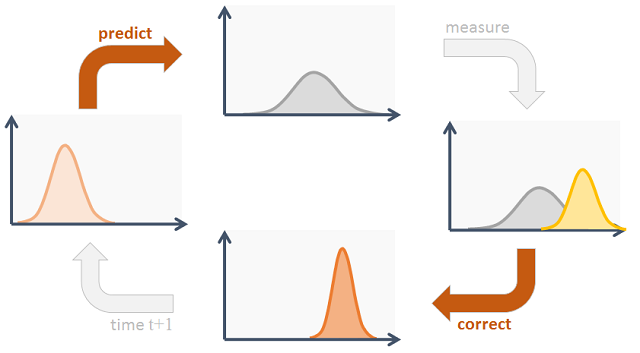
What is a Kalman filter? Why do we use it? An gives a more intuitive explanation here than you will find on Wikipedia:

“Assume the car makes the lane change successfully to get in front of me, I still continuously observe the car and adjust my speed so my car can always stay in the safe zone. If the car goes slow, I predict the car will still be slow in the next seconds and I’ll stay at a slow speed behind it. However, if it suddenly goes fast, I can speed up a little bit (as long as under speed limit) and update my belief. What I did there is a continuous process of prediction and update.”

Udacity Students at Track, in the Didi Challenge, and Building Deep Learning Servers

Udacity Self-Driving Car students have been writing about the Self Racing Cars track day, the Didi Challenge, and building their own deep learning machines!

Self Racing Cars 2017 Photo Gallery — The Day Before

Kunfeng Chen

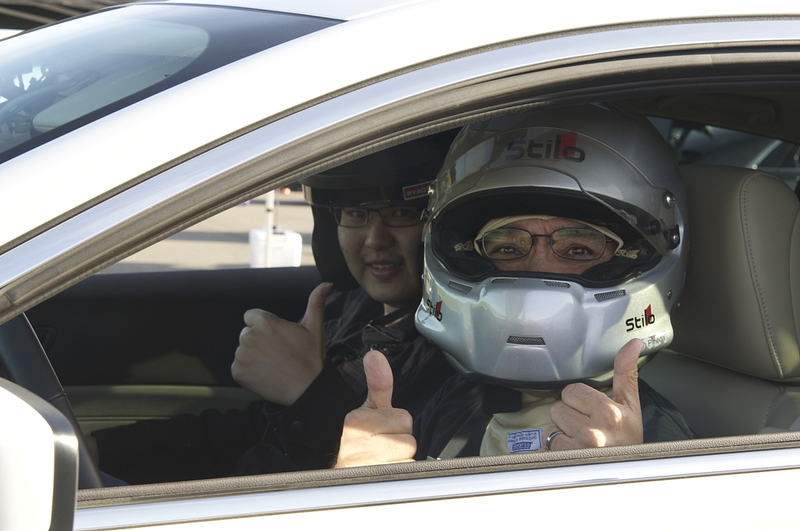
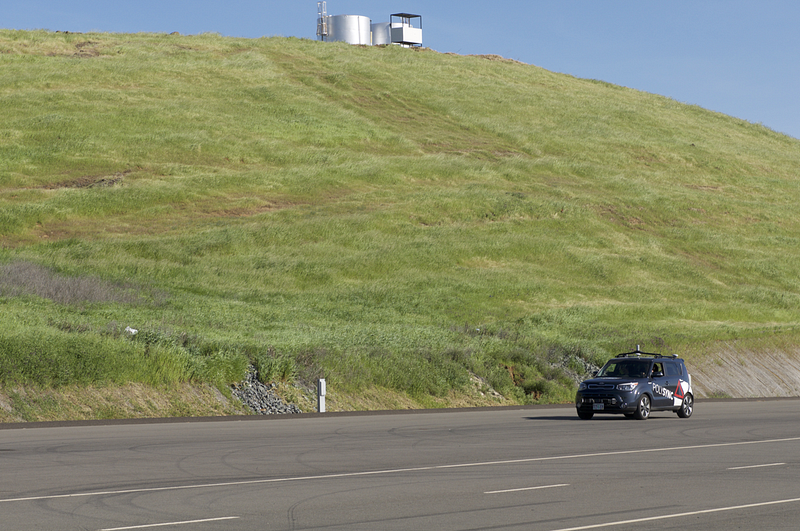
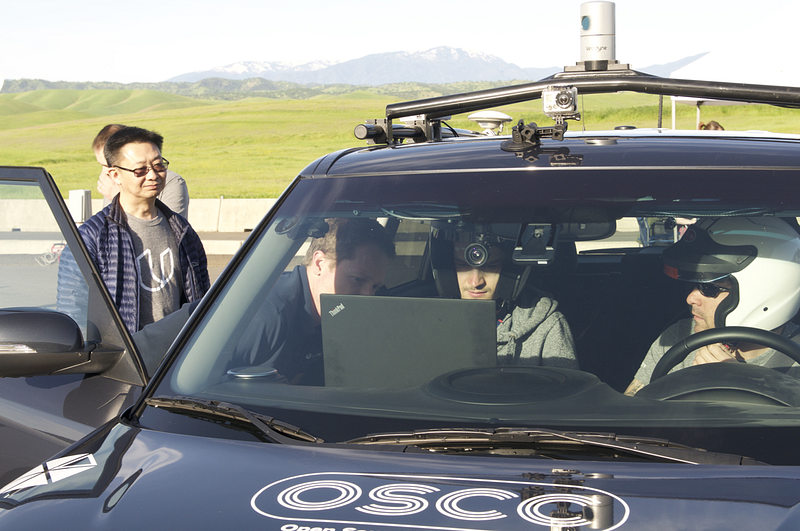
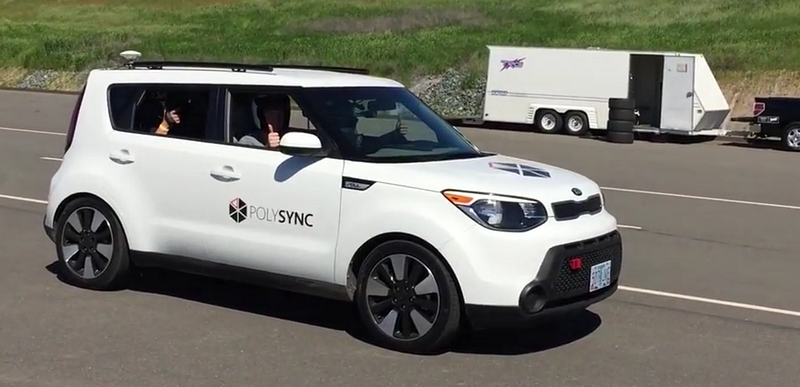
Udacity students were sponsored by PolySync to compete in the Self-Racing Cars track day at Thunderhill last weekend, and these photos show what it was like!

Self Racing Cars 2017 Photo Gallery — Day 1

Kunfeng Chen

Self Racing Cars 2017 Video Gallery — Shot on iPhone 6

Kunfeng Chen

Deep Learning PC Build

Tim Camber

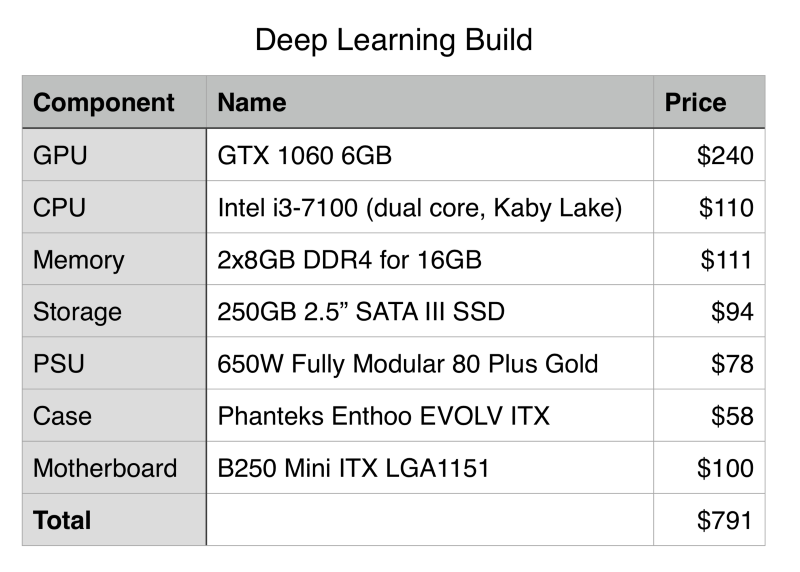
Here’s how Tim built his own GPU-enabled deep learning machine. He provides helpful instructions, a bill of materials, links to graphs comparing the value of different NVIDIA GPUs.

“The GPU is the main component of our system, and hopefully comprises a significant fraction of the cost of the system. ServeTheHome has a nice article in which they show the following graph of GPU compute per unit price.”

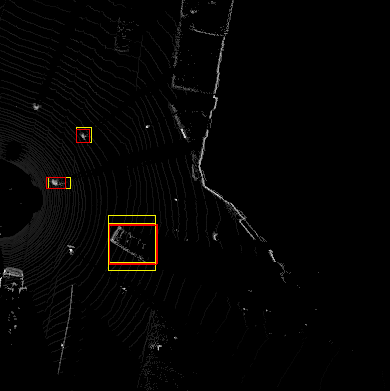
part.1: Didi Udacity Challenge 2017 — Car and pedestrian Detection using Lidar and RGB

This is one student’s journal of tackling the Udacity-Didi Challenge. Pay attention to the different neural network architectures he uses!

“Just from these 2 simple steps, I observed the following possible issues:

Small object detection. This is a well-known weakness in the original plain faster rcnn net.

Creation of 2d top view image could be slow. There are quite a number of 3d points needs to be processed

Now that I am sure that the implementation is correct, the next step will be to start training with the actual dataset, which contains many images.”

Voyage

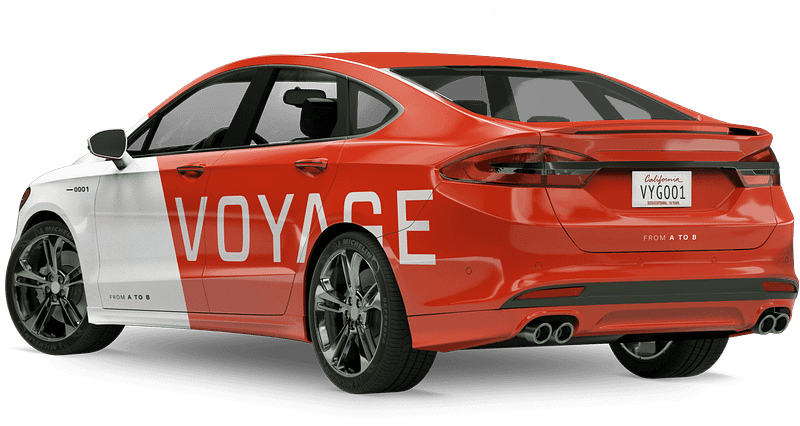
Yesterday Udacity announced that my colleague, Oliver Cameron, is spinning out his own autonomous vehicle company, Voyage.

Friends have texted to ask if that means I’m now part of Voyage, and the answer is no.

I’m staying at Udacity to build the Self-Driving Car Engineer Nanodegree Program, which has thousands of students and is a lot of fun. We’ve launched modules on Deep Learning, Computer Vision, Sensor Fusion, and Localization, with development underway on Control, Path Planning, System Integration, plus several elective modules.

If you’re reading this, you really should sign up for the program 😉

Oliver recruited me to Udacity, gave me lots of room to run, and has been a driving force in building the company for the last three years. While I wish him the best, it’s sad to see him go.

But Voyage is its own independent company, so this won’t affect Udacity’s mission to place our students in jobs with our many amazing hiring partners, like Didi, Mercedes-Benz, NVIDIA, Uber ATG, and many more.

The Udacity Open-Source Self-Driving Car

Last week my colleague Yousuf and I spoke at the Open Source Software for Decision Making Conference at Stanford.

It was a lot of fun! Thanks to Mykel Kochenderfer and Tim Wheeler for inviting us.

Yousuf and I spoke about building the Udacity open source self-driving car. If you’re interested in what Udacity and our students have done, check it out:

You can find all the presentations, including some pretty impressive academic work, at the conference website.

Human and Autonomous Machine Interaction

In a few weeks, I’ll be speaking at Car HMI USA, so please say hi if you’re there.

HMI stands for Human-Machine Interaction, and while I’m at the conference, I’m really excited to hear from UX and HMI engineers about what the future holds for riders of autonomous vehicles.

The Motley Fool predicts that self-driving cars will be great for Netflix and terrible for radio companies, which seems likely, but not particularly creative.

If we spend close to an hour per day in a self-driving car, how will we use that?

Maybe we’ll use it like we use our leisure time: 55% watching TV, 14% socializing, and 8% gaming.

I like to think we can do better. We could use self-driving cars to spend more time with our families — maybe we’ll drag our kids to work with us and have the self-driving car take them home. Maybe we’ll use that time to do housework like paying the bills or online grocery shopping.

Anything but more TV.

The Carnage of Self-Driving Snowplows

From OnMilwaukee.com comes this important April 1st story about the dangers of autonomous snowplowing:

With the 2016–17 winter nearly behind us, the tally is in: The DPW’s fleet of 200 self-driving snowplows destroyed 3,019 parked cars, killed or injured 29 stray cats, created 17,898 potholes/sinkholes and sent one elderly South Side man to the hospital after burying him in a snow drift.

“Yeah, I guess Milwaukee isn’t quite ready for this technology,” admits Kowolski. “We are considering ‘hiring’ monkeys to drive the plows next season.”

But consider the vendor:

In its pilot program, the City had considered using well-tested self-driving plows built by Google and Tesla, but instead opted to install hardware from RadioShack in its existing trucks.

They tested the equipment in Mountain View, of course.

Jobs with Udacity Hiring Partners

Our guiding star in developing the Udacity Self-Driving Car Engineer Nanodegree Program is to help students get jobs working on autonomous vehicles.

To that end, we’ve built hiring partnerships with some of the most exciting employers in the world of autonomous vehicles.

Our newest hiring partners include giants like Fiat-Chrysler and Lockheed Martin, critical suppliers like Delphi and Velodyne and Dataspeed, as well as exciting startups like Renovo.

We work directly with recruiters at these companies to identify open positions that Udacity students might be interested in. Then we announce those positions in the Udacity Career Resource Center, and encourage students to apply.

Once students apply, we connect students to employers and guide students through the interview process.

Udacity has been focused on careers for several years, but this level of support is new to the Self-Driving Car Program, and we’re really excited about it. As Sebastian said recently, you can’t talk about education today without talking about jobs.