The RAND Corporation just released a study hypothesizing that auto companies will not be able to prove the safety of self-driving cars in any feasible amount of time.
The key findings of the study are:
Autonomous vehicles would have to be driven hundreds of millions of miles and sometimes hundreds of billions of miles to demonstrate their reliability in terms of fatalities and injuries.
Under even aggressive testing assumptions, existing fleets would take tens and sometimes hundreds of years to drive these miles — an impossible proposition if the aim is to demonstrate their performance prior to releasing them on the roads for consumer use.
Therefore, at least for fatalities and injuries, test-driving alone cannot provide sufficient evidence for demonstrating autonomous vehicle safety.
Developers of this technology and third-party testers will need to develop innovative methods of demonstrating safety and reliability.
Even with these methods, it may not be possible to establish with certainty the safety of autonomous vehicles. Uncertainty will remain.
In parallel to developing new testing methods, it is imperative to develop adaptive regulations that are designed from the outset to evolve with the technology so that society can better harness the benefits and manage the risks of these rapidly evolving and potentially transformative technologies.
The study includes some sophisticated econometrics and comes across as an exercise in applied math more than anything else.
Which isn’t to say that the study is wrong.
But I would be curious for a comparison between safety testing for autonomous vehicles and safety testing for new car models, or even airplanes. Or maybe let’s look at how Henry Ford safety-tested the Model T way back when.
I suspect there are situations in which this is a solved problem, and hopefully we can learn something from those scenarios that we can then apply to self-driving cars.
As you can imagine, I am incredibly enthusiastic about self-driving cars and I am thrilled to be working on them with one of the most advanced OEMs in the business. I am grateful to Ford for the opportunity!
Initially I was worried I might have to wind down my self-driving car posts as part of the new job, but it turns out Ford has a fairly open and well-defined social media policy.
Having taken Ford’s social media training during my first week, I will now make clear two things:
I am work at Ford.
I do not speak for Ford in my posts here. These posts are my own opinions and thoughts.
I will need to be a little circumspect about my new job, as a lot of the information is proprietary, but I think I am on safe ground saying that I will be splitting time between the domain controller group and the machine learning group, both on Ford’s autonomous vehicle team.
Chang’an Automobile: The Chinese manufacturer just completed a test run of self-driving cars over 2000km (1200 miles) from Chongqing to Beijing.
The cars successfully drove distance from other vehicles, changed lanes, overtook and performed other manoeuvres, including three-point turns automatically but still need the help of a driver in certain road sections and gas stations, the designers said.
Antoine Saucier, managing director for TomTom Automotive commented, “TomTom is delighted that the Dutch presidency is taking the initiative to accelerate innovation and development around autonomous driving in the EU. We are excited to work with PSA Group to support this event and to play a role in enabling the automotive industry to move closer to making autonomous driving a reality.”
This reminds me of the discussion of de jure and de facto standards we had in business school.
De jure (“by law”) standards are top-down and almost never work.
De facto (“by fact”) standards are bottom-up and generally are established by whoever gets a product to market first.
I wouldn’t be shocked to see the EU issue formal regulations in one direction, and then struggle to deal with the fact that the first autonomous vehicles don’t conform to the de jure rules.
For self-driving car enthusiasts, this is the Level 4 vs. Level 3 distinction.
In layman’s terms, this is the difference between fully autonomous vehicles, and vehicles that have self-driving features but require a human driver.
The Level 4 (fully autonomous) approach is championed by Google and Ford:
Ken Washington, Ford’s head of research and advanced engineering, insists there is no alternative to the company’s approach. There is “no reliable model” for handing control back to drivers in semi-autonomous vehicles at short notice, he says, as systems like GM’s Super Cruise demand in certain situations.
“If you’re told you don’t need to pay attention to something, you could go to sleep and, in a matter of a few milliseconds, you could be told you have to wake up, have your wits about you, that the vehicle needs you to take control,” he adds.
Of course, GM believes differently:
GM’s incremental strategy on self-driving cars is similar to that of most automakers, including Sweden’s Volvo. Germany’s Daimler and Tesla of the US, the electric car manufacturer, already offer systems similar to Super Cruise on some vehicles.
…
Eric Raphael, GM programme manager for Super Cruise, says the company is building up from existing systems such as cruise control because it is a “big step” to start entrusting even limited driving entirely to vehicles.
I find both approaches exciting. Ultimately, though, the sooner we can get to Level 4 and all of its attendant benefits, the better.
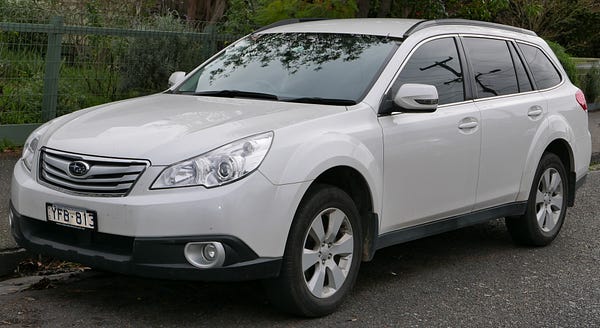
Over the weekend my wife and I drove to Putnam Subaru in Burlingame, California, and took a test-drive in both a Subaru Impreza and an Outback.
Both models come with Subaru’s EyeSight ADAS technology, but the Outback carries a slightly more extensive ADAS feature set, so I’ll cover that here.
Adaptive Cruise Control: EyeSight includes an impressive adaptive cruise control feature that has the vehicle both accelerate and decelerate on the highway. It can hold a much slower speed indefinitely, if there is traffic, and then will re-accelerate when traffic clears.
Distance Control: The cruise control comes with a neat feature that allows the driver to set the minimum distance between their car and the car ahead. The distance can be toggled from close, to not that close, to far.
Backup Camera: This is a standard feature on modern cars, but still great.
Lane-Keeping: This system keeps the car in its lane if the driver starts to drift. My experience was that this would help correct minor drifts, but didn’t work for larger drifts, like those a distracted driver would encounter.
Blind-Spot Assist: I didn’t get a chance to test this out, but it was there.
Acceleration Cut-Off: Supposedly the car will cut off acceleration if the driver hits the wrong pedal and starts to speed into a rear-end collision. Curiously, though, it will not automatically apply the brakes — that has to be done manually.
Overall, EyeSight seems great. I am surprised they don’t have a parallel parking feature, but perhaps that is coming on future models. It would be great to see Subaru roll out these features across all of their models.
A few days ago I wrote about my visit to the local Ford dealer, where I learned about Ford’s ADAS features.
I also wrote that I wasn’t able to test-drive the features, because only the Escape Titanium has them, and the dealer didn’t have the right model in-stock.
Well, that wasn’t quite right.
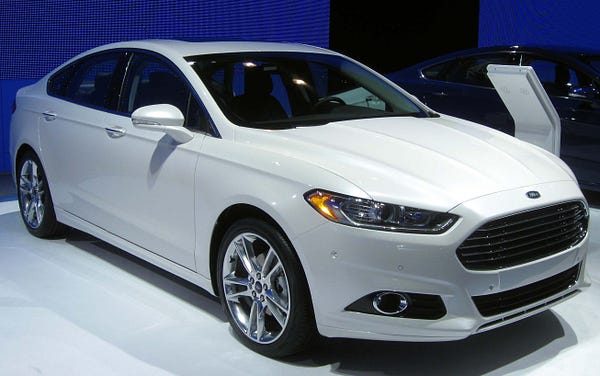
I called another dealer and learned that several other Ford models have the ADAS feature, so I drove to the next-nearest Ford dealership and test-drove a Ford Fusion Titanium with all the bells and whistles.
Parking Assist: This is so cool! The car told me when it identified a parallel parking spot next to me, had me pull up, and then took over for steering into the spot.
Adaptive Cruise Control: We passed President Obama’s motorcade on our test-drive (he was in town for fundraising), which meant that on the way back there was severe stop and go traffic. The cruise control would sense when we would approach too close to the car in front of us, and then cut off the cruise control.
Lane Assist: At speeds of 35mph or higher, the car would detect the lane lines on the road, and then alert me when I drifted.
Blind Spot Assist: The side mirrors have a blinking light if a car crept into my blind spot.
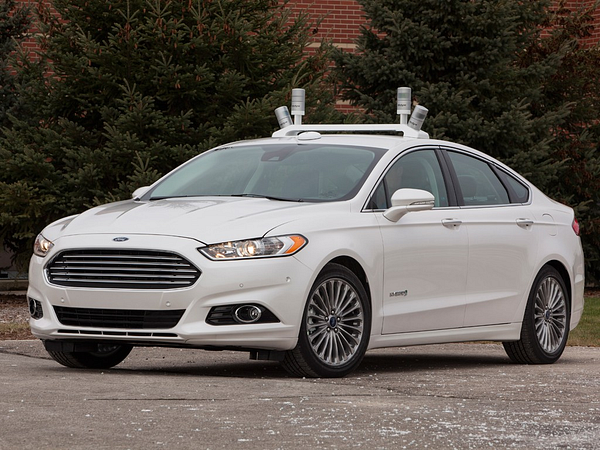
Ford just posted a kind of amazing and funny video on YouTube, showing their Fusion Hybrid self-driving vehicle making the laps around the test track at Ford’s Arizona Proving Grounds.
The catch? This exercise was at night, with no headlights.
Lidar sensing enables the vehicle to drive autonomously without any ambient light, which is pretty neat.
Of course, part of the function of headlights is so that other cars can see you, so it’s not clear if Ford would ever intentionally turn off the headlights on its production vehicles.




 David Silver