This Thursday, August 23rd, at 9am Pacific Time, I will be hosting an online open house for Udacity’s School of Autonomous Systems. RSVP now to join me, my Udacity colleagues, our alumni, and other potential students, and learn about our many exciting programs!
At the Open House, I’ll share an overview of each program, compare them, and describe the careers for which each option prepares you.
We’ll finish with a live question-and-answer session, co-hosted by myself and several of my Udacity instructional colleagues, to answer as many of your questions as we can.
RSVP now to join us on Thursday! And don’t worry if you can’t make it! RSVP via the link, and we’ll send you the recording of the open house so you don’t miss out!
Self-Driving Fundamentals: Featuring Apollo is a terrific, free introduction to how self-driving cars work, through the lens of the Apollo open-source self-driving car project.
It’s perfect for beginners who are in the exploratory phase of their autonomous systems journey, and it does a great job demonstrating how existing basic programming and data skills can be applied to this field.
Upon successfully completing the program, you’ll be ready to combine your newly-acquired self-driving car fundamentals with your existing programming skills to enroll in our Intro to Self-Driving Cars Nanodegree program.
The course begins with an overview of self-driving cars, and how they work. From there, we dive into Apollo and it’s multi-layer architecture: reference vehicle, reference hardware, open-source software, and cloud services.
This is a great opportunity to learn the key parts of self-driving cars, and get to know the Apollo architecture. You’ll utilize Apollo HD maps, localization, perception, prediction, planning and control, and start learning the fundamentals of how to build self-driving cars.
Get the inside scoop on how self-driving cars work, and learn about career opportunities in the autonomous vehicle industry!
A few days ago I hosted a webinar with my colleague Jane Sheppard about how self-driving cars work, and about career opportunities in the autonomous vehicle industry. If you’re interested in self-driving cars, you should watch 😉
I talk about business models in the self-driving car space, run down who’s focused on hardware vs. software, and describe all the players in the arena, from the smallest startups to the biggest global organizations (you wouldn’t believe how much money some of the big companies are putting into this technology!). I specifically discuss Tesla’s consumer sales model, and the impact and involvement of ride-sharing companies—and that’s all before I even get to the core technologies that make self-driving cars possible 🚗
If you want to get the low-down on perception, localization, and planning, just hit play below!
“If sensor fusion and computer vision tell you what the world looks like, localization tells you where you are in that world.”
We thought that if we could give people the best education available anywhere, that those students would form the next generation of autonomous vehicle engineers. And they would go out into the industry, and look back to Udacity as a source of talent to hire from themselves.
At that point, the industry would be open to anybody, anywhere, with the desire and passion to learn how self-driving cars work.
Our partners at Mazda just sent over a job description that includes the “Self-Driving Car Nanodegree” as a qualification, and it makes me feel like we’re getting closer to that goal.
In these projects, students showcase initiative, creativity, and work ethic, as they build projects focused on topics like perception, deep learning, and computer vision.
Their intense interest in these topics translates directly to the high quality of their work. Today, I’d like to share three especially impressive student projects with you that cover these areas!
I love this project! Mohammad did it on his own, and he went way beyond the requirements of the Nanodegree program to do so. That’s going to serve him well in the long run, because employers love it when talented students get so deep into particular subjects, that they start building their own projects to further flesh out their ideas and test their skills.
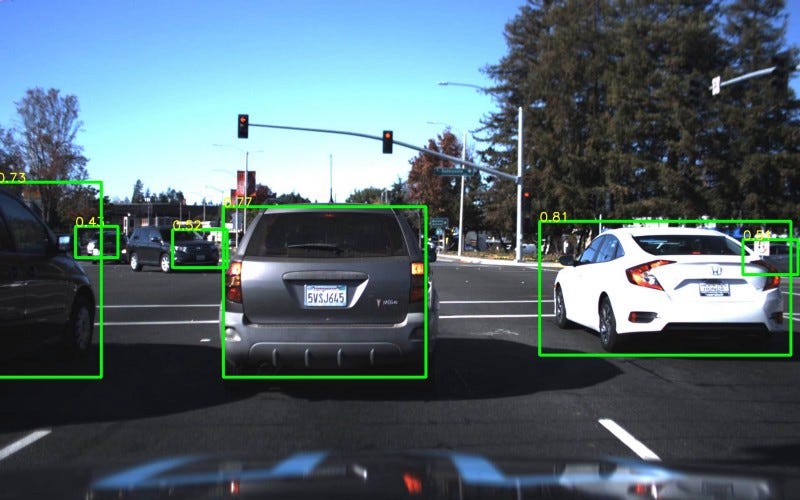
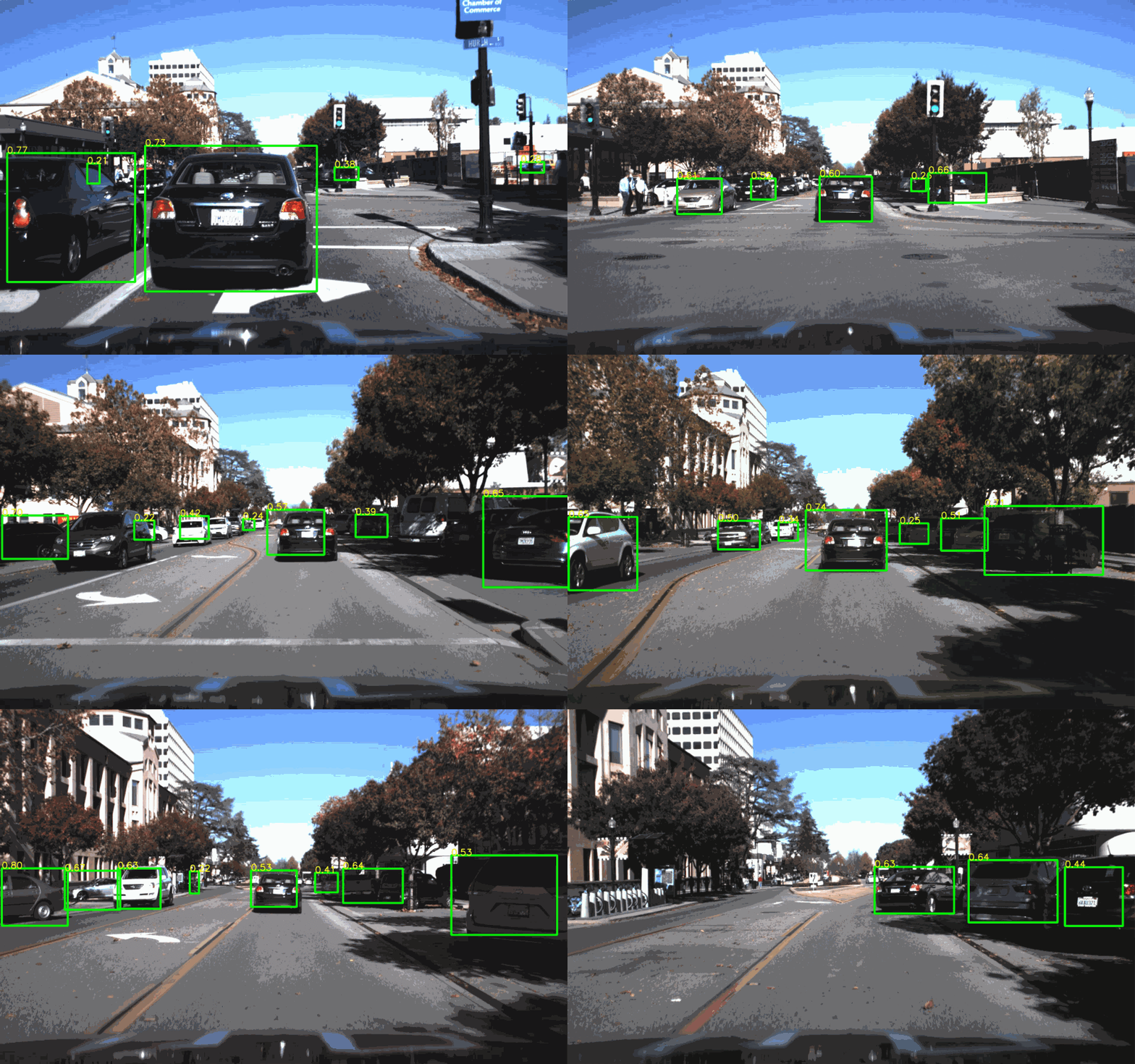
“In this project I have used a pre-trained ResNet50 network, removed its classifier layers so it becomes a feature extractor, and then added the YOLO classifier layer instead (randomly initialized). I then trained the network on Udacity’s CrowdAI dataset to detect cars in video frames.”
Enrique used VGG-16 to create a semantic segmentation network for the Advanced Deep Learning project in the Nanodegree program. He trained that network using the KITTI dataset, and then applied the network to scenes he recorded driving in Mexico. Check out his YouTube videos!
“The original FCN-8s was trained in stages. The authors later uploaded a version that was trained all at once to their GitHub repo. The version in the GitHub repo has one important difference: The outputs of pooling layers 3 and 4 are scaled before they are fed into the 1×1 convolutions. As a result, some students have found that the model learns much better with the scaling layers included. The model may not converge substantially faster, but may reach a higher IoU and accuracy.”
Moataz built a vehicle detection pipeline combining histogram of oriented gradients, support vector machines, and sliding window search. I particularly like the heatmap he employs to reduce false positives in vehicle detection. This is a great example of going beyond the steps outlined in the Nanodegree program, to build a truly standout project.
“Now given the simplicity of the SVM model, we expect some detections to be false positives. In order to filter out these incorrect detections, one approach is to threshold our positive windows such that we only pick areas where more than one window overlap. In essence we are generating a heatmap of the positive windows.”
Udacity practices project-based learning, which means all of our students in all of our Nanodegree programs build projects like these. This approach enables you to learn practical skills, and to build a dynamic portfolio populated with completed projects that clearly showcase your new skills and experience.
Tomorrow I will be hosting a webinar about how self-driving cars work, how they will change the world, and how you can get a job as a self-driving car engineer!
Come for my charm and good looks, stay for the employment opportunities.
It’s free!
Tuesday, July 24th, 9am Pacific Daylight Time. Register below.
Since we launched our Self-Driving Car Engineer Nanodegree program in late 2016, nearly 2,000 students have completed the program, and more new graduates are joining them every month.
Not all students enroll in the program specifically to find a new job, but many do, and it’s exciting to see a new generation of talent entering this field. With that in mind, we’d like to introduce you to some of these alums!
One of our early graduates, Robert Ioffe, transitioned within his company, Intel, to the role of Senior Self-Driving Car Software Engineer shortly after enrolling in our Nanodegree Program. Since then, Intel has announced its plan to begin testing 100 self-driving cars in Jerusalem, and eventually in the U.S.
“The coolest thing is that everything I learn in the class is immediately applicable to my current job, which is building a self-driving Range Rover with Intel technology inside. It is very rare where you can learn things in class one day, and the next day you can apply it in your work!”
Megha Maheshwari, who immigrated to the U.S. from India, began her career as a software engineer, but ultimately landed a position at Volvo Cars as an Autonomous Driving, Deep Learning, and Computer Vision Engineer. Volvo is investing heavily in fully electric and self-driving vehicles, which many industry analysts believe is part of its plan to go public.
“When I was ending Term One, I felt I had enough knowledge about classical computer vision and deep learning. That’s when I started looking for jobs and not long after looking and applying, I got hired.”
Udacity grads are also launching startups to capitalize on the growing opportunities in the autonomous vehicle market. After earning their Nanodegree credentials, alums David Hayes and Duncan Iglesias formed the Autonomous Vehicle Organization, or AVO, to increase safety and security by focusing on the vehicle-to-pedestrian (V2P) segment.
Using skills developed in the course, David and Duncan built a semi-autonomous Honda Civic in just 11 days!
Fellow alum Patrick Kern also co-founded a startup, with a different focus. Brighter AI was launched to develop “Deep Natural Anonymization” to help companies comply with new General Data Protection Regulations (GDPR) in Europe.
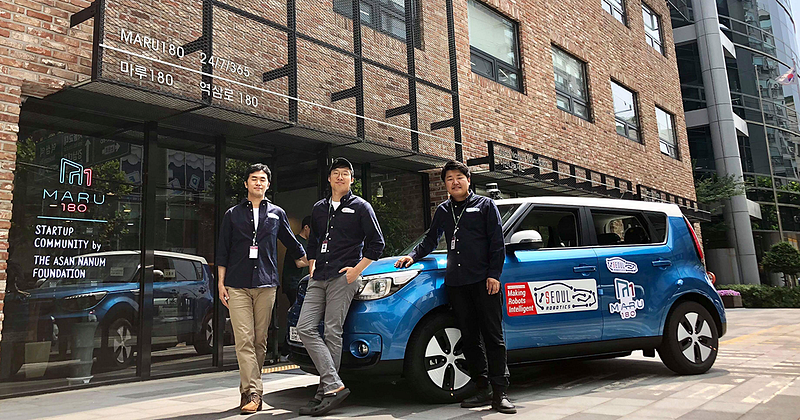
And just last month, we profiled Han Bin Lee, who teamed up with fellow students he met while working on the Udacity-Didi challenge to start Seoul Robotics. Expanding on the Lidar perception software, they began building during the challenge, and today, the company is already looking for a 3D Vision Researcher and a C++ Software Developer to join their crew in South Korea!
“We’re looking for people with the willingness and ability to learn new concepts and algorithms from the latest research. And we’re a startup, so we need team players, who are able to work effectively within a fast-growing, diverse group of people — we have Korean, Vietnamese, American, and Irish people working with us so far. We are really short of people right now, and we would love to work with fellow Udacity alumni to build this company together!”
Because this is still an emerging field, many of our early students didn’t start out wanting to become Self-Driving Car Engineers. That’s changing rapidly as people are realizing how much opportunity there is in this space, but for lifelong learners like Kyle Martin, the decision to enter this field was the culmination of a really interesting journey:
“I started looking for an industry role while I was still in the program. A lead robotics engineer role appeared with a company that was beginning to work on an autonomous shuttle. I jumped at it and got an interview! They were interested in all the areas I’d been working on — things like computer vision and systems architecture. And they were really impressed I’d kept learning and adding to my skills in the program. When they made me an offer, I said “yes” immediately — it sounded like I’d have the opportunity to work on really groundbreaking projects.”
These are just a few examples of how alumni of our autonomous transportation programs are having an impact on this incredible field. As our alumni network continues to grow, we’re excited to help more students find positions in the industry. Stay tuned!
This reads like the climax of a James Bond movie. A recently-fired Apple engineer stole secrets from the company, possibly in collusion with a Chinese self-driving car competitor, and was arrested by the FBI at San Jose Airport, just before boarding a plane to China. The Mercury News got the scoop, and kudos to them.
What’s more, the associated “Criminal Complaint” reveals a few previously unknown details of Apple’s secretive self-driving car effort.
The main reveal is the size of the program: 5,000 employees are “disclosed” on the project (out of 135,000 total Apple employees), and 2,700 have been granted access to project databases. That is a big self-driving car team.
The exact nature of the stolen secrets are not disclosed in the complaint, but they seem to involve proprietary circuit boards for sensors.
This is basically the Waymo-Uber lawsuit all over again, plus a dash of international intrigue.
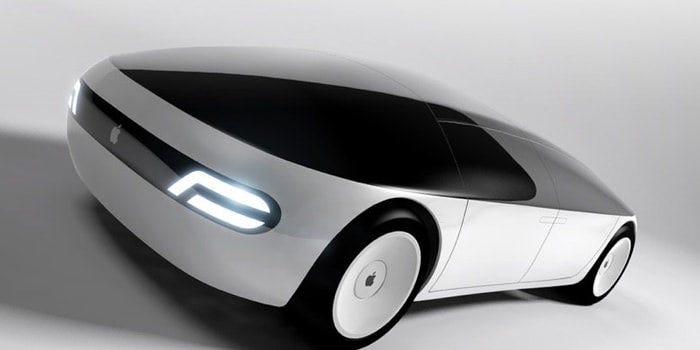
A few years ago, Apple was a highly visible player in the self-driving car world, in spite of their attempted stealth and unwillingness to even acknowledge working on self-driving cars. Recently, Apple has become much less visible, basically because they aren’t demonstrating their cars and attention has moved on to companies that have products to show.
“Waymo and Jaguar Land Rover’s engineers will work in tandem to build these cars to be self-driving from the start, rather than retrofitting them after they come off the assembly line.”
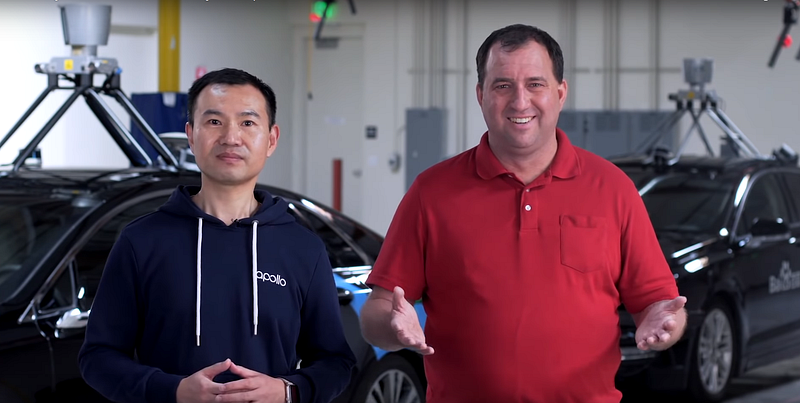
Baidu is one of China’s most important Internet companies, and runs the largest search engine in the largest country in the world. They have also built, Apollo, an open-source self-driving car framework adopted by more and more companies around the globe.
This course is both free and English (with Chinese subtitles, of course). The course consists of 7 lessons:
Welcome
HD Maps
Localization
Perception
Prediction
Planning
Control
These are the fundamental components that comprise the autonomous vehicle software stack, and you can learn how they work by following along!
Self-driving cars are truly a global phenomenon, with centers of innovation in North America, Europe, and of course Asia. This course was built with Udacity’s US and China teams, and Baidu’s US and China teams. It is really exciting to watch engineers from around the world work together on some of the most amazing technology mankind has ever produced.










 David Silver