My First Cruise AV Ride

Yesterday I took my first ride in a Cruise autonomous vehicle! It was so much fun.

You can see in the photo that my car was named Tamale. Cruise names its vehicles playfully 🤗

Tamale took me from Cruise headquarters to the Pacific Heights neighborhood and back. That took a little under an hour, in San Francisco traffic.

Along the way we went up and down lots of hills, through several construction zones, and across multi-way intersections.

I sat in the back, while two Cruise technical operators sat in the front.

The vehicle’s ability to navigate really complex situations amazed me. I’ve seen vehicles handle these situations many times as an engineer, replaying rides at my computer. But riding in the vehicle really emphasizes the vehicle’s performance, and the complexity of the task.

I also observed lots of small potential improvements, many of which I know the engineering teams at Cruise are already tackling.

Riding in a self-driving car is a great way to appreciate just how impressive artificial intelligence and robotics is, and what the future holds in store.

I hope everybody gets the opportunity 🚗 😊

Tangram’s Sensor Industry Map

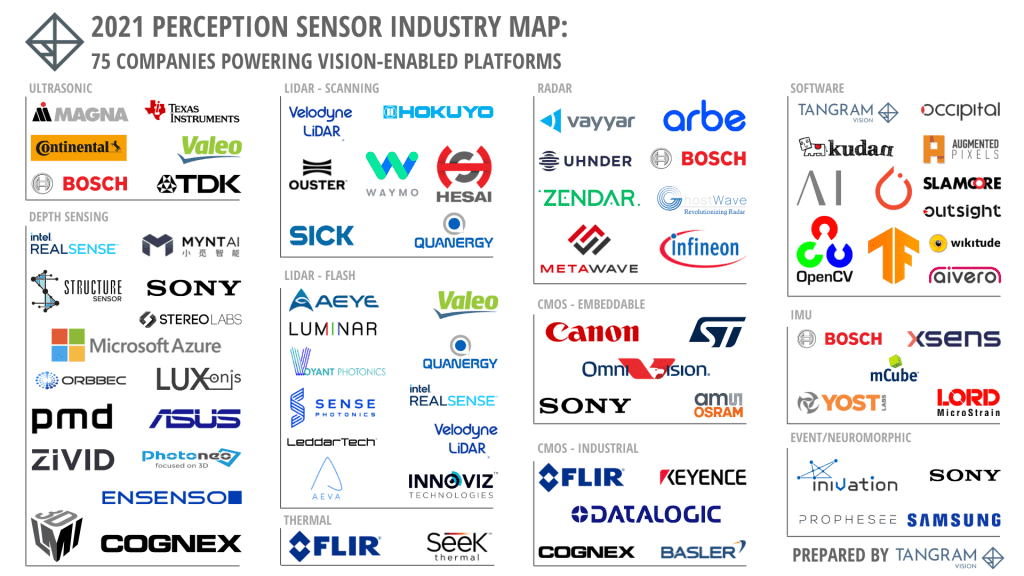
Tangram put together this “2021 Perception Sensor Industry Map”, with 75 companies. Note that Tangram itself focuses on vision, and the tagline for the map is “vision-enabled platforms.”

Lidar has gotten lots of attention in the past few years, and the combination of the scanning and flash lidar sections is the largest on the map.

I’m curious about sensors that get less attention, such as ultrasonic, thermal, and even radar.

I confess I’m not even sure what “CMOS” means in this context. CMOS is a type of integrated circuit, but I don’t know how that ties into perception sensors.

If you do know, leave a please note in the comments.

Lots going on in perception right now!

Faction

The latest fundraising round from Faction crossed my LinkedIn feed today. Their tagline is, “Faction develops driverless vehicles that have the speed and performance of cars, but at the cost of a motorcycle.”

This makes a ton of sense to me. Autonomous vehicles are likely to converge on form factors radically different than the four-door, four-wheel vehicles that have been designed for human drivers and owners.

I met Faction CEO Ain McKendrick several years ago, when I was at Udacity and he was at Cngyn. Cngyn is a below-the-radar company that builds self-driving vehicles for industrial environments, like ports and mines. I imagine that experience gives Faction a headstart in figuring out how to work with unconventional vehicles.

Faction is the first AV company I can remember coming out of Y-Combinator, although surely it must not be the only one. AVs require timelines and levels of funding out of the gate that seem beyond the incubator model.

Nonetheless, Faction managed to land Trucks VC as an investor. They’re the smartest folks in the business, so that is a real vote of confidence.

F-150 Lightning Shows Ford’s Momentum

The Ford F-150 Lightning is a huge hit. The vehicle is marketed as model year 2022 and won’t reach customers until 2023, but the launch has been an unqualified success.

Ford’s stock price, which has languished for as long as I’ve paid attention to it, reached a five year high. That’s a low bar for a raging bull market, but a real accomplishment for Ford. Perhaps more impressively, Ford’s stock has tripled in the last twelve months.

Ford started to gain momentum last year, with the announcement of the Mustang Mach-E, an electric SUV that wows. The F-150 Lightning shows Ford is serious about the future of electrification.

My Forbes.com colleague Sam Abuelsamid writes, “It is quicker off the line than any model in the history of the F-series,” and praises both its towing strength and off-road capabilities.

Reilly Brennan, arguably the highest-profile automotive venture capitalist is impressed.

“Not only is the price [starting under $40,000] surprising but the ideas around vehicle-to-home charging, frunk and power outlets speak to the utility of the truck in a way beyond typical EV announcements.”

Reilly Brennan, Future of Transportation

Alex Tabarrok, who is an economist and blogger, not an automotive gearhead, calls the Lightning, “An Electric Vehicle for Red America.”

I agree.

Ford is building an electric truck that Red America won’t just have to settle for, but one that will actually excite all of us.

Monday Autonomous Vehicle Roundup

Eggenhofer Nick | Cattle Drive | MutualArt
Cattle Drive by Nick Eggenhofer

Sunday Autonomous Vehicle Roundup

2007 Hundreds of cowboys, known as drovers, recreated the 1800s cattle drive  along the Chisholm Trail *U.S. 81, in Oklahoma â€Ļ | Chisholm trail, Cattle  drive, Cattle
  • Moorissa Tjokro wrote a terrific article on AV localization, and the sensors and algorithms involved.
  • “Internal Combustion Engine” is an amazing and deep lesson about how automotive engines work. The three-dimensional animations are the best part. Thanks to Future of Transportation for the pointer.
  • Apple and Google both want to replace car keys with phones, and it seems like a good idea. But they’re having trouble getting the auto manufacturers to participate. I checked into a Hilton Garden Inn a few years ago and bypassed the front desk, because I could open the door with my room key. It was pretty great. Thanks again, Future of Transportation newsletter.
  • Plus sent an autonomous truck (with a safety operator) on a journey down the Silk Road.
  • Last summer, I missed TuSimple’s announcement of plans for a future nationwide self-driving truck network. This analysis suggests that would be extremely hard to pull off. But I guess that means if they do pull it off, they’ve developed a huge competitive advantage.
  • The first drone (“unmanned aerial combat vehicle”) flew 19 years ago, in May 2002. It was called the X-45A and supported (required?) “significant remote piloting”. The first two models are now in the Smithsonian and an Air Force Museum. I have mixed feelings about all of this.

The Boring Company’s Las Vegas Loop

The Boring Company Loop System - YouTube

Elon Musk has so many companies. SpaceX, Tesla, Neuralink, The Boring Company. I’m probably missing a few.

I confess, I hadn’t paid much attention to The Boring Company, and I kind of assumed they were mired in the bureaucratic red tape of infrastructure.

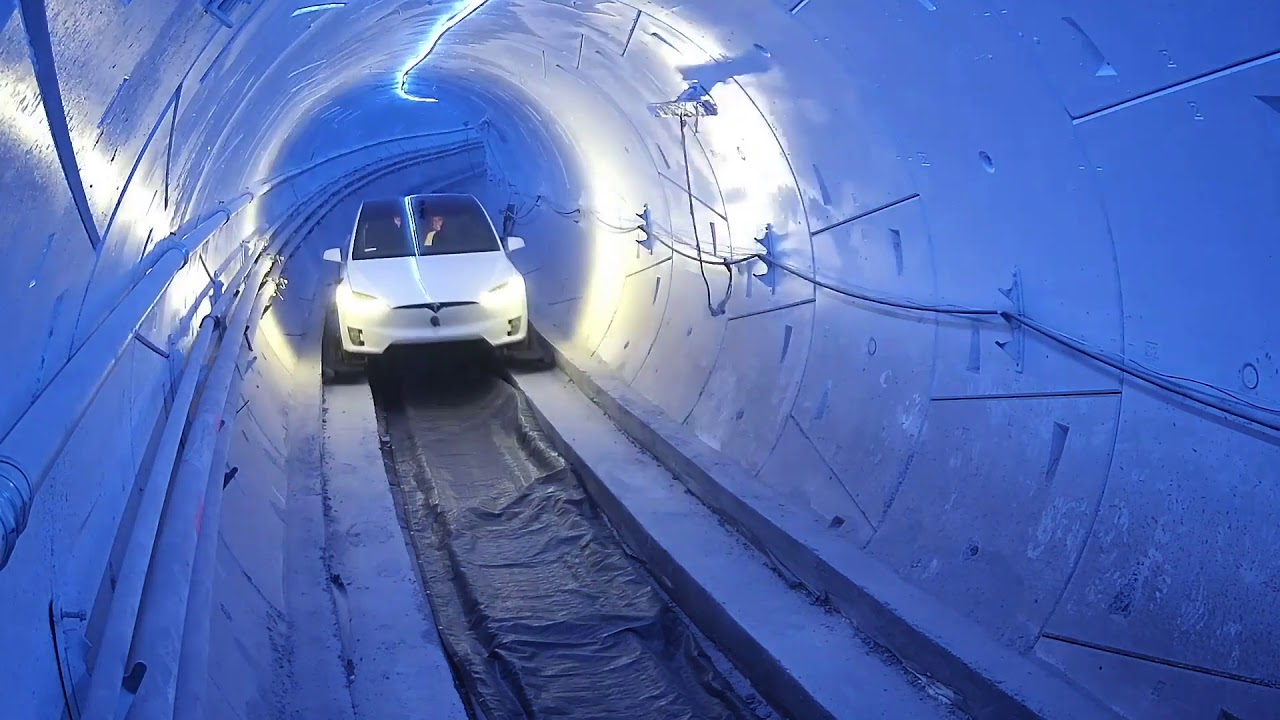
But, lo and behold, they have built a tunnel underneath Las Vegas and are now giving free test rides to the public.

What amazes me about this is The Boring Company’s ability to build infrastructure.

Sure, there are all sorts of reasons this initial project is lame.

“The goal of The Boring Company’s $52.5 million project is to turn a 45-minute walk into a two-minute trip, but testers pointed to inefficiency in the system as they waited for cars to arrive at the stations, and cars became backed up in the tight underground spaces between tunnel roads.”

“Watch Elon Musk’s Boring Company test its Tesla tunnel system in Las Vegas with members of the public”, Business Insider

But they built a 1.7 mile tunnel underneath downtown Las Vegas for $52.5 million! You can’t even buy a startup these days for $52.5 million.

The state of California has spent billions of dollars and fifteen years on a high speed rail line that is not yet running, and may never run. New York City spent fifteen years and over four billion dollars constructing three stops on the Second Avenue Subway.

The Boring Company built the Las Vegas loop in three years, for 1% of the cost of those other projects.

The Las Vegas loop isn’t the point. The point is the boring. The point is that they can build.

Loitering Munitions

FastCompany‘s write-up of the 2020 Nagorno-Karabakh (Azerbeijan-Armenia) War, which I only dimly knew was even a thing, posits that autonomous “kamikaze” drones provided Azerbeijan with a comprehensive victory of Armenia.

That sent me down a Wikipedia rabbithole, until I arrived at the concept of “loitering munitions.”

“A loitering munition (also known as a suicide drone or kamikaze drone) is a weapon system category in which the munition loiters around the target area for some time, searches for targets, and attacks once a target is located. Loitering munitions enable faster reaction times against concealed or hidden targets that emerge for short periods without placing high-value platforms close to the target area, and also allow more selective targeting as the actual attack mission can be aborted.”

Although the FastCompany article might oversell the value of these drones to the 2020 war, the concept seems pretty Terminator-esque.

The canonical loitering munition appears to be the IAI Harop and IAI Harpy drones, from Israel, although Wikipedia lists about 30 countries that have designed some version of a loitering munition.

The idea of a drone that can silently hover in the sky and attack as soon as a person steps out of a bunker is pretty scary, but I suppose it’s not radically different than missiles or bombs or attack aircraft. War is awful.

Perhaps that saving grace comes in the last half-sentence of the Wikipedia quote. The more intelligent the drones become, hopefully the less likely civilian casualties become.

Friday Autonomous Vehicle Link Roundup

Cowgirl Painting - Working Cowgirl by Randy Follis
Working Cowgirl by Randy Follis

Tesla Enhances Driver Monitoring

Tesla adds Driver Monitoring System, DMS to Model 3 and Model Y cars with a cabin  camera - Tesla Software Updates

I wrote this morning about Tesla going all-in on vision and removing radar units from new Model 3 and Model Y vehicles, starting this month. Lo and behold, Tesla has also messaged Model 3 and Model Y owners that it is going to use their driver-facing internal cabin cameras for driver monitoring.

The in-car update, as posted on Twitter, states:

Cabin Camera Updates

The cabin camera above your rearview mirror can now detect and alert driver inattentiveness while Autopilot is engaged. Camera data does not leave the car itself, which means the system cannot save or transmit information unless data sharing is enabled. To change your data settings, tap Controls > Safety & Security > Data Sharing on your car’s touchscreen.

This is an important change for Autopilot. As Kirsten Korosec reports on TechCrunch:

“Until now, Tesla has not used the camera installed in its vehicles and instead relied on sensors in the steering wheel that measured torque — a method that is supposed to require the driver to keep their hands on the wheel. Drivers have documented and shared on social media how to trick the sensors into thinking a human is holding the wheel.”

This is a move in the right direction that will reduce the misuse of Autopilot and risk to other drivers on the road. Although I’d love to learn more detail about the functionality of the Tesla DMS.