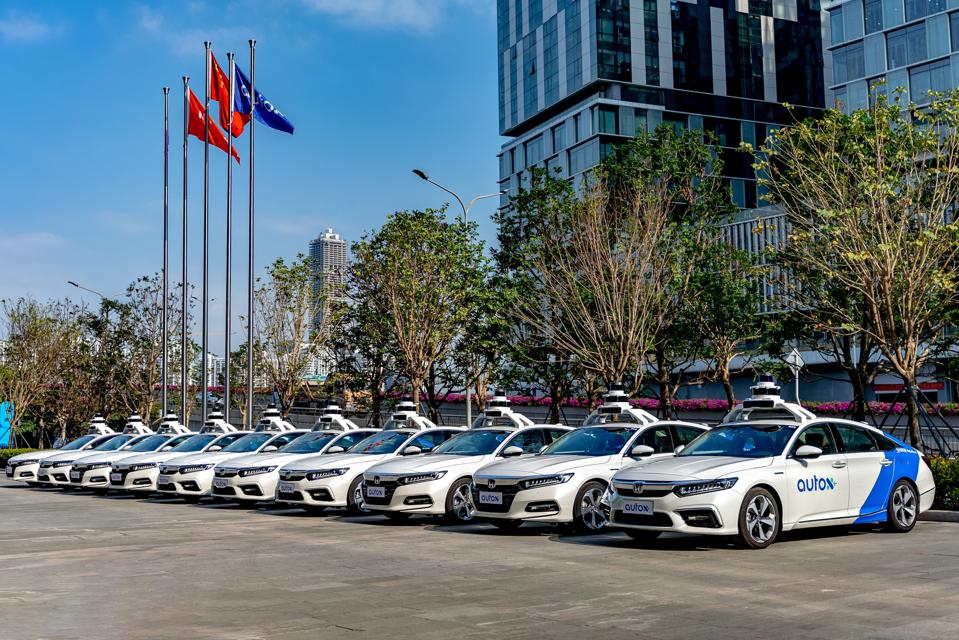
The robotaxis are coming! I wrote in Forbes today that Apollo will become the third company to offer a fully driverless robotaxi service, after Waymo One in Phoenix, Arizona, and AutoX in Shenzhen.
“Baidu, one of China’s largest Internet companies, calls their new robotaxi service Apollo Go. The brand is part of a larger self-driving effort that Baidu has named Apollo. The new service will begin operations in Beijing’s Shougang Park, which is also where the 2022 Winter Olympics will take place.”
Woven Planet is the new-ish name for what was formerly Toyota Research Institute – Advanced Development (TRI-AD). Last fall Toyota re-branded TRI-AD as Woven Planet, and attached an $800 million investment fund, called Woven Capital. Woven Planet also consists of Woven Core (autonomous vehicles), Woven Alpha (future bets, like “Woven City”), and Woven Planet Holdings (executive leadership of the entire group).
Toyota communicated the Lyft Level 5 acquisition as a deal by Woven Planet Holdings, rather than Woven Capital. I’m not sure how much to read into that. The original announcement of Woven Capital highlighted $800 million to invest over 10 years, so $550 million spent on Lyft Level 5 within the first year would be quite a shot out of the gate. Perhaps this $550 does not count against the original $800 million.
I’m also struck by the difference in how Uber and Lyft divested their self-driving units. Uber essentially paid Aurora to take ATG, providing about $400 million to the smaller start-up, in exchange for an ownership stake.
Lyft, on the other hand, sold Level 5 to Toyota for $550 million cash (paid out over several years).
The announcement from Woven Planet CEO James Kuffner doubles down on weaving.
“This deal will be key in weaving together the people, resources, and infrastructure that will help us to transform the world we live in through mobility technologies that can bring about a happier, safer future for us all.”
You can apply directly through the website, or email me (david.silver@getcruise.com) and I can put you into the system.
“We believe in managers who remain deeply technical and understand the challenges their teams are facing.”
Cruise Compute Hardware Tech Lead Job Description
One of the selling points of the role is the opportunity to build a team of world-class “hardware and electrical engineers dedicated to the development of computing hardware for Autonomous Vehicles.” The job description itself suggests that one of the big challenges will be scaling. That’s an exciting challenge!
This is an opportunity to:
Select components
Review schematics
Lay out printed circuit boards
Analyze signal and power integrity
Validate development plans
Direct experience in the automotive industry is awesome, but the job description is open to engineering managers from the robotics and aerospace ecosystems, as well.
If you’re interested, even if you don’t think you meet every single qualification, you should apply! Or send me your CV and I’ll take credit for referring you 🙂
Last Friday, Cruise CEO Dan Ammann announced Cruise for Good, a commitment to allocate 1% of Cruise’s resources to serving the community. This is part of the larger Pledge 1% initiative, that many companies have joined.
Cruise for Good has three mandates:
Partner with nonprofits and organizations that know their communities the best
Serve people who are the most vulnerable
Go where the need is greatest
Today, we join the @PledgeOne movement, meaning our commitment to our communities will grow and scale with us. We’re taking advantage of the opportunity to weave social impact into our company early on, while our industry is taking shape.https://t.co/q8GR0mcQGP
I wasn’t at all involved in this project, but it strikes me as aligned with Cruise’s larger commitment to the city of San Francisco, which is both one of the wealthiest cities in America, and also home to one of America’s largest homeless populations. There is a lot of work to do and a lot of good that can be done.
The commitment is not limited to San Francisco, however. Ammann’s Medium post states, “We pledge 1% of our fleet to serving local communities in need — not just in San Francisco, but everywhere Cruise goes.”
Here’s a video, featuring former San Francisco mayor Willie Brown, explaining Cruise for Good in more detail.
Local Motors has just launched a pilot self-driving shuttle program at Marine Corps Air Station Miramar, the base which was the setting for the original Top Gun Movie (the actual TOPGUN military program has since moved to Nevada, but base remains a Marine Corps Air Station). The vehicle model, which has previously deployed in other environments, is called Olli.
Before Cruise acquired Voyage, we focused on self-driving robotaxis for senior citizen retirement communities. The idea was that these were slower, simpler environments that would lend themselves to faster deployment of autonomous technology. Military bases are very similar in that regard.
In a few minutes, I bet you can think of other environments that share similar characteristics: theme parks, airports, university campuses, warehouses, protected self-driving vehicle lanes.
Years ago, Integrated Roadways CEO Tim Sylvester was a regular reader and commenter on my Medium articles. I think Tim has moved on, at least from commenting, but he is still pushing forward smart infrastruture in the US, almost by force of will.
I was excited to read this local news story about Integrated Roadways Smart Pavement being deployed in Lenexa, Kansas.
Video from Integrated Roadways out of Kansas City shows how they make these blocks of roadway. The material used is sturdy, expected to last 35-to-50 years, which is much longer than asphalt.
“What we basically do is build the road as sections in a factory and then deliver them to the site, install them,” Sylvester said. “When it’s done, it’s totally invisible. You’d never notice that it’s there.”
Smart Pavement has already been deployed in Denver and Colorado Highway 285. The company is based in Kansas City.
I love to see autonomous vehicle progress in all these different places in America!
AutoX deploys its autonomy software and hardware to more vehicle platforms than any other company of which I am aware. In my latest Forbes.com article, I spoke with AutoX COO Jewel Li about how and why they’ve developed this capability.
“The Chinese auto market is more diverse than anywhere else,” according to AutoX COO Jewel Li. “Every manufacturer from the US, Germany, Japan, and Korea sells vehicles in China. On top of that, there are about 200 Chinese auto manufacturers. That’s why we work with so many different partners, whereas in other parts of the world, you tend to see autonomy startups align themselves with a single manufacturer.”
AutoX streamlines engineering work by deploying a consistent sensor and computational suite on all vehicle platforms. All vehicles in the AutoX fleet, whether passenger sedans, minivans, or box trucks, operate the same set of sensors and hardware.
Mobileye and UDelv recently announced a partnership to create driverless last-mile delivery vehicles. When I first read the headlines, I thought this might be Mobileye’s first foray into fully driverless vehicles. Mobileye has for years been the leader in advanced driver assistance systems for cars, but has not yet released a driverless vehicle.
The TechCrunch coverage of the partnership, however, notes that Mobileye has been talking about driverless deployments for quite a while:
“More than two years ago, Mobileye announced plans to launch a kit that includes visual perception, sensor fusion, its REM mapping system and software algorithms. And in 2018, the company made an unlikely turn and announced plans to become a robotaxi operator, not just a supplier. Mobileye also plans to deploy autonomous shuttles with Transdev ATS and Lohr Group beginning in Europe. Mobileye also plans to begin operating an autonomous ride-hailing service in Israel in early 2022.”
That means that, in theory, the UDelv Transports won’t even be the first driverless Mobileye vehicles to market, since the Transports will hit the road in 2023.
An interesting aspect of the Mobileye-UDelv partnership is the presence of Donlen, a Canadian fleet management company that has ordered the first 1,000 UDelv Transports. The roles seem to be that Mobileye will supply the intelligence, UDelv will supply the vehicle platform and teleoperations, and Donlen will manage the vehicles.
Argo is an especially communicative AV company. CEO Brian Salesky hosts the No Parking podcast with journalist-turned-Argo-executive Alex Roy. They also publish Ground Truth, a high-quality online magazine that dives into the details of autonomy.
Particularly to Argo’s credit, they pair this communication with an absence of hype.
Argo’s recently-released Safety Report is of a piece with this communication style. The report clocks in at 55 pages and 22,000 (!) words. Argo’s view is that if you want to understand whether their vehicles are safe, you have to understand the entire company. “Safety isn’t a dial or a switch — it is the foundation on which our company is built.”
The report covers the entirety of how the company organizes and operates. If you want to understand the systems, structures, and processes that govern autonomous vehicle companies, this is the most thorough public guide I’ve seen.
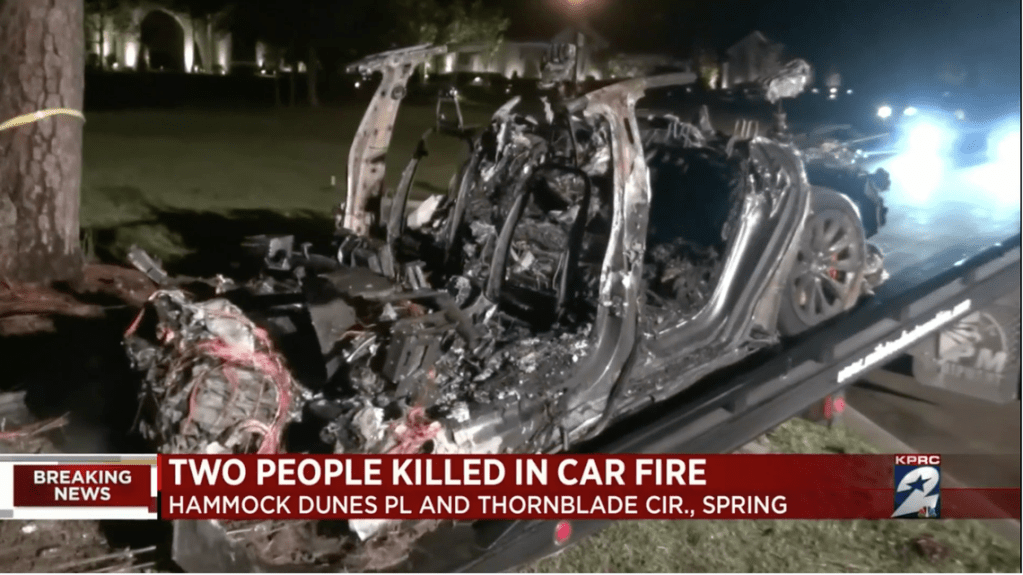
Two people died in a horrific Tesla inferno in Houston today, according to the city’s NBC affiliate, KPRC. Officials responding to the scene are quite confident nobody was driving – one of the deceased was in the passenger seat and the other in the back.
The car was on a quiet neighborhood cul-de-sac, and the vehicle occupants were 59 and 69 years-old, so this wasn’t a case of 20 year-olds screaming down the highway at 90 miles per hour.
Nonetheless, the most likely scenario is that the occupants were trying out Tesla AutoPilot (very much against the system’s guidelines and requirements, which specify that a driver must be in command of the vehicle at all times). The vehicle probably got confused and accelerated into a tree, although we won’t know the details for sure until a full investigation concludes.
The other issue here is that the car burst into flames so intense the fire department called Tesla, in hopes of figuring out how to douse the fire. The scale of the fire was driven by the ignition of the vehicle’s batteries, which has been a problem in previous collisions.
I am really disappointed in folks who abuse AutoPilot. While it’s tragic that vehicle occupants die, I suppose people should be able to make their own risk assessments. What’s really problematic is that pretty soon this won’t be a tree the vehicle crashes into, it will be a minivan full of kids.
I want so much for people would be responsible and not risk the lives of their neighbors and fellow citizens with these types of stunts.
The case for requiring a driver monitoring system in Teslas just gets stronger.